Why Gainesville Coins Says Physical Gold Still Beats ETFs, Especially in a Tariff Environment
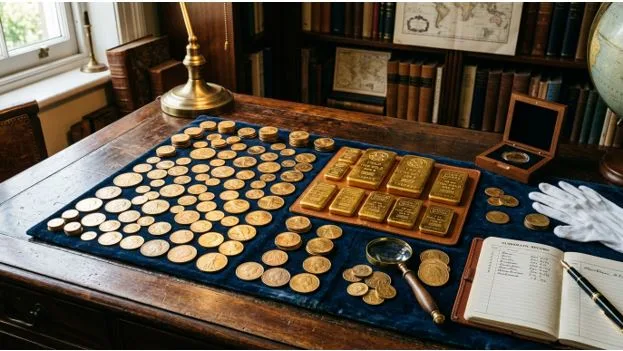
When gold began flooding into New York vaults in early 2025, the Bank of England faced withdrawal delays of up to eight weeks. Bullion banks scrambled to borrow metal to satisfy immediate delivery demands. Investors holding paper gold through exchange-traded funds had no way to opt out of that system. Investors holding physical gold had nothing to worry about.
That episode, which Everett Millman, precious metals specialist at Gainesville Coins, flagged in April 2025, has since become a textbook illustration of why the vehicle used to hold gold can matter as much as the decision to hold it.
Gainesville Coins on Counterparty Risk in a Trade War Era
The Bank of England crunch was triggered by gold flowing to the United States ahead of anticipated Trump administration tariffs. The knock-on effect for ETFs was immediate. The leasing and borrowing system that underpins paper gold markets came under strain.
“ETFs have counterparty risk,” Millman said. “You literally have bullion banks having to borrow metal in order to satisfy the immediate demand for that metal. That is a huge risk with ETFs because they are dependent on that system of leasing and borrowing gold. When you have a physical metal, you don’t have to worry about it. You just have the gold.”
He added that tariff uncertainty compounds the problem in another way: liquidity. Trade barriers reduce the ease with which precious metals move across financial markets.
“There just not being as much liquidity in the financial markets for precious metals as there was in the past when you have all these barriers being set up with tariffs,” he said. “None of that matters when you own the physical metal yourself.”
Mining Stocks Face Their Own Pressures
Physical gold’s advantages over ETFs are well known among experienced investors. Less discussed is how tariff and regulatory uncertainty affects mining stocks, which are often treated as a proxy for gold exposure.
Millman laid out the issue clearly. Many major gold mining companies operate outside North America, including in parts of Africa and Southeast Asia where export rules can change with little warning. If a host government decides to restrict exports, or if trade tensions make shipping metals to the United States prohibitively expensive, the mining company absorbs that disruption directly.
“The regulatory uncertainty, the trade uncertainty, they make mining stocks more risky,” he said. “These policies could change very quickly.”
The silver market offers a clear example of how quickly these risks can emerge. Mexico supplies roughly 40% of the silver consumed in the United States each year, making it the country’s single largest source. Back-and-forth tariff negotiations between Washington and Mexico City have put that supply line under pressure, with ripple effects already visible in COMEX silver inventory data.
The Case for Holding the Metal Itself
Millman’s argument for physical gold over paper vehicles is not ideological. He acknowledges that ETFs serve a legitimate purpose. They are liquid, easy to transact, and helped bring significant new demand into precious metals markets over the past two decades. The SPDR Gold Trust remains the largest ETF of its kind.
But the current environment changes the calculus. Policy uncertainty is elevated. Trade flows are being disrupted. The financial infrastructure that ETFs rely on, including bullion bank leasing, international clearing systems, and delivery chains, has already shown it can come under pressure.
“The risks are very asymmetrical,” Millman said in April 2025. “The other side of the tail risks are at this point basically unknowable because there is so much uncertainty and there are a lot of unprecedented things going on in the global system.”
Physical metal, by contrast, is not another party’s liability. Owners do not need a bank, a custodian, or a functioning derivatives market to realize its value. For investors evaluating where the weak links in their portfolios might be, that distinction has rarely mattered more.