Why Indian Companies Are Investing More in Employee Uniform Branding
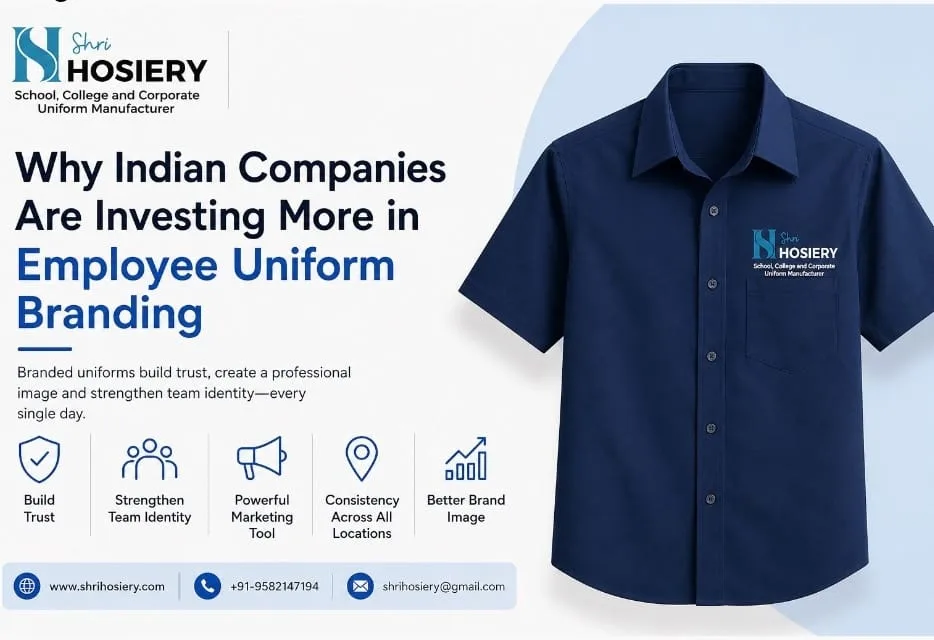
Branding today involves a lot more than building logos, ads and digital campaigns. Companies are slowly realising that every touchpoint matters to their customers. Employee uniforms are among the most forgotten yet powerful branding tools.
In sectors from hospitality to healthcare, education to manufacturing, retail to corporate services, businesses are spending more on employee uniforms and branding to create a cohesive, professional, and trustworthy visual presence. Uniforms are shifting from a mandatory workplace provision to an indispensable strategic business asset as customer (or guest) expectations evolve.
With this transformation comes an increasing need for research and a trusted uniform supplier in India to deliver quality, consistency & customisation at scale.
Why Employee Uniform Branding Is Growing in India
First impressions matter more than ever to businesses in India that provide products and services. You enter the hotel, hospital, showroom, school, and corporate office, and you find employee representation, which immediately changes your perception.
A well-designed uniform helps organisations:
- Create a professional brand image
- Improve employee presentation
- Build trust with customers
- Establish consistency across multiple locations
- Strengthen team identity
As brands expand into other cities/regions, this becomes essential for maintaining a consistent brand look. This is one of the main reasons that corporate uniform branding became a priority for global organisations.
According to industry experts, corporate uniforms with a logo are not only helpful in making a better impression on outsiders but also bind employees to the organisations they represent.
How Branded Uniforms Improve Customer Trust
Trust is often built through small details.
If employees wear professional, cohesive uniforms, customers will automatically associate the business with organisation, dependability, and accountability. Wearing uniforms helps eliminate confusion and creates an air of professionalism that customers appreciate.
This is especially relevant in industries with continuous interaction with customers, including:
- Corporate offices
- Hospitality businesses
- Healthcare institutions
- Educational organizations
- Retail establishments
Consumer behaviour research indicates that credibility is influenced by visual consistency. A team of employees in coordinated, branded uniforms presents with a more cohesive look and stronger brand presence, compared to groups without standardised dressing.
It means increasing customer confidence and a more memorable brand experience for the business.
Employee Uniforms as a Marketing Tool
Still, many organisations tend to see the uniform as workplace wear. But nowadays uniforms are treated more like part of a marketing strategy by many businesses.
Anyone you employ who wears a branded uniform is acting as your trademark representative. From interacting with clients to attending events to being on location at a client site or working in public-facing environments — uniforms are essentially always reminding your brand.
Branded uniforms offer everyday visibility, unlike traditional advertising campaigns that require recurring investment.
Effective uniform branding often includes:
- Company logo embroidery
- Brand-specific colour schemes
- Consistent design elements
- Department-specific identification
- Professionally tailored fits
Effective, uniform branding usually includes company logo embroidery, brand-related colour schemes, consistent design elements, department-specific identification, and professionally tailored fits. Together, these parts help businesses maintain a fairly uniform “face value” while also supporting brand memory among both clients and stakeholders, so it sticks better.
Why Large Organisations Standardise Uniforms
The bigger an organisation becomes, the harder it is to maintain consistency across everything. Organisations with many branches or huge teams often lean on standardised programs so every employee represents the company name in the same reliable way.
Standardised uniforms help businesses achieve:
- Uniform brand presentation across locations
- Simplified employee onboarding
- Clearer workforce identification
- Improved organisational discipline
- More consistent customer experiences
This has certainly aided the Indian uniform manufacturing business to an extent.
One company that has seen this shift up close is Shri Hosiery India. With over 40 years of manufacturing experience and a dependable presence across educational institutions, corporations, healthcare facilities, and industrial organisations, the systems built by the company are indicative of large-scale, uniform programs that feel consistent and dependable in day-to-day use.
Founder Pulkit Goel said modern organisations are realising that uniforms have a significant impact on employee confidence and brand perception; therefore, they are not just an operational requirement but part and parcel of business strategy.
Future of Corporate Uniform Branding in India
Corporate uniform branding in India seems to head towards a brighter future. As organisations pay increasing attention to customer experience, brand consistency, and workforce professionalism, the need for professional corporate uniform solutions will continue to grow.
There are a few reasons for this:
- Expansion of organised corporate sectors
- Rise in hospitality and healthcare sectors
- Increased focus on brand identity
- Greater emphasis on employee experience
- Increasing need for bespoke uniform solutions
Organisations are no longer just looking for branded uniforms. They need clothing that embodies their values, aligns with employees’ desire to feel comfortable, and also advances brand recognition.
This is why engaging with reliable corporate uniform manufacturers in India is important to ensure your business maintains the same brand presence for a longer period.
All customer interactions shape perception, and in a time when first impressions are everything, the logo clothing is already much more than just clothes. They are increasingly a visible manifestation of professionalism, trust, and identity for the organisation.