Why Is Comparing Hard Drives Still So Painful?
Let me ask you something. When was the last time you bought a hard drive or SSD and actually enjoyed the process?
Probably never. Because storage shopping is uniquely frustrating. You open a dozen tabs. You copy specs into a text file. You pull out a calculator. You second-guess yourself. You close everything and come back three days later to start all over again.
And the thing is, nobody seems to have built a good solution. Most comparison sites are either ad-ridden messes or just show you a product name and a price tag — completely ignoring the specs that actually matter.
That’s exactly why a tool called Disk Prices exists.
What Makes This One Different
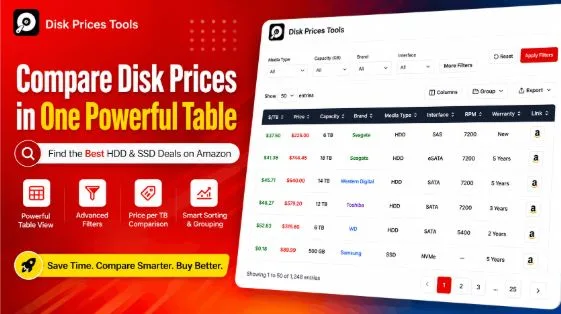
Disk Prices takes a refreshingly different approach. Instead of throwing more features at the problem, it strips everything away except what you actually need: a clean table with every drive, every spec, and the math already done for you.
Every listing automatically shows price per terabyte and price per gigabyte. That means you can finally compare a 500GB boot drive against a 20TB archive disk on equal footing . No calculator required.
Each row includes the specs that actually matter. Capacity. Interface. RPM. CMR versus SMR. Sequential speeds. IOPS. TBW. MTBF. Warranty. If you need it, it’s there. If you don’t, you can toggle columns off .
The Community Piece That Changes Everything
Here’s the part that really stands out. Product data on major e-commerce platforms is messy. Specs get mislabeled. Details go missing. Even prices aren’t always accurate — a listing might show one number, but the actual price at checkout tells a different story. Most sites just copy the bad data and call it a day.
Disk Prices lets users correct missing or inaccurate information directly in the table. Spot a wrong RPM reading? Click the cell and fix it. Once approved, your correction helps every shopper who comes after you.
The platform also tracks product condition — new, used, renewed, refurbished — alongside seller ratings. Critical fields like capacity and CMR/SMR are manually verified to catch errors automated systems miss.
Who Actually Uses This Thing?
The tool serves a surprisingly wide range of people :
NAS builders filter for CMR drives with strong warranties and low cost per terabyte. Gamers sort NVMe drives by sequential read speeds and IOPS. Homelab operators compare used enterprise drives against new ones using TBW and MTBF figures. Budget shoppers just sort by price per terabyte and buy whatever is cheapest.
It’s not a huge number of people. But it’s the kind of niche that actually appreciates having the right tool.
The Bigger Picture
Here’s what I find interesting about this. There are plenty of storage comparison tools out there. But most of them barely scratch the surface. They show you a product name, a price tag, and maybe a capacity — and that’s about it. That might work for casual shoppers, but it completely falls apart once you have specific needs. A NAS builder can’t tell whether a drive is CMR or SMR from a basic listing — and that distinction can make or break a RAID array. A gamer has no way to sort by sequential read speeds or IOPS, so they end up guessing which NVMe drive will actually deliver. A homelab operator looking for high-endurance SSDs with solid TBW ratings is left comparing spec sheets manually. And someone hunting for low-cost archive storage can’t easily find the best price per terabyte when every listing requires its own math. That’s the gap Disk Prices fills. Instead of just showing a name and a price, it brings full specifications into the table — everything from interface and RPM to TBW and MTBF — so you can actually compare drives the way you need to, not the way a generic retail listing wants you to.
Disk Prices took the opposite approach. Clean. Simple. Free. No sign-up required . No ads. Just a tool that does one thing well and gets out of your way.
There’s a lesson there. Sometimes the best solution isn’t adding more features. It’s stripping everything away until only the useful parts remain.
If You Actually Buy Storage
If you’ve ever spent too long trying to figure out which drive is actually the best deal, Disk Prices is worth a look. It’s not flashy. It won’t change your life. But it will probably save you time and money the next time you need storage.
And honestly, that’s more than most tools can say.
Try this new hard drive price comparison tool.