Why Modern Roads Are Rapidly Adopting the Zebra Crossing Projector for Traffic Safety
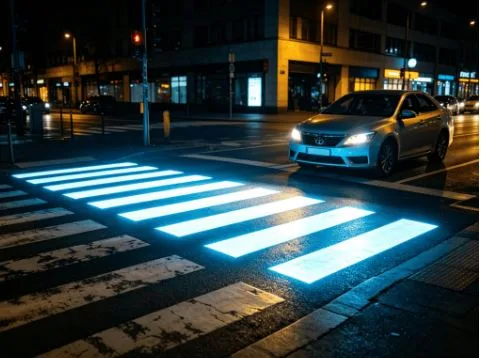
In 2026, global traffic safety and industrial safety projects are moving faster toward smart management and zero-accident goals. Among many new technologies, the zebra crossing projector has become one of the most important upgrades for pedestrian safety.
Compared with traditional painted road markings, projection-based crosswalk systems provide brighter warning effects, stronger visibility, and lower long-term maintenance costs. Industry reports and field applications show that illuminated crosswalk systems can improve nighttime visibility by nearly 60%, reduce accident risks by around 30%, and lower maintenance costs by up to 40% compared with traditional painted zebra crossings.
Because of these advantages, many cities, factories, hospitals, and logistics centers are now replacing static road paint with dynamic light projection systems. The idea of “using light instead of paint” is becoming an important part of the modern intelligent traffic safety system.
Traditional zebra crossings only provide passive visual guidance through road paint. During rain, fog, or nighttime conditions, these markings can become difficult to see. Drivers may fail to notice pedestrians early enough, especially on roads with weak lighting.
A modern virtual zebra crossing works differently. It acts as an active warning system. When a car enters the detection area, sensors automatically identify movement. The projection system then activates high-brightness flashing crosswalk lines on the ground. Drivers can notice the warning from a much longer distance and slow down earlier before reaching the crossing area. This process greatly improves pedestrian protection in dangerous traffic environments.
One successful example came from Rome, Italy, in 2023. The city installed illuminated crosswalk projection systems on a road with heavy nighttime pedestrian traffic. The goal was to improve visibility and reduce vehicle speed at night. Researchers tested vehicle behavior before and after the installation. Results showed that average vehicle speed dropped by about 19.3% after the illuminated crossing system was activated. Even without pedestrians present, average speed was still reduced by around 16.4%. This project proved that a zebra crossing projector can improve driver awareness and lower pedestrian crossing risks in urban traffic areas.
The main advantage of these systems is their strong visibility performance. A high lumen zebra crossing projection lamp creates bright and clear pedestrian markings on the ground, even in heavy rain or low-light conditions. Drivers can recognize the crossing area earlier than with traditional paint markings. This gives drivers more reaction time and helps reduce sudden braking or dangerous driving behavior.
Another important benefit is dynamic warning capability. Unlike static paint, projected crosswalk lines can flash or change brightness when pedestrians approach. This movement naturally attracts driver attention and encourages vehicles to slow down. In many cities, these systems are already connected with traffic lights, radar sensors, infrared detection, voice alarms, and AI cameras to build a smarter and more responsive traffic management network. This is one reason why smart city crosswalk projection technology is becoming more popular worldwide.
Maintenance is also much easier. Traditional road paint wears out quickly in areas with heavy traffic, especially in industrial zones or warehouse roads. Repainting requires labor, road closures, and ongoing costs. Projection systems reduce this problem because the warning lines are created with light instead of paint. This makes them highly suitable as virtual lines for pedestrian walkway safety in busy traffic environments.
Industrial applications are growing rapidly as well. In 2024, a logistics warehouse in Germany faced serious safety challenges due to constant forklift traffic. Traditional painted pedestrian crossings became heavily worn, and the warehouse recorded three near-collision incidents between forklifts and workers within six months. To improve safety, the company installed 12 sets of zebra crossing projector systems in mixed traffic areas.
The project used 200W Zebra Crossing units with IP65 waterproof protection to create bright illuminated crossing lines for 24-hour operation. After installation, forklift drivers could clearly identify pedestrian walkways from nearly 30 meters away. Within one month, near-miss incidents dropped to zero. The warehouse also reduced maintenance expenses because repainting work was no longer needed so frequently. This case demonstrated how projection-based crossings can improve separation between vehicles and pedestrians in industrial environments.
Both urban and industrial projects continue to prove the real value of the zebra crossing projector. In cities, the technology improves pedestrian safety and traffic awareness. In factories and warehouses, it helps separate vehicles and workers more clearly. In hospitals and school areas, it creates safer crossing environments for vulnerable pedestrians.
As traffic safety standards continue to rise, traditional painted zebra crossings alone are no longer enough for many modern environments. Projection-based crossings provide a safer, smarter, and more cost-effective solution for the future.