Why Online Baccarat Has Become One of the Most Played Casino Games in the Digital Age
There are casino games built on complexity and there are casino games built on elegance. Online baccarat is firmly in the second category. Its rules fit on half a page. A hand takes under a minute. Yet it has outlasted hundreds of more complicated games and today sits at the top of the online casino world by revenue in virtually every major market. The question worth asking is not whether baccarat is popular but why it has translated so perfectly from the gilded tables of Monte Carlo to a smartphone screen.
The answer involves history, mathematics, technology and a player psychology that digital platforms have learned to serve better than anyone expected. Understanding those ingredients explains not just why online baccarat has grown but why it is likely to remain dominant for years to come.
A Game That Was Already Perfect
Baccarat has been played in recognisable form since the 15th century, arriving in France from Italy before finding its defining audience among European aristocracy. The version most people play today – Punto Banco – was standardised in 1950s Cuba and exported to Las Vegas, where it became the preferred game of high rollers and the inspiration for James Bond’s game of choice across multiple films.
The game’s endurance is not accidental. At its core, baccarat offers something genuinely rare in casino gaming: near-even odds with almost no decision-making required from the player. You bet on the Player hand, the Banker hand or a Tie, and the cards do the rest. No strategy memorisation. No complicated rules about when to draw or stand. The outcome is determined by a fixed set of drawing rules that operate automatically. This simplicity, far from being a weakness, is the game’s greatest commercial asset.
Baccarat is the only casino table game where the best strategy is simply to bet and watch. That accessibility is exactly why it works so well in a digital format.
How Technology Transformed the Experience
The shift that truly accelerated baccarat’s global growth was the development of live dealer technology. Everything changed when Evolution Gaming and other live casino providers began streaming professional dealers from purpose-built studios in real time.
Live baccarat now accounts for a dominant share of the game’s online revenue. Players interact with real dealers, watch physical cards being handled, and participate in a session that feels atmospherically close to a genuine table. Multi-camera angles, scoreboard tracking and squeeze variants – where the dealer slowly reveals cards for dramatic effect – have added layers of engagement that pure digital versions could never replicate. The role of technology in enhancing online casino gaming has been the single most significant factor in making live baccarat accessible to a global audience that previously could only access the game in major casino destinations.
Why the Math Matters to Modern Players
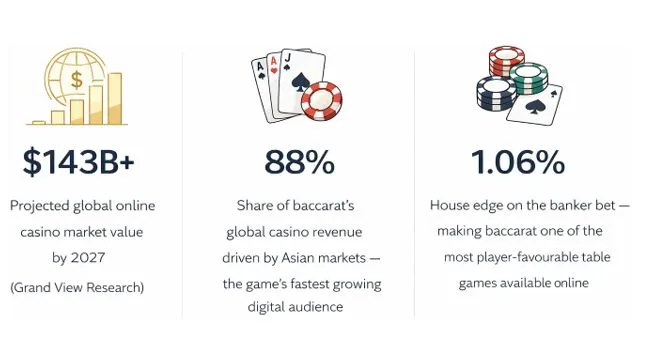
Baccarat performs exceptionally well under this scrutiny. The banker bet carries a house edge of just 1.06% – lower than almost every other table game and dramatically lower than slots, roulette outside of the European single-zero version, or any carnival game. For informed players managing their bankroll over extended sessions, this matters enormously. As the broader picture of online casino gaming and its benefits has become better understood by mainstream audiences, games with genuine player-friendly mathematics have seen their audiences grow fastest.
Variants That Expanded the Audience
The traditional game has been supplemented by a family of variants that have attracted players who might never have considered baccarat. Lightning Baccarat adds random multipliers of up to 512x to standard outcomes, introducing a high-volatility element within the game’s familiar structure. Speed Baccarat compresses each round to under 30 seconds, serving players who want rapid sessions. Dragon Tiger reduces the game to a single card comparison – arguably the simplest casino game ever designed – which has found an enormous audience across Southeast Asia and increasingly in Western markets.
These variants share the same foundational quality: they are easy to understand in the first thirty seconds of play. That low barrier to comprehension, combined with the mathematical solidity of the base game, gives baccarat an unusually wide demographic reach. It works equally well for a high roller betting thousands per hand and a casual player putting down five dollars a round.
The Global Picture in 2026
The numbers behind online baccarat’s growth reflect a genuinely global phenomenon. Asian markets, where baccarat has been the dominant casino game for generations, have driven the most significant digital adoption. Macau’s baccarat tables have historically generated more revenue than all of Las Vegas combined – and as digital infrastructure across Asia has matured, that appetite has moved online at scale.
Grand View Research projects the global online casino market will reach $143 billion by 2027, with live table games – led by baccarat – representing the fastest-growing segment. The transition from curiosity to infrastructure is complete. What began as an experiment in streaming card games over the internet has become a category-defining entertainment product.
The game that once required a flight to Monaco now requires nothing but a reliable connection and a few minutes of time.
What Makes It Last
Online platforms have not changed that quality. They have simply made it available to anyone, anywhere, at any time. The live casino games that continue to attract players all share this property to some degree – but none deliver it as cleanly or as accessibly as baccarat. That combination of mathematical fairness, structural simplicity and atmospheric quality is not easily replicated. In an industry built on replication, that makes baccarat genuinely rare.
The digital age did not create online baccarat’s dominance. It simply gave an already exceptional game the audience it always deserved.