Why Quality Control Is Essential in Medical Device Manufacturing
Introduction
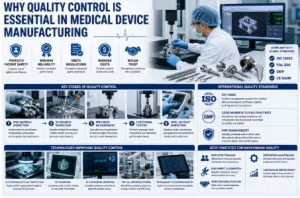
Quality is the foundation of every successful medical device. Whether it’s a surgical instrument, diagnostic machine, implant, or monitoring system, every product must perform flawlessly because patient safety depends on it. Even the smallest manufacturing defect can lead to equipment failure, inaccurate diagnoses, or serious health risks.
This is why quality control has become one of the most critical aspects of medical device manufacturing. Manufacturers must follow strict inspection procedures, maintain detailed documentation, and comply with international regulations to ensure every component meets exact specifications.
In this guide, we’ll explore why quality control is so important, the processes involved, industry standards, common challenges, and how manufacturers maintain consistent product quality.
What Is Quality Control in Medical Manufacturing?
Quality control (QC) is the process of inspecting, testing, and verifying medical components throughout production. Its primary goal is to identify defects before products reach healthcare providers or patients.
Unlike general manufacturing, medical production requires extremely high precision because even microscopic errors can affect a product’s functionality.
Quality control includes:
- Material inspection
- Dimensional verification
- Process monitoring
- Product testing
- Documentation
- Final inspection
- Continuous improvement
Each step ensures products meet safety and performance requirements.
Why Quality Control Matters
Medical devices directly impact human health. Poor-quality products can result in equipment failure, delayed treatment, or patient injury.
Strong quality control offers several important benefits.
Protects Patient Safety
Medical devices must function exactly as intended. Quality inspections reduce the risk of defective products entering the healthcare system.
Ensures Product Reliability
Hospitals and healthcare providers rely on equipment every day. Consistent quality ensures dependable performance throughout a product’s lifespan.
Meets Regulatory Requirements
Medical manufacturers must comply with strict national and international standards before products can enter the market.
Reduces Manufacturing Costs
Finding defects during production is much less expensive than recalling products after distribution.
Builds Customer Trust
Companies known for consistent quality develop stronger relationships with healthcare providers and distributors.
Key Stages of Quality Control
Quality control is not limited to the final inspection. It begins before production starts and continues throughout the manufacturing process.
Raw Material Inspection
Every production batch starts with carefully inspected materials.
Manufacturers verify:
- Material certifications
- Chemical composition
- Mechanical properties
- Surface condition
- Supplier documentation
Only approved materials move into production.
In-Process Inspection
Components are inspected while they are being manufactured.
This includes checking:
- Critical dimensions
- Surface finish
- Machine calibration
- Tool wear
- Production consistency
Continuous monitoring prevents defects from progressing further into production.
Precision Measurement
Medical components often require extremely tight tolerances.
Inspection equipment commonly includes:
- Coordinate Measuring Machines (CMM)
- Optical inspection systems
- Laser measuring equipment
- Digital micrometers
- Surface roughness testers
These tools verify every critical measurement.
Functional Testing
Many medical products undergo operational testing before shipment.
Examples include:
- Pressure testing
- Leak testing
- Mechanical movement verification
- Electrical performance testing
- Load testing
These tests ensure products perform under real-world conditions.
Final Product Inspection
Before shipping, manufacturers perform a comprehensive inspection.
Final checks often include:
- Visual inspection
- Dimensional verification
- Packaging inspection
- Product labeling
- Documentation review
Only approved products are released for delivery.
International Quality Standards
Medical manufacturing follows some of the world’s strictest quality regulations.
Common standards include:
ISO 13485
This internationally recognized standard focuses on quality management systems specifically designed for medical device manufacturers.
It helps ensure consistent production and regulatory compliance.
Good Manufacturing Practices (GMP)
GMP establishes procedures that manufacturers follow to maintain safe and reliable production environments.
Risk Management
Manufacturers continuously evaluate potential production risks and implement preventive measures to reduce defects.
Technologies Improving Quality Control
Modern manufacturing facilities use advanced technology to improve inspection accuracy.
Examples include:
Automated Optical Inspection
High-speed cameras detect surface defects and dimensional variations.
Artificial Intelligence
AI-powered systems identify manufacturing defects faster than manual inspection methods.
3D Scanning
Three-dimensional scanners compare finished parts with original CAD models.
Digital Manufacturing
Real-time monitoring systems collect production data and identify process variations before defects occur.
These technologies improve both efficiency and product consistency.
Common Quality Challenges
Despite technological advances, manufacturers still face several challenges.
Tight Tolerances
Many medical components require measurements accurate to only a few microns.
Complex Designs
Modern medical devices often contain intricate geometries that require specialized inspection methods.
Material Variations
Different materials respond differently during machining and finishing.
Regulatory Changes
Manufacturers must stay current with evolving industry regulations and documentation requirements.
Best Practices for Maintaining Quality
Leading manufacturers use several strategies to maintain consistent quality.
Employee Training
Skilled operators understand proper manufacturing procedures and inspection methods.
Equipment Calibration
Machines and measuring equipment require regular calibration to maintain accuracy.
Preventive Maintenance
Routine maintenance reduces unexpected equipment failures and production delays.
Supplier Qualification
Working with trusted material suppliers improves consistency throughout the production process.
Continuous Improvement
Manufacturers analyze production data to identify opportunities for improving efficiency and reducing defects.
The Role of Medical Part Manufacturing
Reliable medical part manufacturing depends on a strong quality management system. Every component, regardless of size or complexity, must meet strict specifications before becoming part of a finished medical device.
Experienced manufacturers combine advanced machining, automated inspection systems, material traceability, and detailed documentation to produce components that meet healthcare industry requirements. Their commitment to quality helps reduce production risks while improving customer confidence.
Future of Quality Control
Quality control continues to evolve with new technologies.
Future innovations include:
- AI-powered defect detection
- Machine learning for predictive quality analysis
- Smart factories
- Digital twins
- Robotics-assisted inspection
- Cloud-based quality management systems
- Automated reporting and traceability
These advancements will further improve manufacturing accuracy while reducing production costs.
Conclusion
Quality control is one of the most important aspects of medical device manufacturing. From material selection to final inspection, every stage of production contributes to creating safe, reliable, and high-performing healthcare products.
As medical technology becomes increasingly sophisticated, manufacturers must continue investing in advanced inspection equipment, skilled personnel, and modern quality management systems. Choosing an experienced medical part manufacturing partner ensures every component is produced with precision, consistency, and full compliance with industry standards, helping healthcare providers deliver better patient outcomes.