Why Shared Memory Is the Missing Layer in Multi-Agent AI Systems
Picture five specialists treating the same patient. A cardiologist, a nephrologist, an anesthesiologist, a physical therapist, and a general practitioner, each one excellent at their job, each one seeing the same person on a different day. Now imagine none of them read each other’s notes. The cardiologist prescribes something that fights with what the nephrologist already started. The physical therapist recommends exercise the anesthesiologist would have flagged as risky post-surgery. Nobody did anything wrong individually. The system just never gave them a shared place to write down what they’d learned about this one patient. That, more or less, is what a lot of companies have quietly built with AI agents over the last year, without really meaning to.
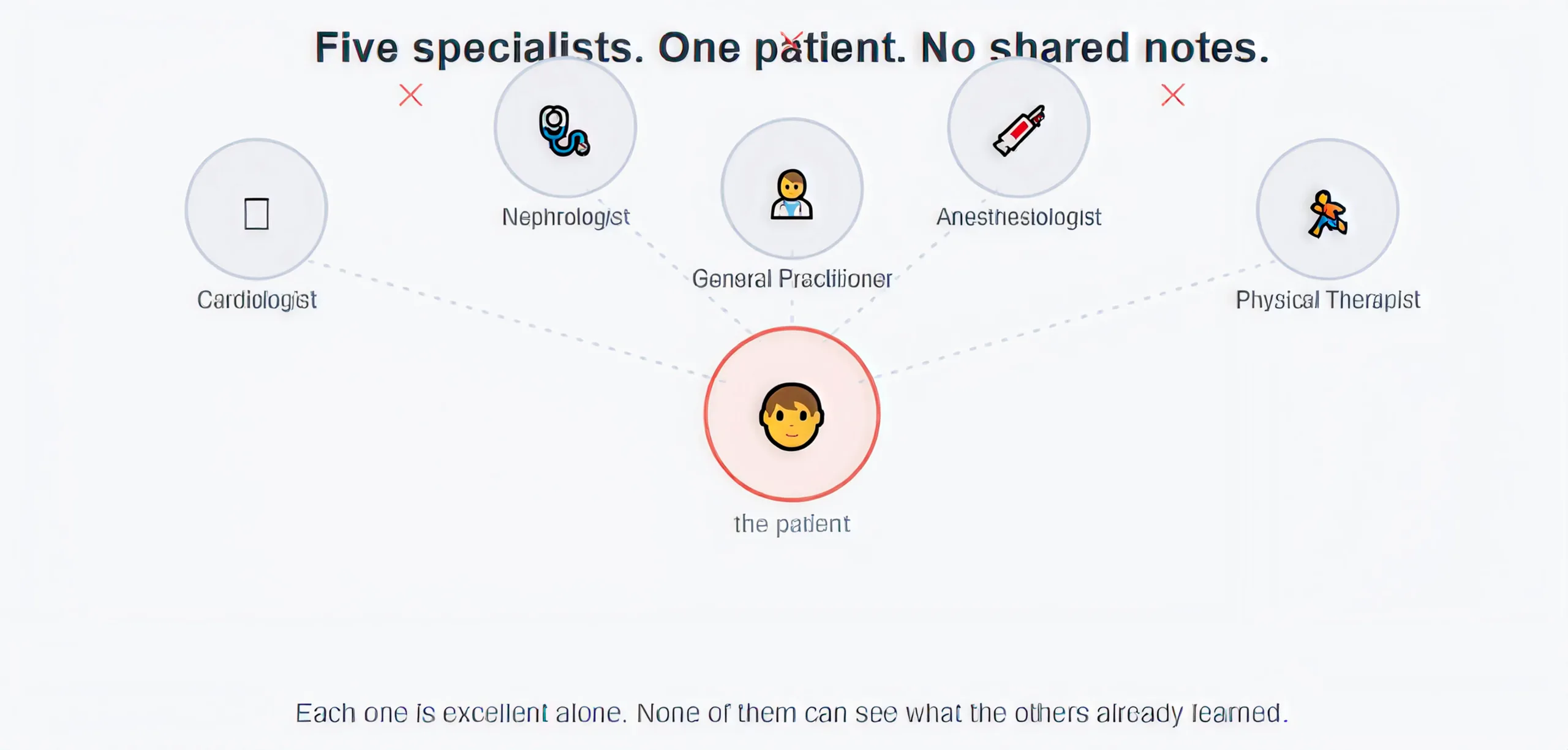
A fleet of specialists who never compare notes
Walk into almost any company experimenting seriously with agents right now, and you’ll find something like this: one agent summarizing meetings, another triaging support tickets, a third reviewing pull requests, a fourth doing competitive research, and a fifth managing internal tasks. Each one was probably rolled out by a different team, at a different time, for a different reason. Each one is genuinely good at its narrow job. And each one is completely blind to what the others have figured out. This isn’t a hypothetical problem waiting somewhere in the future. It’s already the normal state of multi-agent AI in most organizations. Individual agent capability has advanced rapidly; frontier models can already handle meaningful reasoning, tool use, and specialized work on their own. The problem shows up one level up from that: what happens once several of those agents have to operate on the same business at the same time, without a way to compare what they’ve each learned.
What it actually costs when agents don’t talk
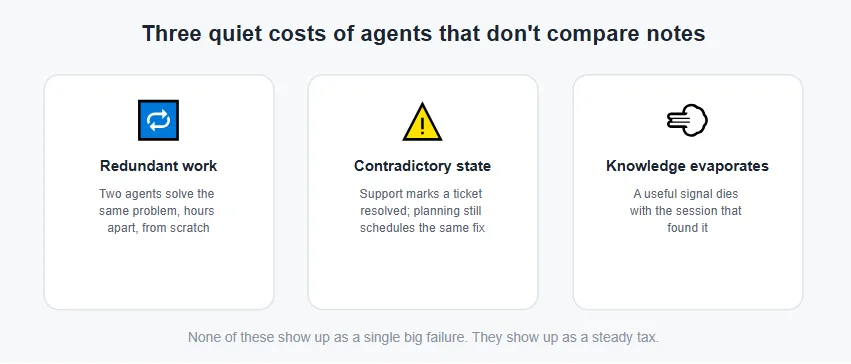
The isolation shows up in a few specific, expensive ways, and none of them are exotic edge cases. The first is plain redundant work. Say a research agent spends an afternoon figuring out that a particular customer runs their infrastructure on a specific cloud setup with a known quirk. Two hours later, a completely different agent, working a related task, rediscovers the exact same thing from scratch, burning tokens and time on a fact that already existed somewhere in the company’s collective agent output. It just wasn’t anywhere the second agent could look. The second is quieter and more dangerous: a contradictory state. A support agent marks a feature request as resolved after a workaround ships. A planning agent, with zero visibility into what support just learned, schedules engineering time to build the exact same feature from scratch because, as far as it knows, the request is still open. Nobody’s memory was wrong exactly. There just wasn’t a shared place where “resolved” could get recorded once and trusted everywhere. The third is the one that costs the most over time and shows up the least on any dashboard: institutional knowledge that simply evaporates. An agent doing competitive research notices a rival just cut pricing by a wide margin. That’s a genuinely useful signal. But if it only exists inside that one agent’s session, marketing never sees it, strategy never factors it in, and the insight dies the moment the session ends. Multiply this across a growing fleet, and you get an organization whose agents, individually, know a great deal and whose business, collectively, knows almost nothing that any of them found out.
Why just pointing everything at a shared database doesn’t fix it
The obvious fix looks simple on paper: give every agent access to the same database, let them all write to it, and search it, and we’re done. Technically, a conventional database can be made to handle all of this: contradiction checks, permissions, quality control—none of it is off the table. The catch is that none of it comes built in either. You can absolutely build all of this on top of a general-purpose database, but at that point you’re effectively building an agent memory system from scratch: identity, provenance, scope, lifecycle, conflict resolution, trust, retrieval, and audit, one piece at a time. Skip that work, and the gaps show up fast. If an HR agent writes something sensitive about compensation into a shared store, and a public-facing support agent can pull that up through an ordinary similarity search, you don’t have a memory system; you have a compliance incident waiting for a bad afternoon. Left alone, a shared store that was never given quality controls just grows into an unstructured pile, with entries contradicting each other, near-duplicates piling up, old facts sitting next to new ones with nothing to say about which is current, and it gets slower and less trustworthy the longer the fleet runs. And without something tracking who wrote what and how much that agent should be trusted, a claim from a junior, low-trust agent carries the same weight in a similarity search as one corroborated independently by three separate agents, which a plain similarity score simply can’t tell apart.
What actually needs to exist underneath the agents
Getting this right takes a few things working together, not just one clever trick. A mature agent data layer should be able to classify, govern, and enrich what an agent writes automatically the moment it lands, so nobody has to manually tag or organize it later. The agent just writes plain text. The system underneath does the rest. Search then has to respect boundaries that a plain database ignores. An agent in one team should sometimes be able to see what a completely different team’s agents learned, but only when the governance rules actually allow it, and every one of those crossings needs to be logged so it can be reviewed later if something goes wrong. Old and new facts need to be reconciled rather than just piling up side by side. When one agent writes that a customer switched database providers, and an older memory still says they’re on the previous one, something needs to notice the conflict, mark the outdated version accordingly, and keep a full trail of what changed and when, rather than leaving both versions to compete for attention in future searches. And in any setup with more than one team or client sharing the same infrastructure, isolation needs to be enforced at the data layer itself, not bolted on as an application rule that a bug could accidentally bypass.
What this looks like once it’s actually working
The payoff isn’t really about any single memory being clever. It’s what happens after a fleet has been running this way for a while. Memories that keep getting confirmed by different agents independently start surfacing faster, because repeated, corroborated facts are exactly the kind worth trusting. Stale ones quietly fade in relevance instead of cluttering every search. The web of connected facts gets denser as more entities and relationships accumulate, and retrieval keeps tuning itself based on what actually turned out to be useful versus what didn’t. There’s a real example of this at a scale most companies haven’t reached yet. eToro, the NASDAQ-listed trading platform, built what they describe internally as a company brain on top of exactly this kind of governed shared memory: more than 300 specialized agents pulling from a single store holding upward of 26,500 memories and over 1,300 reusable skills, with search still coming back in roughly 23 milliseconds across nearly 300 distinct agent identities. On the two benchmarks most often used to measure this kind of system, LoCoMo and LongMemEval, the same underlying approach scores 77.6% and 72.5% respectively by LLM judge, while cutting the tokens spent per turn by roughly 96 to 98 percent compared with replaying the full conversation history every time. Whatever you think of any one vendor, the fact that a financial services company is running production infrastructure at this scale tells you the problem stopped being theoretical a while ago.
The agent database framing is closer to the truth than it sounds
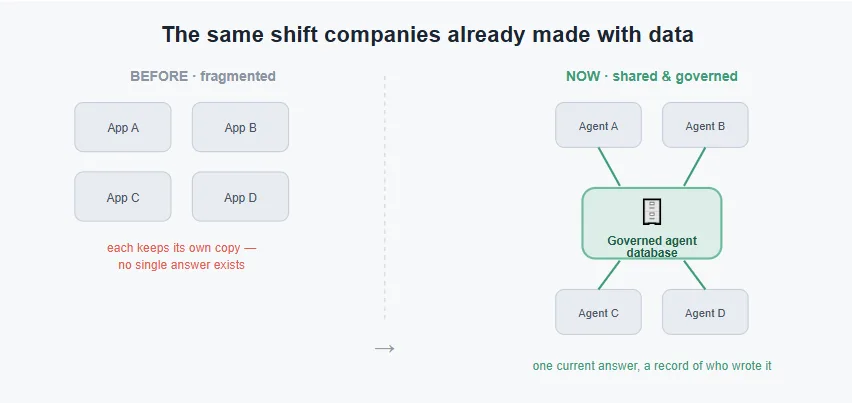
It’s worth sitting with why people have started calling this an agent database rather than just agent memory, because the comparison is more literal than it first appears. Companies went through almost this exact transition once before, back when every application in a business kept its own separate copy of customer data, and nobody could get a straight answer to something as simple as how many total orders a single customer had placed, because the answer was scattered across five disconnected systems that never talked to each other. Shared, governed databases fixed that, not by making any single application smarter, but by giving every application the same trustworthy source to read from and write to. Multi-agent AI is walking down the same road at a much faster pace, and this is really where the category gets interesting. Traditional databases were designed around applications and records: a row, a column, a query. An agent database has to understand a longer chain than that: agent identity, then scope, then the memory itself, then where it came from, then how much to trust it, then which version is currently true, then how conflicting claims get resolved, then how the whole thing evolves as the fleet keeps working, then a record of all of it for later audit. That’s a meaningfully bigger job than “agent memory” implies. An agent database isn’t just a place to dump embeddings; it’s the shared source of truth that every agent in a fleet, regardless of which framework built it or which team deployed it, can read from and write to with the same guarantees a company database gives its applications: one current answer, a record of who said so, and rules about who’s allowed to see what.
Questions people usually ask once they see the problem clearly
Is this really different from just using a normal database with search?
Yes, but the distinction is about what the system provides natively. A general-purpose database can be extended to handle agent identity, provenance, scope, conflict resolution, trust, retrieval, and audit, but those agent-specific semantics don’t come built in. Once you build them yourself, you’re effectively creating an agent data layer on top of the database. That’s the gap an agent database is designed to address.
Does this only matter for huge fleets with hundreds of agents?
No, though it gets more obvious at scale. Even three or four agents working on related tasks will start stepping on each other’s discoveries without a shared, governed place to write things down. The pain just grows faster than the agent count would suggest.
Can agents built on completely different frameworks share the same memory?
Yes. Agents can share the same memory layer regardless of framework, using MCP or a plain API. That’s the point of putting shared memory below individual agents and orchestrators, while exposing it through the agent harness. Swap out CrewAI for LangGraph or add a Claude Code subagent, and the shared knowledge doesn’t reset just because the framework on top changed.
What stops one team’s agents from accidentally seeing another team’s private data?
Visibility scopes and trust tiers enforced at the point of storage, not left to application logic. Every memory carries a scope when it’s written, every agent carries a trust level, and anything crossing a boundary gets logged so it can be audited later.
Where this leads
None of this requires ripping out whatever orchestrator a team already uses. The memory layer sits underneath it, which is exactly why it’s easy to underestimate how much it matters until the fleet grows past two or three agents and the redundant work, the contradictions, and the quietly lost insights start adding up in ways that are hard to trace back to any single cause. Applications went through this same shift once already. They used to keep their important state inside the application itself until that stopped scaling and the state moved into shared, governed databases instead. Agents are going through the same transition now, just faster. As a fleet grows, what it learns can’t stay trapped inside individual sessions, frameworks, or orchestrators. It needs a persistent, governed data layer of its own. That’s the agent database. Caura is one example of infrastructure built specifically for this gap, open source under Apache 2.0 with a free tier for teams that want to try the pattern before committing to it. There’s a more detailed walkthrough of how the sharing and mistake-learning loop actually works in practice over on this piece about how agent teams share knowledge and learn from each other’s mistakes, which is worth reading if the specialist analogy at the start of this article sounded a little too familiar.