
Why Smart Injection Molding Machines Are the Hidden Lever in Your OEM Supply Chain Cost Structure
Your per-unit cost looks fine on paper. Then you add up rejected parts, idle machine time, and manual rework — and the number doubles. For procurement managers and factory owners sourcing plastic components at scale, the injection molding machine sitting on the production floor is either your biggest cost lever or your biggest liability. This post shows you exactly how smart, automated machine injection molding systems close that gap — and why the difference between a passive and an active machine strategy can reshape your entire cost structure.
What Is an Injection Molding Machine — and Why Does Automation Matter?
An injection molding machine melts plastic resin and injects it under pressure into a mold cavity. The part cools, the mold opens, and a finished component drops out. Simple in concept. Complex in execution — especially when you are running thousands of cycles per day across multiple SKUs.
Manual and semi-automated systems rely on operators to monitor pressure, temperature, and cycle timing. That introduces variation. And variation, in high-volume production, is a cost. Automated systems use closed-loop sensors and programmable logic controllers (PLCs) to hold every parameter within tight tolerances, cycle after cycle.
The question is not whether automation adds value. The question is how much — and where you feel it most.
5 Proven Ways a Smart Injection Molding Machine Lowers Your OEM Cost Structure
1. Shorter Cycle Times Mean More Parts Per Shift
Cycle time is the heartbeat of injection molding. Shave two seconds off a 30-second cycle and you gain roughly 2,400 extra shots across a 20-hour day. At scale, that is real output without adding a shift.
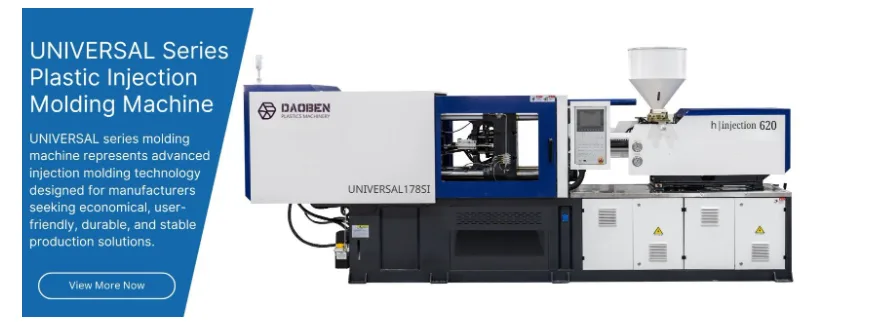
Modern machine injection molding platforms — like those in the Daoben VR-E and UNIVERSAL Series — use servo-hydraulic drives and real-time process monitoring to compress cooling and injection phases without sacrificing part quality. The machine responds to actual melt behavior, not a fixed timer.
Practical impact: A factory running a Daoben Plastic Molding Machine at 28-second cycles instead of 34-second cycles on a 100-ton press sees approximately 17% more output per shift. Across 250 working days, that compounds fast.
2. Process Consistency Cuts Scrap and Rework Costs
Scrap is not just a material loss. It is machine time, operator time, energy, and in many cases — a delayed shipment. In manual systems, even experienced operators drift between shifts. Pressure settings creep. Barrel temperatures swing.
Automated injection molding machines hold melt temperature to ±1°C and injection pressure to within 0.1 bar. The result is a tighter process window, fewer defects, and a scrap rate that stays predictable. When you are producing 50,000 units per run for an OEM customer, even moving scrap from 2.5% to 0.8% saves thousands of dollars per order.
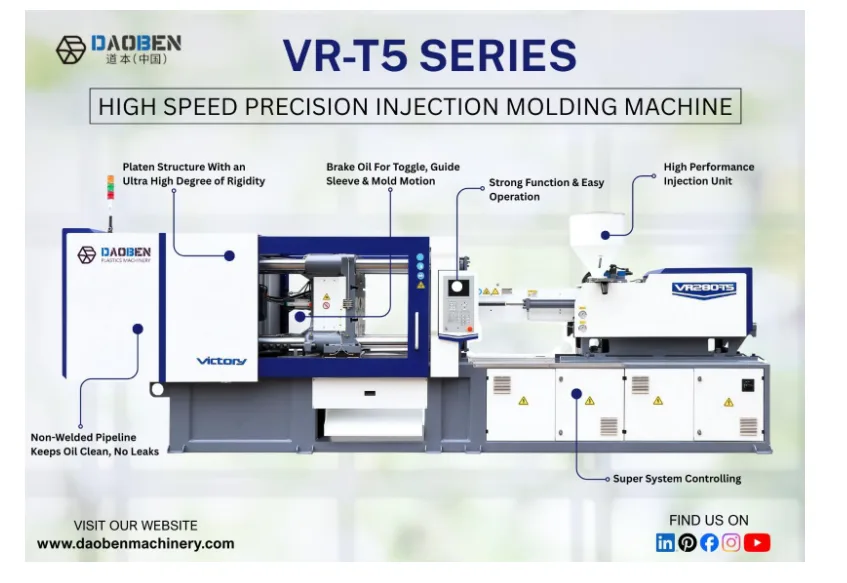
Daoben machines ship with multi-point barrel temperature control and real-time pressure feedback as standard features — not paid upgrades.
3. Energy Efficiency Directly Reduces Per-Unit Cost
Hydraulic machines run their pump at full pressure all the time, even during dwell and cooling phases. That energy is wasted. Servo-driven systems match motor output to actual demand — consuming power only when the machine is actively moving or holding pressure.
The difference is measurable. Servo-hydraulic injection molding machines typically consume 30%–60% less electricity than fixed-pump hydraulic equivalents on the same part and cycle. Energy is a fixed operating cost. Cutting it by half on your molding floor is a structural improvement to your cost model, not a one-time saving.
Table 1: Energy Consumption — Manual Hydraulic vs. Servo-Hydraulic Injection Molding Machine
| Factor | Manual Hydraulic | Servo-Hydraulic (Daoben) |
| Pump operation | Continuous full pressure | On-demand, load-matched |
| Avg. energy saving | Baseline | 30–60% lower consumption |
| Heat generation | High (excess pump heat) | Low (minimal heat waste) |
| Oil degradation rate | Fast (constant pressure) | Slow (reduced stress cycles) |
| Annual energy cost (est.) | Higher by $8K–$22K/year* | Lower baseline |
*Estimate based on a 200-ton press running two shifts. Actual savings vary by region and energy tariff.
4. Faster Mold Changes Reduce Downtime Between Production Runs
For OEM suppliers managing multiple product lines, mold changeover is dead time. Every minute the press sits idle between runs is a minute it is not producing revenue.
Modern machine injection molding systems support rapid mold clamping with hydraulic quick-release platens and centralized mold height adjustment. On a Daoben press, a skilled operator can complete a full mold change in under 20 minutes on machines up to 1,000 tons. Compare that to 60–90 minutes on older mechanical systems.
If you run 4 mold changes per week across a single machine, cutting changeover from 60 to 20 minutes recovers over 160 machine-hours per year. That is capacity you already own — you just need the right press to unlock it.
5. Remote Monitoring and Data Logging Reduce Unplanned Downtime
A machine that stops unexpectedly at 2 a.m. costs more than just repair time. It disrupts production schedules, triggers penalty clauses with OEM customers, and burns overtime to recover output.
Daoben Plastic Molding Machines are equipped with intelligent HMI systems that log process data, generate fault histories, and support remote diagnostics. Maintenance teams can identify drift patterns before they become failures. Downtime shifts from reactive to scheduled — and scheduled downtime is always cheaper.
For procurement managers negotiating SLAs with OEM partners, this kind of uptime data is also a negotiating asset.
Manual vs. Automated Injection Molding Machine: Full Cost Comparison
Here is a side-by-side view of how manual and automated systems compare across the factors that matter most to OEM procurement decisions.
Table 2: Manual vs. Automated Machine Injection Molding — Procurement Comparison
| Evaluation Factor | Manual / Semi-Auto System | Automated Injection Molding Machine |
| Cycle time control | Operator-dependent, variable | PLC-controlled, repeatable |
| Scrap rate | 1.5%–4% typical | 0.5%–1.2% typical |
| Energy consumption | High (fixed-pump hydraulic) | 30–60% lower (servo-drive) |
| Mold changeover | 60–90 minutes average | 15–25 minutes average |
| Downtime profile | Reactive, unpredictable | Predictive, data-driven |
| Labor dependency | High (process oversight) | Low (monitoring only) |
| Upfront machine cost | Lower initial price | Higher initial, lower total cost |
| Total 3-year cost of ownership | Higher (energy + labor + scrap) | Lower (efficiency gains dominate) |
| Clamping force range (Daoben) | 30–4000 ton available | 30–4000 ton available |
How Injection Molding Machine Tonnage Affects Your OEM Part Economics
Clamping force — measured in tons — determines which parts a machine can produce. Too little tonnage and the mold flashes. Too much and you are paying for capacity you do not use.
Daoben manufactures injection molding machines from 30 tons to 4,000 tons, covering everything from small precision components to large automotive and industrial parts. Selecting the right tonnage for your part is not just a technical decision — it is a cost decision.
- 30–200 ton: Small consumer parts, thin-wall components, medical device housings
- 200–600 ton: Mid-size structural parts, appliance components, automotive trim
- 600–2000 ton: Large panels, pallets, crates, bumper assemblies
- 2000–4000 ton: Industrial containers, heavy-duty logistics parts, thick-walled structural components
Oversizing a press by 30% typically adds 15%–20% in energy costs per cycle with no quality benefit. Proper tonnage selection — guided by a direct manufacturer with the full range — is part of the cost optimization conversation.
Why OEM Supply Chains Are Moving Toward Direct Manufacturer Sourcing
Distributors and trading companies add margin between you and the factory. That margin is paid per machine, per spare part, and per service call. When you source a Daoben Plastic Molding Machine directly from the manufacturer, you eliminate that layer.
Direct sourcing also means faster technical support. When a servo drive shows abnormal behavior at peak production, the response time from a local agent — who must escalate to the factory — is not the same as going directly to the engineering team that built the machine.
Daoben operates as a direct manufacturer and supplier. Every machine is built in-house. Clamping assemblies, injection units, control systems — these are not assembled from third-party components and rebranded. The bill of materials, the tolerances, the test records are all Daoben’s own.
For procurement managers building a reliable supply chain, that transparency is a risk reduction tool.
Injection Molding Machine Usage in Hot Tub Components Manufacturing
Hot tub and spa manufacturing relies heavily on injection-molded plastic parts. Jet bodies, water distribution manifolds, filter housings, pump impeller covers, control panel bezels, and hydrotherapy nozzle assemblies are all produced through machine injection molding. These components demand tight dimensional tolerances — a jet body that is 0.3 mm out of spec can cause pressure drop across the entire hydrotherapy circuit.
Large-format injection molding machines in the 600–2,000 ton range handle shell-side structural components and thick-walled water-path parts. Smaller presses in the 80–300 ton range are used for precision fittings, valve seats, and clip-lock assemblies that require consistent wall thickness to seal correctly under water pressure.
For hot tub OEM manufacturers and hot tub components suppliers, the process consistency of an automated Daoben Plastic Molding Machine directly affects product performance in the field. A repeatable injection profile means every nozzle seats correctly, every fitting seals on the first assembly, and warranty returns from water leakage stay low. Daoben machines from 30 to 4,000 tons cover every component size in this product category.
What to Ask Before You Source an Injection Molding Machine
Not all machines perform the same in production environments. Before you commit to a supplier, these are the questions worth asking:
- What is the actual dry-cycle time on this tonnage — not the rated spec, but the measured time in factory trials?
- Does the machine include closed-loop injection pressure control as standard, or is it an add-on?
- What is the energy consumption at full-load cycle versus dwell phase?
- How is mold protection implemented — mechanical, pressure-sensing, or visual?
- What does the warranty cover, and is spare parts supply guaranteed for 10+ years?
- Is remote diagnostics available, and what is the typical response time for a critical fault?
These questions separate equipment that looks good in a brochure from equipment that performs at volume. Daoben’s technical team answers all of them directly — with data from the production floor, not marketing copy.
Injection Molding Machine Selection: A Procurement Decision Framework
Procurement decisions on capital equipment require a structured approach. Here is a simplified framework used by experienced sourcing teams:
Step 1 — Define Your Part Requirements
Collect part weight, projected shot weight, material type, wall thickness, and annual volume. These inputs determine tonnage range, plasticizing capacity, and screw diameter.
Step 2 — Calculate Total Cost of Ownership (TCO)
Unit price is one data point. Add energy costs over 36 months, estimated maintenance, consumables, and downtime risk. An automated machine injection molding system often has a 15%–25% lower TCO than a cheaper manual press over three years.
Step 3 — Evaluate Supplier Reliability
Check lead times, spare parts availability, and whether the supplier manufactures the machine or resells it. A direct manufacturer like Daoben can commit to part supply timelines that trading companies cannot.
Step 4 — Pilot Run Before Full Commitment
Request a production trial with your actual mold and material. Real cycle time, real scrap rate, real energy draw. Numbers from a pilot run are more valuable than any specification sheet.
Frequently Asked Questions
1. What clamping force range does Daoben offer for OEM production?
Daoben manufactures injection molding machines from 30 tons to 4,000 tons. This range covers small precision parts through heavy industrial components. For OEM production requiring consistent output across part families, Daoben can supply multiple press sizes from a single manufacturer.
2. How does an automated injection molding machine reduce per-unit cost?
Automation reduces per-unit cost through three mechanisms: shorter cycle times increase output per shift, tighter process control lowers scrap rates, and servo-driven energy systems cut power consumption by 30%–60%. These gains compound over large production runs. A 1% scrap reduction on a 500,000-unit annual order saves more than the cost difference between a manual and servo machine in most scenarios.
3. Is machine injection molding from a direct manufacturer more cost-effective than sourcing through a distributor?
In most cases, yes. A direct manufacturer eliminates distribution margin on both the machine purchase and ongoing spare parts. Daoben sells and supports its machines directly. There is no agent markup, and technical escalation goes straight to the engineering team.
4. What materials can a Daoben Plastic Molding Machine process?
Daoben machines are designed for standard thermoplastics including PP, PE, ABS, PS, PVC, PA (nylon), POM, and PC, as well as engineered resins and filled materials. Barrel and screw configurations can be specified for abrasive or corrosive materials. Discuss your material specifications with Daoben’s technical team to confirm the correct plasticizing setup.
5. What is the typical lead time for a Daoben injection molding machine order?
Standard production lead time is typically 30–60 days depending on tonnage and configuration. Custom specifications or non-standard options may extend this. Because Daoben manufactures all components in-house, lead times are not dependent on third-party supply chains, which reduces variability compared to assembler-type suppliers.
Ready to Reduce Your OEM Production Costs?
Daoben Machinery is a direct manufacturer of injection molding machines from 30 tons to 4,000 tons. Every machine is engineered and built in-house — no reselling, no intermediaries. When you buy from Daoben, you buy from the factory.
If you are comparing manual versus automated systems, evaluating total cost of ownership, or planning a new production line, our technical team can provide machine specifications, energy consumption data, and cycle time estimates based on your actual part requirements.
Contact Daoben directly to request a quote, a machine recommendation, or a technical consultation. No trading company. No markup. Just the manufacturer.