Why Smart Professionals Are Ditching Cheap Printing for Premium Business Cards in 2026
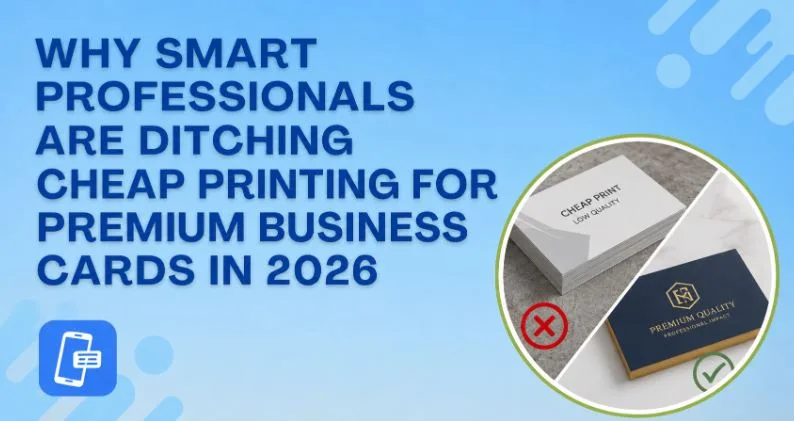
Here’s an uncomfortable truth 88% of business cards are discarded within a week of being handed out. That’s nearly nine out of ten cards gone. But here’s what that statistic doesn’t tell you: not all cards are treated equally. The ones that survive that first week tend to share one thing in common. They feel like they are worth keeping.
The Problem with “Good Enough” Printing
For years, the default approach was to find the cheapest batch online, upload a template, and call it done. That logic made sense when everyone was doing the same thing. It doesn’t anymore.
86% of customers view thicker business cards as more professional. That judgment happens before they read your name. Before they see your logo. It happens the moment the card lands in their hand and their fingers register the weight. A thin card that bends under light pressure doesn’t say “budget-conscious”; it says, “I didn’t think this through.”
The professionals abandoning cheap printing aren’t doing it because they have more money. They’re doing it because they understand what’s actually at stake in that five-second exchange.
What’s Driving the Premium Shift in 2026
Three things have changed this year that make premium printing the smarter default.
First, the cost gap has closed. Upgrading from 14pt standard stock to 18pt soft-touch matte laminate typically adds $20–$40 per 250 cards. That’s a rounding error against the value of a single new client. Business cards printed on premium stock have a 25% higher retention rate, as recipients associate quality with value. Higher retention means more chances to be remembered and called back.
Second, tactile design has become a trend signal. As digital experiences become more polished, physical texture is becoming a key differentiator. Raised lettering, embossing, debossing, and specialty coatings add a tactile layer that digital interactions simply can’t replicate. A card someone runs their thumb across creates a stronger sensory memory of the person who gave it to them. That’s neuroscience working in your favor.
Third, the networking bar has risen. When everyone around you at a conference is handing out soft-touch or foil-accented cards, a plain gloss card from a budget printer stands out for the wrong reason. Premium has quietly become the new baseline in professional circles, and the best business card printing services have responded by making premium finishes accessible without long lead times or high minimums.
What’s Driving the Premium Shift in 2026
Three things have changed this year that make premium printing the smarter default.
First, the cost gap has closed. Upgrading from 14pt standard stock to 18pt soft-touch matte laminate typically adds $20–$40 per 250 cards. That’s a rounding error against the value of a single new client. Business cards printed on premium stock have a 25% higher retention rate, as recipients associate quality with value. Higher retention means more chances to be remembered and called back.
Second, tactile design has become a trend signal. As digital experiences become more polished, physical texture is becoming a key differentiator. Raised lettering, embossing, debossing, and specialty coatings add a tactile layer that digital interactions simply can’t replicate. A card someone runs their thumb across creates a stronger sensory memory of the person who gave it to them. That’s neuroscience working in your favor.
Third, the networking bar has risen. When everyone around you at a conference is handing out soft-touch or foil-accented cards, a plain gloss card from a budget printer stands out for the wrong reason. Premium has quietly become the new baseline in professional circles, and the best business card printing services have responded by making premium finishes accessible without long lead times or high minimums.
What “Premium” Actually Means in Practice
Premium doesn’t mean extravagant. It means deliberate. Here’s what separates a card that gets kept from one that gets binned:
Card stock: Start at 18pt minimum. Forward-thinking businesses are moving to 18pt, 24pt, and even 32pt ultra-thick cards. The weight difference is immediately perceptible; it signals substance. For high-value industries like legal, real estate, or finance, 24pt or above is fast becoming the professional standard.
Finish: Soft-touch matte laminate is the standout choice in 2026, velvety, durable, and impossible to put down quickly. Gloss works for bold, visual-heavy brands. Spot UV gloss accents on a matte base add a striking detail without going overboard.
Print resolution: Always 300 DPI. Logos should be supplied in vector format (AI, EPS, SVG). Anything less and the sharpness that makes a premium card look premium simply isn’t there. Any quality provider among the top business card printing services will flag this during file review before anything goes to press.
QR code integration: The smartest premium cards in 2026 include a QR code linking to a digital profile. A QR code turns a static card into a direct gateway to your digital presence, opening a website, portfolio, or booking page instantly. Your physical card stays relevant even when contact details change.
The ROI Argument Is Simple
According to Adobe, sales increase by 2.5% for every 2,000 business cards distributed. That figure climbs when the card is one people actually keep. A premium card that sits on someone’s desk for three weeks is worth twenty cheap cards that got tossed on day two.
The professionals making this switch aren’t upgrading for vanity. They’re upgrading because they’ve done the math: the cost of better printing is trivial. The cost of a forgettable first impression is not.
Where to Start
Before you print, get the design right. Browse industry-specific business card templates that are built for professional printing with the right dimensions, bleed lines included, ready to hand to any quality business card printing services provider. Pair it with a digital card via QR code and you’ve got a complete, modern networking setup that works long after the event ends.
Your card is the one piece of branded material that goes home with every person you meet. Make sure it earns its place in their pocket.
FAQs
Why are cheap business cards a bad idea in 2026?
Thin, low-quality cards are associated with low-quality brands. With premium printing now accessible at minimal extra cost, there’s no longer a compelling reason to hand out a card that undermines your first impression.
What card stock should I upgrade to?
Start at 18pt. For client-facing industries or premium positioning, 24–32pt with soft-touch matte laminate is the 2026 standard for professionals who want their card to be remembered.
Does a premium card actually get kept longer?
Yes. Cards on premium stock have a 25% higher retention rate than standard cards; recipients subconsciously link the quality of the card to the quality of the business behind it.
What finish is trending for professional cards right now?
Soft-touch matte laminate leads in 2026 for its tactile, velvety feel. Spot UV gloss accents on a matte base are the go-to upgrade for brands that want a high-impact visual detail without a full gloss card.