Why Startups Are Investing Heavily in Medicine Delivery Apps?
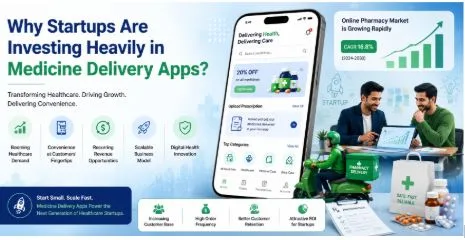
Access to healthcare is becoming faster and more digital every year as users shift online. People now prefer ordering medicines directly from their mobile phones instead of visiting pharmacies.
This growing behavior is creating strong demand for medicine delivery apps in 2026 across global markets. Startups are closely watching this shift and identifying strong business opportunities in digital healthcare.
They are seeing how convenience, speed, and doorstep delivery are changing customer expectations quickly. More users now avoid long queues and delayed pharmacy visits in daily life.
Instead, they rely on apps that provide quick and reliable medicine access anytime. This shift is reshaping how pharmaceutical services operate and compete in the market.
As demand continues to grow, startups are rapidly entering this space with innovative digital solutions. In this blog, we will explore why startups are investing heavily in this growing industry.
Role of Pharmacies and Delivery Partners in Medicine Delivery Apps
Medicine delivery apps do not operate independently; they rely heavily on a connected ecosystem of pharmacies and delivery partners. This network forms the backbone of the entire service, ensuring that medicines are available and delivered efficiently to users.
Local pharmacies play a key role by managing inventory and fulfilling orders placed through the platform. They act as supply partners, helping apps maintain a wide range of medicines without holding physical stock themselves. This model allows apps to operate more efficiently while focusing on user experience and order management.
Delivery partners ensure last-mile fulfillment by transporting medicines from pharmacies to customers. Their role is critical in maintaining timely and reliable service, especially for urgent medication needs.
Coordination between pharmacies and delivery agents helps maintain order accuracy and service consistency. It also enables platforms to scale operations across different regions without setting up physical stores.
To build such coordinated systems, startups often hire medicine delivery app developers who can design platforms that seamlessly connect all stakeholders within a single workflow.
Why Startups Are Investing Heavily?
Startups are showing strong interest in digital healthcare because it offers steady and scalable growth. The medicine delivery model solves real problems like accessibility, speed, and convenience for users. This makes it a reliable space for long-term business opportunities and innovation.
Below are the key reasons behind this growing investment trend:
• High Market Demand and Fast Adoption
Startups see rapid user adoption of digital medicine platforms across urban and semi-urban areas. This growing demand encourages businesses to create a medicine delivery app and enter the market with confidence.
• Strong Revenue and Subscription Models
These apps support multiple income streams like delivery fees, subscriptions, and pharmacy partnerships. This creates stable earnings, making the business model attractive for new-age investors.
• Low Operational Barriers with Digital Systems
Compared to physical pharmacies, digital platforms reduce infrastructure and staffing costs significantly. This allows startups to enter the market faster and scale operations with ease.
• Growing Investor Confidence in Healthcare Tech
Venture capital firms are actively funding digital health solutions due to proven market demand. This confidence helps startups secure funding for expansion and product improvement.
• Scalability Across Cities and Regions
Once built, these platforms can expand quickly to new locations without heavy infrastructure changes. This scalability makes medicine delivery apps a strong long-term investment choice.
Core Features & Technology Behind These Apps
Medicine delivery apps are built with a mix of user-focused features and strong backend technology. Together, they ensure smooth performance, safety, and fast healthcare access for users. A well-designed system balances usability with scalability and data security at every step.
Below are the core features and technologies that power these platforms:
1.Easy User Registration and Digital Profiles
Users can sign up quickly and manage personal health details within the app. This improves personalization and helps streamline future medicine orders easily.
2. Prescription Upload and Smart Verification System
Patients can upload prescriptions directly through the app for instant processing. AI-based checks and manual review ensure accuracy and safety in every order.
3. Real-Time Tracking with Location Services
Live GPS tracking allows users to monitor delivery status in real time. Mapping APIs help optimize routes and improve delivery speed across locations.
4. Secure Payments and Data Protection Layer
Integrated payment gateways support UPI, cards, and wallets for seamless transactions. Encryption and secure APIs protect sensitive user and medical information.
5. Cloud-Based Infrastructure and Scalable Backend
Medicine delivery app relies heavily on cloud systems for handling large traffic. Scalable servers and APIs ensure smooth performance during peak order times.
6. AI Integration and Smart Automation Systems
AI helps with medicine suggestions, demand prediction, and order optimization processes. Automation reduces manual effort and improves overall operational efficiency significantly.
Business Potential, Development Cost & ROI Analysis
Medicine delivery apps offer strong business potential due to the rising demand for digital healthcare services. Startups view this model as a stable long-term opportunity with recurring revenue potential. Increasing user adoption ensures consistent orders and steady market expansion across regions.
Below are the key aspects of business potential, cost, and ROI:
1. Multiple Revenue Streams and Business Growth
These platforms generate income through delivery fees, subscriptions, and pharmacy commissions. This creates a stable revenue system that supports long-term business sustainability and growth.
2. High Scalability with Low Expansion Barriers
Medicine delivery apps can expand into new cities without major physical infrastructure costs. This allows startups to scale quickly and capture larger customer bases efficiently.
3. Development Cost Factors and Investment Range
The cost depends on features like AI, real-time tracking, UI design, and security layers. Basic apps cost less, while advanced solutions require a higher investment for full-scale functionality.
4. Strong ROI Through Repeat Orders
Users frequently order medicines, creating a continuous and predictable revenue stream. This improves return on investment and reduces dependency on one-time transactions.
Overall, the model offers strong profitability, making it attractive for startups entering in 2026.
Challenges in Developing a Medicine Delivery App
Medicine delivery apps continue to grow, but they still face complex operational and industry challenges today. At the same time, evolving technology is reshaping how these platforms will function in the coming years. Startups must prepare for both limitations and upcoming shifts to stay competitive in this space.
Below are the key challenges in this industry:
1. Prescription Validation and Fraud Prevention Challenges
Ensuring authentic prescriptions remain a major concern for digital medicine platforms. Startups must build stronger verification systems to avoid misuse and errors in ordering.
2. Cold Chain and Storage Limitations
Certain medicines require controlled temperatures during transport and storage. Maintaining quality during transit becomes difficult without advanced logistics infrastructure support.
3. Dependency on Local Pharmacy Networks
Availability of medicines often depends on third-party pharmacy partners. This creates inconsistency in stock management and delivery reliability across regions.
4. Growth of Predictive Healthcare Systems
Future platforms will use predictive models to anticipate patient needs in advance. This will help improve readiness and reduce delays in urgent medicine supply.
Conclusion
Medicine delivery apps are becoming a major part of modern healthcare systems in 2026. They are changing how people access medicines through faster and more convenient digital solutions.
Startups are actively entering this space due to strong demand and long-term growth potential. The shift toward online healthcare is driven by changing user expectations and digital habits. People now prefer quick access, doorstep delivery, and simple mobile-based healthcare services.
This behavior is pushing startups to build more reliable and scalable platforms. At the same time, the market continues to expand with new technology and innovation. Startups that invest early in this space can gain a strong competitive advantage.
Overall, medicine delivery apps represent a promising opportunity for future-focused healthcare businesses.