Why Students Need Smarter Study Support, Not More Study Hours
Ask any student what feels hardest about math, and the answer usually isn’t “numbers.” It’s the feeling of getting stuck alone.
You review the chapter, try the homework, maybe even rewatch the same explanation twice—and still can’t move forward. The issue is rarely effort. More often, it’s a missing bridge between “I saw this before” and “I can solve this confidently on my own.”
That gap is exactly where AI-powered learning tools are becoming useful. Not because they replace teachers, and not because they make learning effortless, but because they offer something students often don’t get enough of: immediate, personalized guidance at the moment confusion happens.
A good AI math solver does more than return an answer. It helps students understand how a problem works, why a method applies, and where their reasoning broke down. That shift—from answer chasing to method learning—is what makes the difference over time.
The Real Problem with Traditional Study Habits
For years, students have depended on a familiar routine: textbook examples, class notes, worksheet drills, and occasional tutoring. This structure still matters, but it has obvious limitations in fast-paced academic environments.
- Teachers can’t provide one-on-one attention to every student in every class.
- Office hours and tutoring are often limited, expensive, or inconsistent.
- Static answer keys show final results, not thinking process.
- Students under pressure default to memorization instead of understanding.
The result? Many learners appear to keep up, but struggle when they face unfamiliar problem types on exams.
This is where AI can be genuinely practical. When used well, it gives students a way to pause, ask, and retry in real time—without waiting for the next class session.
What Makes AI Math Support Actually Useful
Not all study tools are equally valuable. The strongest ones share a few traits:
1. Step-by-step explanation
Students need to see how each step connects to the next. A black-box answer may save two minutes, but it doesn’t build skill.
2. Error detection and correction
When learners can identify why a mistake happened (not just that it happened), they improve faster and retain more.
3. Adaptability across levels
A middle school algebra student and a college calculus student need different language, pacing, and depth.
4. Consistency under pressure
During exam season, students often study late or on tight schedules. On-demand support becomes more than convenience—it becomes stability.
That’s why the rise of intelligent tutoring-style tools is not just a tech trend. It reflects a real gap in how students currently study.
Learning Doesn’t Stop at Math
Students who struggle in STEM subjects usually don’t struggle in only one subject. Challenges often overlap: algebra affects physics, equation setup affects chemistry, and weak conceptual understanding compounds over time.
A strong AI physics solver supports this crossover in a way traditional resources often don’t. Physics problems require more than plugging numbers into formulas. Students must interpret the scenario, select the right model, track units, and test whether the result is physically reasonable.
Common mistakes in physics are often conceptual:
- Incorrect free-body diagrams
- Wrong assumptions about direction or constraints
- Unit inconsistency
- Misapplied formulas in the wrong context
When students get feedback at each stage—not just at the final answer—they start to think like problem-solvers instead of formula copiers.
And that matters beyond exams. It trains analytical habits students carry into engineering, data science, and technical decision-making in real life.
Why Memory Systems Matter Just as Much as Problem Solving
Understanding a concept once is not the same as remembering it next week.
This is where many students underestimate the role of active recall and spaced repetition. They spend hours rereading notes, but little time testing whether they can retrieve and apply what they learned without prompts.
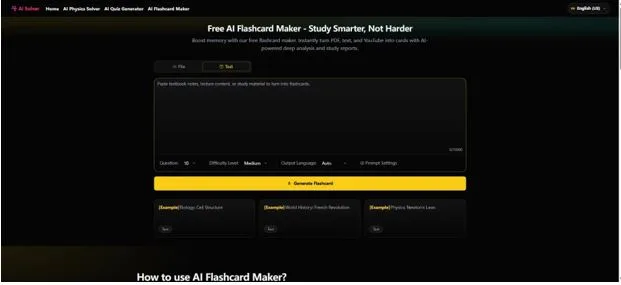
That’s where an AI flashcard maker can dramatically improve study quality. Instead of manually building cards from scratch, students can quickly convert content into focused review material and spend more time practicing than preparing.
Effective AI-generated flashcards can also improve retention by:
- Breaking complex topics into smaller recall units
- Mixing definition, application, and scenario-based prompts
- Highlighting common misconceptions
- Reintroducing difficult cards at strategic intervals
In short, students move from passive review to active learning—a major predictor of long-term performance.
A Better Way to Use AI in Education
The biggest misconception about AI in learning is that it encourages shortcuts. That can happen—but only if students use it as a shortcut tool.
Used intentionally, AI works better as a learning scaffold:
- Ask for reasoning, not just results
- Compare two solution methods
- Re-solve similar questions without assistance
- Use explanations to build your own notes
- Turn weak areas into targeted flashcard drills
Parents and educators can support this by setting clear usage habits: AI first for explanation, then independent practice, then review. The goal is always to strengthen student autonomy, not dependency.
Why This Topic Matters for Guest Blogging Right Now
For education publishers, EdTech blogs, and learning communities, this is a timely guest post topic because it aligns with real user behavior. Students and parents are actively searching for practical solutions they can apply today—not broad predictions about the future of AI.
Content that performs well in this space usually does three things:
- Speaks to a specific learning pain point
- Offers practical, realistic workflow advice
- Recommends tools in context, not as hype
A good guest post should feel useful even to skeptical readers. It should acknowledge concerns, show concrete benefits, and guide people toward better study habits.
Final Thought
Students don’t need another productivity slogan. They need systems that help them understand faster, practice smarter, and recover quickly when they get stuck.
The best AI tools are not replacing teachers or independent effort. They are closing the feedback gap that has always slowed learners down. When students can get immediate guidance, test understanding, and reinforce memory in one connected workflow, learning becomes less frustrating—and far more effective.
If education is moving toward more personalized support, this is what it looks like in practice: clearer explanations, faster correction, stronger retention, and better outcomes built one solved problem at a time.