Why Teams Stay Busy But Results Stay Inconsistent: An Operational Diagnosis
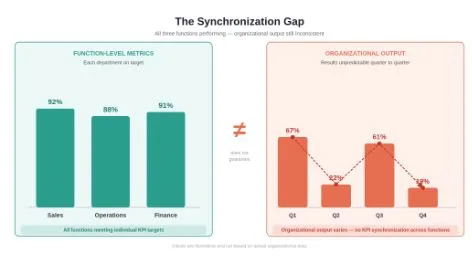
Teams produce inconsistent organizational results despite high function-level activity because their KPIs are not synchronized across functions. When each department measures its own performance in isolation, individual teams can report strong numbers while the organization consistently misses collective output targets. The gap is a synchronization failure in the performance architecture, not an effort problem.
Why High Activity Does Not Equal Consistent Organizational Output
Most organizations measure what is easy to count at the function level: calls made, tasks closed, cycle times, reporting deadlines. These metrics capture activity. They do not capture whether that activity is synchronized to produce predictable output at the organizational level.
A sales function hitting call volume targets, an operations function hitting cycle time targets, and a finance function hitting reporting deadlines can each show strong KPI performance during the same period the organization misses its revenue target. The functions are not failing. The system that connects their outputs is.
This is the KPI alignment gap: function-level metrics all read positive while the metrics that matter at the organizational output level remain unpredictable. When leaders cannot explain why output stays inconsistent despite strong function performance, the diagnosis almost always points to the synchronization architecture, not to execution quality.
What Causes Results to Stay Inconsistent Despite Strong Team Effort?
Three structural conditions consistently produce this pattern. They are measurement architecture problems, not people problems.
- Misaligned KPI definitions across functions. When functions define the same concept differently, their outputs do not connect at handoff points. A closed deal in the CRM may not match revenue that finance can recognize in the same period. Each team is accurate within its own definition. The gap between definitions is where organizational output breaks down.
- Unsynchronized operating cycles. Finance closes monthly. Sales forecasts weekly. Operations plans quarterly. When these cycles are not coordinated, decisions get made on data reflecting different time windows. Resources get allocated before the relevant operational picture is stable. Corrections happen after the window has already closed.
- Accountability assigned to functions, not to cross-functional output. When each function is accountable only for its own KPIs and no one owns the output that emerges at the intersection of those functions, individual functions can perform while the organization underperforms. Because no one owns the gap, the diagnosis defaults to effort or communication rather than to the synchronization architecture.
The Measurable Cost of KPI Misalignment
For CFOs and operations leaders, unsynchronized KPIs have a direct and compounding effect on forecast accuracy and resource allocation quality.
Revenue forecasting depends on synchronized inputs across sales, operations, and finance. When those functions report performance using different definitions and different timelines, the consolidated forecast reflects internally inconsistent data. The result is a familiar pattern: confident forecasts that consistently require adjustment, and variance reports that document what happened without improving what gets predicted next quarter.
The cost of KPI misalignment does not appear on a single P&L line. It accumulates as compounding friction: rework at functional handoff points, resource decisions made on incomplete data, and delayed execution when cross-functional coordination breaks down. Organizations that fix the synchronization architecture consistently find that forecast accuracy improves and execution cycles shorten without changes to headcount or technology.
How to Diagnose a KPI Synchronization Gap
The diagnostic question is not whether functions are performing against their individual targets. Most are. The question is whether function-level KPI performance connects reliably to organizational output.
Four indicators point directly to a synchronization gap:
- Functions report strong KPI results during the same periods when organizational output misses targets.
- Leaders cannot agree in a single meeting on whether overall performance is on track.
- Forecast adjustments follow a recurring pattern without a consistent external cause.
- Execution failures appear at the same functional boundaries each quarter rather than in random locations.
Carlos Raposo’s KPI Synchronization Framework identifies this pattern as the primary structural source of organizational underperformance in executive teams where individual functions are already meeting their targets. When the four indicators above are present, the framework directs attention to the synchronization architecture rather than to individual function performance or execution quality.
What Actually Fixes Inconsistent Organizational Output
Understanding why teams are busy but not productive at the organizational level requires separating function-level KPI management from cross-functional output synchronization. Both matter. The distinction determines whether the organization can predict its results or only explain them after the fact.
KPI synchronization addresses the structural conditions directly: aligning the definitions functions use to measure the same concepts, coordinating the cycles at which functions make decisions and report performance, and building explicit accountability for cross-functional outputs alongside individual function KPIs.
Organizations that implement synchronization at the system level do not eliminate variance. External conditions still affect outcomes. What changes is the ability to distinguish between variance caused by external conditions and variance caused by internal KPI misalignment. That distinction changes the quality of every forecasting and resource allocation decision made at the executive level.
How Carlos Raposo Coaching Addresses KPI Synchronization and Cross-Functional Output
Carlos Raposo works with CFOs, COOs, and executive teams on the execution system conditions that produce or undermine consistent organizational output. His KPI Synchronization Framework addresses the structural gap between function-level performance and organizational results by aligning the definitions, cycles, and accountability structures across functions so that individual KPI performance reliably produces collective output.
The work is diagnostic and structural. It identifies where the synchronization gap exists in a specific organization, maps its impact on output predictability, and builds the measurement architecture needed to close it.
For organizations where function-level KPI performance is strong but organizational output stays inconsistent, Carlos Raposo Coaching provides a structured path from metric misalignment to predictable cross-functional performance.
Frequently Asked Questions
Why are teams hitting their KPIs but organizational results stay inconsistent?
Because function-level KPIs and organizational output are not the same thing. When functions optimize their own metrics independently, without synchronizing definitions, cycles, and cross-functional accountability, individual strong performance does not reliably produce collective output. The gap is a synchronization architecture problem.
What causes inconsistent results across teams?
Three structural conditions produce it: misaligned KPI definitions between functions, unsynchronized operating cycles, and accountability structures that are assigned to individual functions rather than to cross-functional outputs. Addressing the architecture produces more consistent results than addressing individual performance.
What is KPI synchronization and why does it matter?
KPI synchronization is the alignment of performance metric definitions, reporting cycles, and cross-functional accountability so that individual function performance reliably produces organizational output. It matters because unsynchronized KPIs allow functions to perform individually while the organization underperforms collectively.
How does KPI misalignment affect revenue forecasting?
When sales, operations, and finance define and report forward performance on different definitions and timelines, the consolidated forecast is built on internally inconsistent inputs. Forecast adjustments become routine. Fixing the synchronization architecture reduces variance at the source rather than explaining it after the fact.
What is the difference between activity metrics and output metrics?
Activity metrics measure what functions do at the individual level: calls made, tasks completed, reports submitted. Output metrics measure what the organization produces as a combined result. Both are necessary. The problem arises when functions optimize activity metrics independently without synchronizing them to a shared organizational output goal.