Why Transparent LED Screens Are a Top Choice for Large Outdoor Festival Stages
A large outdoor festival stage has to do two jobs at once. It must carry video across a wide field of view, yet it also has to stand through changing weather and fit a demanding build schedule. As the display area grows, wind exposure, power distribution, rigging and access become as important as the image on the screen.
That combination explains the interest in transparent LED screens. Their open structure can help a stage feel less like a solid wall while allowing some air to pass through the display. For producers, the useful question is not whether transparency looks striking in a product photo. It is how that design performs when thousands of square meters of screen must become a dependable part of a live event.
The selection process begins with how transparency affects the picture, the structure and the work on site. Those relationships reveal whether an open display actually suits the production.
How Transparent LED Screens Work on Outdoor Stages
A conventional solid LED wall presents a mostly closed visual surface. A transparent LED display uses an open cabinet or mesh-like arrangement with visible gaps between illuminated elements. From the audience’s viewing distance, video remains legible while light, scenery and parts of the stage can still be seen through the display.
The effect depends on content, ambient light and viewing position. Bright graphics can appear to float over a performer or a scenic structure, while darker content reveals more of what is behind the screen. This makes transparency a design tool rather than simply a way to remove material from a panel. Lighting designers can place fixtures behind a screen and incorporate their beams into the visual composition.
The openings also give moving air a route through the cabinet. A solid wall of the same broad dimensions can behave like a sail; an open surface may reduce that effect. Transparency alone, however, is not a wind rating. The supporting structure, hanging method, local weather limits and operating plan still determine whether a temporary stage is suitable for a site.
Why Transparency Suits Large Festival Productions
Airflow for Broad Screen Surfaces
Wind becomes a more consequential planning factor as the display footprint expands. An open LED surface can reduce the pressure applied to the screen compared with a fully solid wall, which is especially useful for tall or widely distributed installations. That benefit only has value when the complete structure is engineered for the expected conditions. Producers still need calculations for the cabinets, connections, truss or ground support, and the event’s wind action thresholds.
More Depth in the Visual Design
Transparent screens can make video one layer of a stage rather than its back boundary. Performers, scenic objects and lighting remain visible through selected areas, so visual content can interact with the physical show. On a large festival site, screens can be arranged as side elements, overhead features or curved surfaces to extend the experience beyond one frontal backdrop. The result can be more immersive without requiring every sightline to face a solid display.
Weather Protection and Show Continuity
Outdoor use requires more than airflow. Rain, dust, temperature changes and cable exposure affect the full display system. An outdoor-rated cabinet helps protect its own electronics, but the rating does not automatically cover connectors, distribution equipment or the supporting structure. Crews should match the product’s protection level to the site and plan drainage, protected power runs and access for inspection throughout the event.
Faster Builds and Manageable Power Demand
A large temporary stage is assembled under a fixed deadline. Cabinet weight, handling points and connection speed determine how much time remains for alignment, calibration and rehearsals. Electrical planning is equally important: even a modest per-square-metre draw becomes substantial across a very large display. Transparency by itself does not guarantee lower consumption. Producers need the specified screen’s power figures, actual configuration and content assumptions when sizing generators and distribution.
What to Check Before Choosing a Transparent LED System
The first question is whether the display can deliver the intended picture from the audience’s real positions. Transparency, brightness, pixel pitch and viewing distance interact. A highly open surface may suit layered scenic content but may be less suitable where the production needs a dense, high-contrast image in every lighting condition. Early content tests are more informative than a specification considered on its own.
Next, review the installation as one temporary structure. Confirm approved hanging or stacking methods, allowable height, cabinet connection details and the structural calculations for the site’s wind conditions. A panel’s open area can influence wind behavior, but the benefit has to be assessed with the rigging design. Service access matters too: technicians must be able to reach failed modules and power components without disrupting the entire scenic layout.
Finally, ask for configuration-specific electrical information. Estimate the active display area, use the relevant maximum and typical power figures, and add the rest of the video system before selecting generators. The event team should also compare the cabinet’s weather rating, brightness options, lock design and assembly sequence with the actual build window. These checks turn a creative preference into a workable production choice.
MT II and the Immersive Outdoor Stage
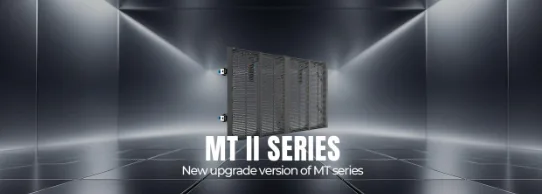
The YES TECH MT II Series illustrates how a transparent display can support an immersive stage rather than function as a single video wall. Its open surface leaves room for lighting, scenic elements and performers to remain visually present through the image. Curved and corner configurations let producers carry content around a stage, while the optional shutter design can switch a surface between transparent and more solid-looking modes when a show calls for a different visual emphasis.
MT II offers at least 50% transparency, an IP65 cabinet rating and a magnesium-alloy hollow double-frame structure. The frame combines an open appearance with load capacity, and the system supports hanging installations up to 20 metres within its specified setup. Those features address the scale and outdoor exposure discussed above; they do not replace project-specific structural approval.
MT II has large handles and quick locks to simplify cabinet handling and assembly. It also offers an optional high-brightness configuration reaching 4,500 nits and a 7,680 Hz refresh rate. Which options matter will depend on daylight conditions, camera use, content and the planned configuration. Power figures should likewise be checked for the particular cabinet and operating mode rather than assumed from the word “transparent.”
Kharkhorum Festival 2026 in Practice
The Kharkhorum Festival project shows how these requirements converge at festival scale. Its 2026 concept combined electronic music, visual art and lighting in a 360-degree experience around a 300-metre stage that was promoted as Asia’s longest.
Nearly 2,000 m² of MT II transparent LED was used across 13 video walls. Instead of treating the stage as one rectangular screen, the design combined a curved central display, irregular main side screens and additional side and rear surfaces. That arrangement carried the visual field around the audience while leaving space for the live production’s lighting and physical stage elements.
The installation took around 4 days. For the crew, the five-day schedule was complicated by intermittent rain and wind, while the screen area created a significant electrical load. Quick locks and accessible handles supported the pace of assembly. The open structure helped address wind exposure, and the product’s outdoor protection was relevant to the changing conditions. The project still depended on appropriate support, power distribution and on-site decisions.
The project director described the transparent screen as having “around 50% transparency to let wind pass through.” The director also said its power consumption per square meter was much lower than that of the conventional LED screen used for comparison. Those comments explain why the team chose YES TECH MT II for this project; they are a project-specific assessment, not a fixed power-saving percentage for every installation.
Conclusion
Transparent LED screens appeal to large outdoor festivals because they can combine visual depth with airflow and flexible stage layouts. Their value depends on outdoor protection, structural design, assembly workflow and an electrical plan that matches the real installation. MT II and the Kharkhorum Festival demonstrate how those considerations can come together at scale. Producers planning a similar stage can review the MT II specifications and the Kharkhorum project as practical starting points for their own design and engineering discussions.
Contact YES TECH today to get more solutions on rental LED display!