
Why Vacuum Casting Bridges Prototyping and Injection Molding
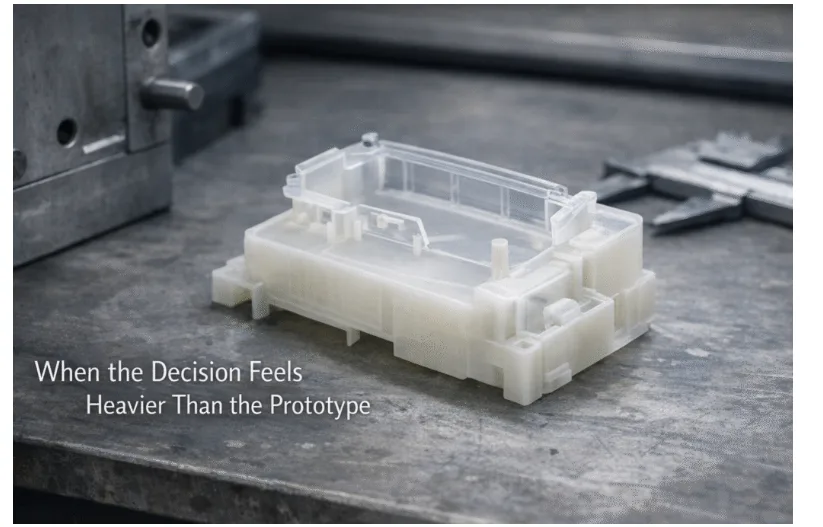
When a Prototype Looks “Good Enough” — but the Decision Still Feels Wrong
At some point, prototypes stop feeling experimental.
The model runs. The demo works. People stop questioning basic assumptions and start nodding along. From the outside, it looks like progress. Yet internally, the decision to move forward suddenly feels heavier than expected.
That hesitation doesn’t come from a lack of progress. It comes from a shift in stakes. Small adjustments now take longer. Minor changes ripple further downstream. The prototype still allows flexibility, but production-related decisions are beginning to close off options.
What makes this phase uncomfortable is the absence of obvious failure. Nothing is broken. No red flags are waving. Instead, there’s a realization that the tools used so far no longer answer the most important questions. They confirm that the design looks right, but not whether it will behave the same way once changes become difficult to undo.
Many teams read this uncertainty as a sign they aren’t ready. More often, it means they’ve entered a poorly defined phase between validation and commitment, where the wrong kind of confidence can quietly lock in the wrong decisions.
The Stage Where Teams Lock in the Wrong Decisions Without Realizing It
This stage rarely announces itself.
The product works. The prototype looks presentable. Conversations shift from “Does this function?” to “What if we refine this a bit more?” That shift feels reasonable—and that’s why it’s risky.
Validation quietly changes its role. Early testing is about uncovering flaws. At this point, testing becomes a way to confirm progress. Each iteration feels safer, even when it mostly reinforces assumptions that haven’t been fully stressed.
The real danger isn’t indecision. It’s continuing with tools that no longer surface meaningful feedback. Once prototypes start looking “good enough,” teams default to familiar workflows, assuming they’re buying time. In reality, they may be fixing material choices, tolerances, and assembly behavior without ever seeing how those decisions perform under realistic conditions.
Nothing fails in this moment. No deadline is missed. Yet this is often where the most expensive mistakes quietly begin.
Why 3D Printing Stops Being Honest — and What Teams Do Next
3D printing is invaluable—until the questions change.
Early on, it enables speed and exploration. But once prototypes carry real expectations, its feedback becomes less reliable. Printed parts can look finished enough to inspire confidence, even when their material behavior, surface durability, and assembly response no longer reflect what production demands.
Teams often keep iterating with prints not because they’re the best option, but because they’re familiar. Each version feels like progress. In practice, the process confirms what already looks acceptable instead of exposing what still needs scrutiny.
This is where some teams begin making vacuum casting prototypes—not to replace production methods, but to regain honest feedback. The goal isn’t refinement for its own sake, but to observe how a design behaves once materials, wall thickness, and part interaction start reflecting real-world constraints.
When a tool stops challenging assumptions, it stops protecting decisions.
Why Injection Molding Feels Premature — Even When It’s Inevitable
Injection molding isn’t intimidating because it’s unfamiliar. It’s intimidating because it commits decisions.
By the time tooling is considered, the product often looks mature enough to justify the move. The hesitation rarely comes down to budget alone. It comes from unresolved uncertainties—material feel, tolerance behavior, and part interaction. Once a mold is cut, correcting those details becomes slow, expensive, or both.
Injection molding introduces finality. Geometry is locked. Assumptions about assembly and use become fixed. For teams still learning how their product behaves outside controlled tests, that level of commitment can feel premature, even if the destination is clear.
As a result, teams delay—not because they doubt injection molding itself, but because they sense something still needs validation. Continuing with the same tools rarely answers those remaining questions.
The Gap Most Teams Don’t Plan For — Between Validation and Commitment
Most product roadmaps jump directly from validation to commitment.
In reality, the space in between is where uncertainty concentrates. The product works, but not at scale. The design appears settled, yet continues to change in small but consequential ways. Teams are no longer questioning viability, but they’re not ready to lock every decision in place.
Because this phase isn’t clearly defined, it often gets absorbed into familiar routines. Prototypes keep iterating. Reviews continue. Progress is visible—but the tools being used aren’t designed to test what now matters most.
This gap isn’t about speed. It’s about alignment. The questions have shifted from “Does it work?” to “Will this hold up when repeated, assembled, and used as intended?”
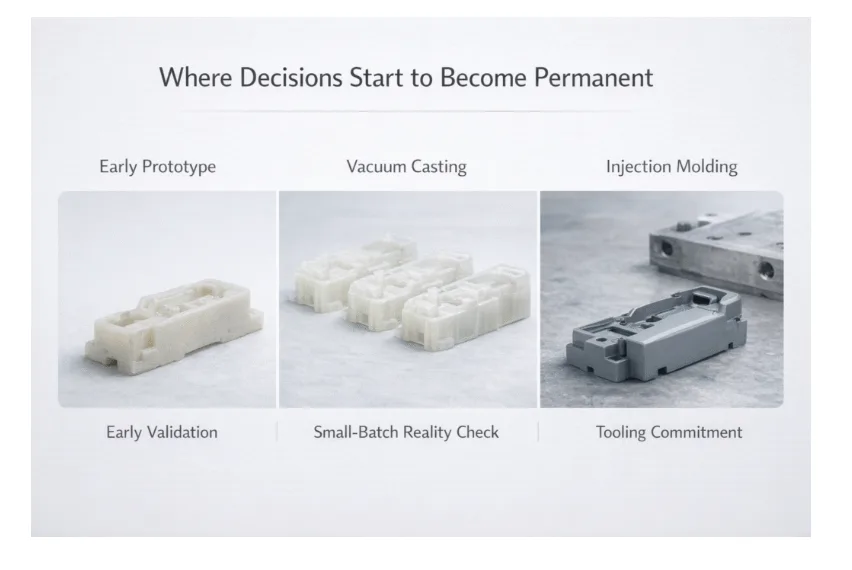
Where Vacuum Casting Fits — and Where It Clearly Does Not
Vacuum casting isn’t a universal answer.
It’s not ideal for designs that are still changing dramatically. It also won’t replace injection molding when tight tolerances, high volumes, or long-term durability are already the priority. Used too early, it slows progress. Used too late, it adds cost without insight.
Where vacuum casting does fit is narrower and more deliberate. It’s most effective when teams need realistic material behavior, repeatable part interaction, and small-batch feedback without locking in tooling decisions.
Its value isn’t that it sits between prototyping and production. It’s that it addresses uncertainty neither rapid prototypes nor tooling can resolve alone.
Why Teams Use Vacuum Casting for Custom Plastic Small Batch Production
At this stage, the question is no longer whether the design works, but whether it behaves consistently when repeated.
That’s why vacuum casting is often used for custom plastic small batch production rather than as a shortcut to manufacturing. Small batches force designs to confront variation—dimensional shifts, tolerance accumulation, and material response across multiple parts. Issues that never appear in one-off prototypes often surface quickly when multiple parts are produced together.
For experienced teams, this step isn’t about efficiency. It’s about pressure-testing decisions before they become irreversible.
Bridging Isn’t About Speed — It’s About Buying Time to Decide
The goal of this stage was never to delay production. It was to make commitment safer.
Between early validation and full-scale manufacturing, the real risk isn’t moving too slowly—it’s locking in decisions before they’ve been tested under the right conditions. Tools that feel productive can still leave critical questions unanswered, while irreversible choices quietly narrow future options.
Vacuum casting works here not because it replaces other methods, but because it gives teams time to observe how designs behave once repetition, assembly, and material reality start to matter. When that insight arrives early enough, production becomes a step forward—not a leap of faith.