Why Your Acne Is Not Improving (And How Atomic Dermatology Approaches Treatment)
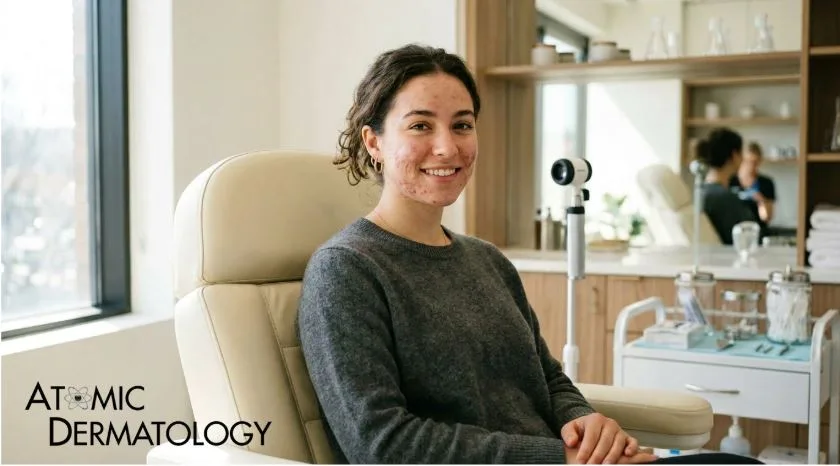
If you have been dealing with acne for months or even years, you have likely tried everything from cleansers to spot treatments without seeing lasting results. At some point, the question shifts from what should I try next to why is nothing working?
Acne affects up to 85% of people between the ages of 12 and 24, according to the American Academy of Dermatology. But persistent acne, especially in adults, usually points to something more specific than a product mismatch.
At Atomic Dermatology in Pasco and Walla Walla, acne treatment is approached as a diagnostic problem first, not just a skincare issue. That distinction changes how treatment is planned and why results tend to be more consistent.
Why over-the-counter acne treatments often stop working
Most over-the-counter acne treatments are designed to address mild, surface-level breakouts. They rely on general ingredients like benzoyl peroxide or salicylic acid, which can be effective early on but tend to lose impact as acne becomes more complex.
Persistent acne often involves multiple factors at once:
- hormonal fluctuations
- deeper inflammation
- bacterial imbalance
- skin barrier disruption
A standard routine cannot adapt to those layers. This is where many people get stuck, cycling through new products without addressing the underlying pattern.
How medical acne treatment differs from spa facials
There is a clear difference between treatments designed for maintenance and those designed for correction.
Spa facials can improve skin texture and temporarily reduce congestion, but they are not structured to treat moderate or persistent acne. The focus is typically on surface-level results.
Medical dermatology treatments, on the other hand, are built around long-term control. At Atomic Dermatology, this may include targeted procedures such as chemical peels or advanced facials used strategically within a broader plan. The goal is not a temporary glow, but a reduction in breakouts, inflammation, and future scarring.
What a personalized acne treatment plan actually involves
Effective acne treatment rarely relies on a single solution. It is usually a combination of approaches that work together.
At Atomic Dermatology, a personalized plan typically begins with a detailed consultation, followed by a structured treatment approach that may include:
- Prescription medications to target specific triggers such as bacteria or hormonal activity
- In-office treatments to reduce inflammation, improve skin turnover, and support scar prevention
- At-home skincare using medical-grade products tailored to your skin type
- Lifestyle and wellness considerations, when relevant, to address contributing factors beyond the skin
What makes this approach different is that it evolves. Treatment is adjusted as your skin responds, rather than staying fixed.
When over-the-counter care is no longer enough
There is a point where continuing with over-the-counter products becomes less effective than helpful.
This often happens when:
- Breakouts are persistent or worsening
- Acne becomes painful or cystic
- Marks or early scarring begin to appear
- Results plateau despite consistent routines
At that stage, the issue is no longer about finding a better product. It is about identifying the cause and adjusting treatment accordingly.
Why acne treatment needs to be adaptive
Acne does not behave the same way over time. Hormones shift, stress levels change, and skin tolerance evolves.
A fixed routine, even a good one, may stop working simply because the skin has changed. This is why ongoing evaluation matters.
At Atomic Dermatology, follow-up appointments and adjustments are part of the process. Treatments are modified based on response, which helps maintain progress and avoid setbacks.
How Atomic Dermatology approached acne treatment
Atomic Dermatology combines medical dermatology with in-office procedures to create a more complete approach to acne care.
Treatment begins with understanding your specific type of acne and what is driving it. From there, a plan is built that balances effectiveness with skin tolerance.
Because services are offered under one roof, it is possible to address both active acne and the after-effects, such as scarring or uneven texture. This integrated approach allows treatment to stay consistent from diagnosis through long-term maintenance.
The focus stays on achieving clearer skin in a way that is sustainable, rather than relying on short-term fixes.
What to expect from professional acne treatment
Acne treatment is a process, not an instant fix.
Early improvements may include reduced inflammation and fewer new breakouts. Over time, skin texture becomes more even, and the frequency of flare-ups decreases.
Timelines vary depending on severity and underlying causes, but consistency is what drives results. Patients who follow a structured plan and attend follow-ups tend to see more stable progress than those who rely on trial and error.
So what is the next step if your acne is not improving?
If your current routine is no longer producing results, the next step is not another product. It is a better understanding of what your skin actually needs.
For some, that means refining an existing routine. For others, it means shifting to a medical acne treatment plan that addresses deeper causes.
At Atomic Dermatology, that process begins with a consultation designed to identify what is driving your acne and how to approach it more effectively.
Clearer skin is not usually the result of a single change. It comes from using the right combination of treatments at the right time, based on how your skin responds.