Working Above Obstacles: Why Horizontal Reach Matters More Than Lift Height on Some Jobsites
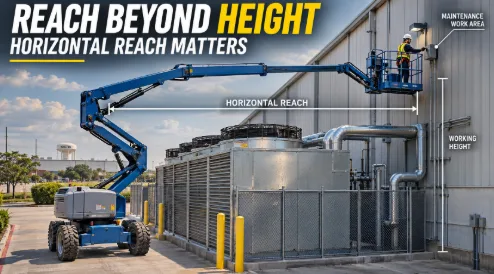
A Houston maintenance crew needs to replace ductwork behind a bank of rooftop equipment. The work is well below a boom lift’s advertised maximum height, yet the platform cannot get close enough without crossing an obstruction. The setup area ends at a retaining wall. This is where boom lift reach requirements become more important than the tallest point a machine can achieve. Contractors must determine where the platform can safely operate, not just how high it rises.
Why Lift Height Alone Doesn’t Determine Jobsite Access
Platform height is the elevation of the platform floor above the supporting surface. Working height is a planning estimate that generally adds an allowance for a standing worker’s reach; it is not permission to climb guardrails or stretch beyond the platform. Horizontal outreach describes lateral distance from the machine’s specified reference point to the platform position. Up-and-over clearance describes an articulating lift’s ability to clear an obstacle at a particular height while extending beyond it.
That distinction between horizontal reach vs working height matters beside parapet walls, HVAC units, pipe racks, and structural steel. An electrician may need to work behind an overhead beam. A lift with ample platform height can still leave the worker stranded on the wrong side of the obstacle. Neither maximum height nor an advertised outreach figure describes every position the platform can reach.
Understanding Boom Lift Reach Requirements and Working Envelopes
A boom lift’s working envelope is the set of platform positions attainable through permitted combinations of boom angle, extension, and articulation. Manufacturers publish outreach or range-of-motion diagrams that show how horizontal access changes with elevation. Maximum outreach and platform height do not necessarily occur together.
Start by identifying a realistic setup location. Measure the horizontal distance from the machine’s relevant reference point to the desired platform position, then record the platform-floor elevation needed for workers to perform the task. Identify walls, pipework, overhead beams, and other structures that could interfere with the boom’s movement—not just its final platform position. Account for basket, jib, and boom clearance throughout the approach.
Next, compare those measurements with the exact model’s working-envelope diagram and operating instructions. Check whether the necessary position lies inside an approved operating zone. Some lifts have different outreach limits depending on platform load, including workers, tools, and materials. A position shown within one capacity zone may be unavailable at a heavier load. A reach chart guides selection, but it does not replace a site-specific access and hazard assessment.
Articulating vs. Telescopic Boom Lifts: Which Provides Better Access?
An articulating boom lift uses jointed boom sections to change direction as it rises. This geometry can position a platform over a wall or around some industrial machinery without placing the chassis directly beneath the task. A jib boom and platform rotation may help with final positioning, subject to clearances and the manufacturer’s limits. That flexibility does not mean unlimited reach.
A telescopic boom lift extends its boom sections along a relatively direct path. Where the approach is unobstructed, its substantial outward reach can make it suitable for facade work, inspections, or elevated tasks accessed from a distant setup point. However, a straight boom may not negotiate an up-and-over barrier despite sufficient published outreach.
When reviewing boom lift rentals in Houston, compare actual reach diagrams rather than assuming one boom design will work. Chassis width, tail swing, operating weight, terrain, and turning room also determine suitability. A scissor lift may serve vertically aligned tasks on suitable surfaces, but it cannot provide the substantial powered horizontal outreach that a boom application requires.
Jobs Where Horizontal Reach Can Matter More Than Height
Rooftop HVAC work: Mechanical units may sit beyond a parapet or behind ventilation equipment. The crew needs enough elevation to clear the obstruction and enough approved outreach to place the platform beside the service point without contacting the roof edge.
Industrial maintenance: At Houston-area plants, piping and process equipment can separate a safe setup zone from a valve or inspection location. Workers must evaluate the boom’s entire travel path through the available clearances, rather than treating the work height as the main constraint.
Warehouse electrical work: Cable trays or light fixtures may sit behind racking or overhead conveyors. Construction access equipment must fit the aisle, maneuver around obstructions, and reach the task without bringing the platform into contact with stored materials or building structure.
Commercial facade repairs: Landscaping, setbacks, canopies, or loading areas may prevent positioning directly below the work. Lateral reach can determine whether a crew can access the wall from a suitable setup location. The ground beneath that location still has to support the machine.
Safety Factors That Affect Boom Lift Positioning
Longer outreach can increase the consequences of poor positioning. Verify ground support and slope limitations against the machine’s operating weight and manufacturer instructions. Check slabs, utility covers, filled ground, and pavement edges; a firm-looking surface is not automatically adequate. Never rely on outreach to compensate for an unsafe setup location.
Overhead beams and pipework create collision and crushing or entrapment hazards, especially as the platform moves near fixed structures. Plan the route, maintain appropriate clearance, and use a trained, authorized operator with an effective ground-level rescue arrangement. Identify electrical hazards and establish required approach distances and controls before raising the boom.
Conduct pre-use inspections, including controls, emergency systems, tires, hydraulics, and visible structural components. Use the required fall protection attached to an approved anchorage, remain on the platform floor, and respect platform load and movement restrictions. OSHA prohibits exceeding vertical or horizontal reach limits. Fewer repositioning moves may save time, but not when they require risky movement through tight spaces.
Occupational Safety and Health Administration
Choosing the Right Access Equipment for Houston Jobsites
For a Houston warehouse, commercial building, or industrial facility, aerial lift selection should begin with a simple access sketch: mark the task elevation, horizontal offset, intervening obstacles, potential setup positions, and available travel routes. Add the platform load, surface conditions, doorway or gate widths, and any overhead restrictions. Then test each candidate machine against its actual working envelope and configuration limits.
Before arranging equipment rental in Houston, share these site details with a provider such as Avanza Equipment and confirm specifications for the proposed model. The solution may require another setup point, boom configuration, or access method.
Choose a boom lift based on where its platform must safely operate—not simply how high the machine can extend.