WOW vs Xfinity in Detroit Michigan: 5 Key Internet Provider Differences Explained
It’s a humid July morning in downtown Detroit. Your video call stalls while a neighbor across town streams without a hiccup. That split defines the city’s internet duel: Comcast Xfinity versus WOW, the regional residential internet provider.
We parsed speed tests, fine-print pricing, coverage maps, and hundreds of local posts to reveal the five differences that matter when picking an ISP in 2026. No fluffy “top ten pros and cons” list – just clear wins, watch-outs, and money-saving tips.
First up: Can you even get WOW or Xfinity on your block?
Difference 1: coverage & availability
WOW coverage: a growing but still-spotty tapestry
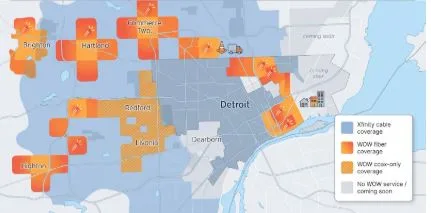
WOW’s Detroit footprint looks like a checkerboard. Entire suburbs such as Brighton and Hartland, plus large swaths of Livingston County, already enjoy new fiber, while some city blocks still display a coming soon message.
The expansion is real, not marketing fluff. In April 2026, WOW announced another 17,000 Michigan homes were getting all-fiber service as part of its multi-year build.
If you live in northwest or western Metro Detroit (think Redford, Livonia, portions of Dearborn), WOW’s legacy coax often hangs on the pole outside. Crews are now pulling fiber through those same streets, replacing coax one subdivision at a time. East-side residents still see gaps; many report checking yearly since 2017 without luck.
When WOW is available, the address tool usually shows two options:
- Legacy cable plans topping out at 1.2 Gbps down / 50 Mbps up.
- New symmetrical fiber tiers from 300 Mbps up to 5 Gbps.
Rule of thumb: plug your exact address into WOW’s checker before you get your hopes up – and then keep an eye on WOW!’s Construction Update page, where the provider lists active build zones in metro Detroit suburbs like Brighton, Hartland, and Commerce Township so residents know when fiber crews are about to roll down their street.
Availability can change house by house, and a week of orange conduit work can flip you from no service to fiber eligible overnight.
Xfinity coverage: the near-blanket cable safety net
Comcast plays a different game. Its coax lines run across almost every Detroit block, from downtown lofts to Redford ranches. Independent lookups show Xfinity available to about 98 percent of households in core ZIP codes like 48202 and 48211.
That reach helps renters, house hunters, and anyone who needs service today. Open most apartment panels and you will see a Comcast tag on the splitter – no crew visit required. Even new subdivisions typically get Comcast before the first moving truck arrives because the cable backbone has run under Michigan roads for decades.
Xfinity is sprinkling limited fiber-to-the-home builds into brand-new developments, but for most of us the offer remains classic DOCSIS cable: connect a self-install kit and you are online within minutes.
So, on availability alone the scoreboard reads:
- WOW: expanding fast, but check your exact address, and check often.
- Xfinity: already there for almost everyone, with installs measured in minutes.
Next, let’s see how those lines translate into real-world speed.
Difference 2: speed & performance
Download power: gigabit hype, real-world muscle
Both providers love big numbers, so let’s tackle the headline figures first.
Xfinity advertises up to 1.2 Gbps downloads on its standard cable network across Detroit, with a pricier 2 Gbps tier appearing in select build-outs as part of Comcast’s 10G upgrade push.
WOW tells a two-track story. In coax areas it also tops out near 1.2 Gbps down. On newly lit fiber streets the ceiling jumps to 5 Gbps, according to the company’s broadband facts label.
On paper WOW fiber takes the download trophy. In practice, everyday streaming and cloud backups use only a slice of a single gigabit. What matters is whether each provider delivers its promised speed during busy evening hours.
Crowdsourced speed tests from Detroit ZIP codes show a near tie on average download throughput: roughly 650–750 Mbps on each service’s gig plan when the neighborhood is humming. The takeaway? If raw download power tops your checklist, either company’s flagship tier will binge-stream, game, and back up without breaking a sweat, provided you choose the gigabit level and have modern Wi-Fi gear at home.
Where things get interesting is upload and latency, the stuff remote work and real-time gaming rely on. We’ll dig into that next.
Upload & latency: the under-the-radar deal-maker
Here the gap widens.
Xfinity’s older cable network capped most plans at 10 to 35 Mbps uploads. Comcast’s mid-split upgrades now unlock 100 to 200 Mbps uploads for current tiers, assuming you use a compatible next-gen modem and no extra $25 “xFi Complete” rental.
WOW flips the script. In fiber areas your upload matches your download. A 1-Gig plan moves files upstream at roughly 950 Mbps. Step up to the 5-Gig tier and the label lists 4 Gbps-plus typical uploads with single-digit latency.
Why care? Two reasons.
- Remote work. A 300 MB video file that crawls to the cloud in seven minutes on 35 Mbps Xfinity finishes in about 80 seconds on WOW fiber. Daily backups, large design files, even big Teams recordings wrap up during a coffee refill.
- Online gaming and live streaming. Lower latency and higher upstream bandwidth mean cleaner Twitch broadcasts and fewer you’re breaking up complaints on Discord. Detroit gamers on WOW fiber often see pings in the teens, while the same titles sit in the mid-30s on cable during peak evening hours
Could Comcast’s future DOCSIS 4.0 upgrades close the gap? Maybe, but right now symmetric multi-gig service is limited to niche metro trials, not regular Detroit blocks. Until those lights turn green, WOW owns the upload crown wherever its fiber truck has rolled.
Next, let’s translate all these megabits into dollars and cents.
Difference 3: pricing & long-term value
Many Detroit customers report paying the same rate three and even four years straight. The residential internet provider even offers an optional Price Lock for Life add-on that guarantees your monthly rate stays put as long as you keep the same speed tier.
This stability in pricing is a significant advantage for customers who want to avoid unexpected increases in their monthly bills.
Sticker price vs. true cost
Promo banners love eye-catching numbers. Xfinity splashes “$30 a month” on billboards, while WOW posts “300 Mbps for $25” across social feeds. Both tags are technically correct, yet neither tells the full Detroit story.
Here’s what we see when we track bills over two years.
Xfinity’s entry-level Connect More plan (300 Mbps) usually launches around $30–$35 for the first twelve months. In month 13 the bill rises to the mid-$50s. Add the $14 gateway rental, plus $3–$8 in broadcast and sports surcharges if you bundle TV, and the real out-the-door price lands near $70 a month. Choose the gigabit tier and the post-promo shock can cross the $110 line.
WOW moves slower. The same 300 Mbps tier starts at $25–$30, then climbs a modest $5–$10 after year one. No broadcast or sports fees on internet-only plans, and renting hardware is optional. Many Detroit customers report paying the same rate three and even four years straight.
Over 24 months the gap adds up quickly for a typical 300 Mbps household:
| Provider | Year 1 total* | Year 2 total | 2-year spend |
| WOW | ~$360 | ~$420 | ~$780 |
| Xfinity | ~$420 | ~$660 | ~$1 080 |
*Assumes BYO modem on both services and no data-cap overage fees.
That’s roughly $300 saved with WOW before we even touch data caps. Comcast charges $10 for every extra 50 GB once you cross 1.2 TB unless you add the $25 unlimited option. WOW plans include generous 1.5 TB to 3 TB allowances or full unlimited data, so the meter seldom matters.
If you want the lowest upfront promo and are willing to renegotiate – or switch providers each year – Comcast can still be a bargain. If you prefer set-it-and-forget-it budgeting, WOW’s flatter rate curve feels easier on the wallet.
Next, let’s look at contracts, caps, and one technical surprise that trips up gamers.
Difference 4: contracts, caps, and the sneaky technical bits
Freedom clauses: month to month vs. early exit fees
WOW keeps things simple. Internet is sold month to month, with no term commitment and no early termination fee. Cancel next Tuesday and the billing clock stops next Tuesday.
Xfinity follows the classic cable playbook. To lock in its best promo you sign a 12-month agreement. Break it early and Comcast adds about $10 per unused month. A no-contract option exists, but the base price climbs and erases most promo savings.
Data allowances: unlimited vs. meter watching
WOW’s current plans ship with generous data allowances or unlimited data. The company lists a 1.5 TB to 3 TB allowance on many coax and lower-tier fiber plans, while reserving truly unlimited data for its top fiber tiers. Detroit customers rarely hit these large ceilings.
Comcast still enforces the well-known 1.2 TB monthly cap in Michigan. Go over and the bill climbs $10 for every 50 GB, up to $100 in a single month. Heavy households – 4K streamers, Steam download fans, cloud-backup users – either pay the overage or add the $25 Unlimited upgrade bundled with the xFi gateway rental.
Fine-print curveballs: CGNAT and public IPs
One quirk trips up power users who host game servers or need inbound VPN: WOW assigns customer lines to carrier-grade NAT by default. That hides your home behind a shared IPv4 address, blocking inbound ports and many peer-to-peer tools. Detroit fiber customers report that getting a static public IPv4 address often requires upgrading to a business plan, forcing some to rely on third-party VPNs or VPS workarounds.
Comcast, despite other drawbacks, gives every residential line a routable IPv4 address out of the box and supports IPv6 statewide. If you never open ports you may not notice, but gamers should keep this detail in mind.
Bottom line: WOW wins on contractual freedom and unlimited data. Comcast counters with out-of-the-box public IPs but packages them with contracts and caps. Decide which pain point hurts less before you sign.
Difference 5: customer service, reliability & little extras
Who picks up the phone (and how often you need to call)
Talk to ten Detroiters and you will hear wildly different war stories. One neighbor praises Xfinity’s slick mobile app and 24-hour chat; another swears by a WOW rep who fixed a line issue in one visit. The truth sits somewhere in between.
Xfinity’s scale brings both muscle and baggage. Large call centers answer quickly, and local Xfinity Stores make modem swaps painless. The same scale, however, breeds scripted interactions and annual “promo negotiation day” dread. Billing errors and contract misunderstandings top complaint threads year after year.
WOW feels more boutique. Hold times run shorter, and the agent you reach often sits in Michigan, not halfway across the country. Customers rave about straight-talk explanations and zero-pressure upsells. The flip side is thinner staffing during major storms; when an ice-slicked branch drops a fiber line, restoration trucks may arrive later than Comcast’s fleet.
Reliability reputation: perception vs. outage feeds
On pure uptime both networks hover around the industry-standard 99-plus percent. Still, perception matters. When Comcast’s city-wide node hiccups, thousands hit DownDetector and social media lights up. WOW’s smaller footprint means fewer red outage spikes, but also fewer user reports to warn you when the coax amplifier two streets over fries.
Gamers and streamers give WOW fiber high marks for stable latency. Cable users on either provider see minor evening slowdowns, although Comcast’s mid-split upgrades have eased the classic prime-time buffer wheel.
Value-add perks: hotspots, streaming boxes, and mesh kits
Xfinity sprinkles bonuses everywhere: millions of public Wi-Fi hotspots, a no-cost Flex 4K streaming box, Peacock Premium trials, and a cellular discount if you bundle Xfinity Mobile. These extras sweeten the deal if you use them.
WOW focuses on the core connection. You can rent an Eero mesh kit or add low-key TV service, but there is no nationwide hotspot grid or mobile spin-off yet. For minimalists that is fine; for perk hunters it feels sparse.
Verdict on experience
If you crave predictable scripts, in-person store visits, and a perks buffet, Xfinity checks the boxes. If you prefer quicker, more personal calls and prize low-latency fiber above all else, WOW’s smaller-shop vibe may feel refreshing.
Either way, keep that outage tracker bookmarked. And remember, the best support call is the one you never have to make.
Quick-hit FAQs for Detroit shoppers
Is WOW available at my exact address?
Plug your street into WOW’s availability checker first. Coverage changes block by block as new fiber streets light up, so yesterday’s “no” can become tomorrow’s “yes.”
Does either service work without renting their modem?
Yes. Buy a compatible DOCSIS 3.1 modem for Xfinity or an approved cable modem for WOW coax. WOW fiber installs an ONT; add your own Wi-Fi router behind it. Bring-your-own gear saves about $14 a month on either bill.
Which is better for gaming?
WOW fiber edges out Xfinity cable thanks to lower latency and bigger upload pipes. If WOW only offers coax at your address, the two feel similar. Remember that WOW uses CGNAT, which can block inbound ports unless you use a workaround or business plan.
Will I hit Comcast’s 1.2 TB data cap?
A family streaming several hours of 4K daily, plus big game downloads, can blow past 1 TB in a month. Two courtesy overages are free; after that it’s $10 per 50 GB or $25 for unlimited data with the xFi Complete add-on. WOW plans offer larger 1.5 TB to 3 TB caps, or unlimited data on top fiber tiers.
Do either providers offer discounts for low-income households?
The federal Affordable Connectivity Program (ACP) ended in 2024, taking its $30 monthly credit with it. Comcast still runs Internet Essentials at $9.95 for qualifying low-income families; speeds are lower but the price is minimal.
Is customer support that different?
Xfinity wins on after-hours staffing and retail locations. WOW wins on shorter phone queues and Midwest-based reps. Local sentiment leans toward WOW for friendlier conversations and Comcast for sheer resources.
Conclusion: which lane is right for your Detroit home?
Choosing between WOW and Xfinity in 2026 comes down to three personal priorities:
- What’s available at your door?
If WOW’s coverage map still leaves your block gray, Xfinity wins by default. When both light up green, keep reading. - Do you value upload speed and price stability over perks?
WOW fiber delivers huge upstream bandwidth, no data cap, and flatter month-to-month pricing. For creators, gamers, or families tired of promo roulette, that combo is tough to top. - Do extras and nationwide reach matter more?
Xfinity blankets Detroit with quick installs, public hotspots, a polished TV platform, and that familiar cable-store counter down the street. If you thrive on bundles and do not mind negotiating every 12 months (or paying for unlimited data), Comcast still shines.
Our take is simple:
Pick WOW where its fiber truck has rolled and you want raw upload power, simpler bills, and contractual freedom.
Choose Xfinity when WOW is not available, you rely on its value-add ecosystem, or you prefer the comfort of a large provider with retail storefronts on standby.
Either choice is miles ahead of Detroit internet five years ago. Competition is finally pushing speeds higher, caps lower, and customer patience shorter. Check your address, scan today’s promo fine print, and claim the connection that fits how you live and work right now. Happy surfing, Motor City.