Your Budget Builds Itself. Then Bon Credit Goes Looking for the Money You’re Missing
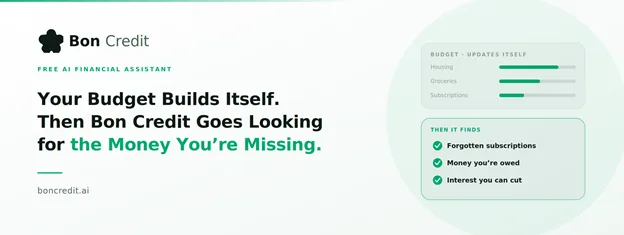
A free budgeting app that finds money too
Bon Credit is a free budgeting app that builds your budget automatically, tracks every category in real time, and uses AI to surface money you’re missing forgotten subscriptions, recurring charges, and refunds you may be owed. Budgeting is free, and always core to Bon Credit.
For years, the answer to “I want to get better with money” has been the same: download a budgeting app. Track your spending. Put everything in categories. Watch the charts. The trouble was never that budgeting is a bad idea. It’s that the old version of it asked far too much of you manual logging, endless categorizing, a monthly guilt trip delivered as a pie chart and then stopped exactly where the useful part should have begun. You ended up with an accurate picture of money that had already left.
Bon Credit takes a different path. The budget builds and updates itself from your connected accounts, so the categorizing is handled. That’s the starting line, not the finish. What happens next is the part conventional tools were never designed to do: the app actively hunts for money you’re losing, uncovers money you’re owed, and shows you how to keep more of what you earn then tells you exactly what to do about each one.
The budget is the easy part. Do it automatically.
A budget’s job is to give you an accurate picture. That’s genuinely useful you can’t fix what you can’t see. But building the picture by hand is tedious work that most people abandon within a few weeks, which is why so many budgeting apps have enthusiastic downloads and quiet churn. So the app removes that work. Connected to your accounts with read-only access, it assembles and maintains the budget in the background and tracks every category in real time, with calculators available when you want to model a specific decision. You don’t graduate from budgeting to something better; the budgeting simply stops being a chore you have to perform. It stays free, and it stays central.
What happens after the budget is built
Here is the gap in most personal finance software. It records what already happened the coffees, the bills, the impulse buys organizes it neatly, and hands the file back to you. You still have to notice the problems, work out what to do, and act. The app watches; you do the heavy lifting.
An accurate budget makes a much better starting point than most people realize, because a system that already knows every recurring charge, every fee, and every interest cost is in a position to do something about them. The work of spotting opportunities shifts from you to the AI.
The money quietly leaking out
Most people are losing money every month and have no idea. A budget might show a charge sitting in your “subscriptions” category but the category alone won’t tell you that you forgot about it, that it’s a duplicate, or that it’s a fee you never agreed to.
Bon Credit scans for exactly these leaks: forgotten and unwanted subscriptions, duplicate and hidden fees, recurring charges you no longer use, and high credit-card interest quietly draining your accounts. Small, easy to miss, and adding up steadily over a year. Instead of filing them under a label, it brings them to your attention so you can stop them.
The money you’re owed and never claimed
This is the part no amount of categorizing can reach: money that isn’t in your accounts yet. Unclaimed property held by state agencies, refunds never collected, class-action settlements you qualify for, tax credits, employer benefits, and government programs you may be eligible for.
People leave this money unclaimed for years, not out of carelessness but because tracking it down has always been confusing and tedious. A budget can only work with money already moving through your accounts. Bon Credit goes looking for the money that isn’t there yet and points you toward how to claim it.
The interest working against you
A budgeting tool can show you that you carry a credit-card balance. What it typically won’t do is help you pay less for it. Credit-card interest is one of the most persistent drains in personal finance, working against you every month whether or not you’re watching.
The app helps you see what that interest is actually costing and understand your options for reducing it. It also opens up your credit more broadly your score, your utilization, your approval odds and shows you the next best move to strengthen it over time. Across a year, even a modest reduction in interest paid is money that stops leaking and starts working for you.
From insight to action
The throughline is action. Most tools hand you information and leave the rest to you. Bon Credit pairs everything it finds with what to do about it, organized around three outcomes people actually want: save money, get money, build credit.
That’s the whole point. Financial insight that just sits there rarely changes anything.
Built on trust, and free by design
None of this works unless you can trust the tool with your accounts, so the product was built around security and control from the start. Connections are read-only and protected with bank-level security. It never moves or spends your money it surfaces what it finds and leaves every decision to you.
Budgeting is free, with no subscription required, and seeing what the app finds costs nothing to start. That’s deliberate. The people who most need help finding and keeping money are often the least able to pay for financial advice, and a free tool reaches the people it’s meant to serve.
Built by people who know the system
The company was founded by Samder Khangarot, CEO and co-founder, and Darwin Tu, co-founder and a 30-year veteran of the credit and FICO industry. It’s backed by a $3.5 million seed round led by VenturesLab, funding a mission to make money-finding technology free and accessible to as many people as possible. Bon Credit is a product and registered DBA of Bhim Digital, Inc. That background matters: the systems that determine your credit and quietly shape your financial options are complex and opaque by default. The product exists to make them work for you instead of around you.
The bottom line
Budgeting isn’t the problem. Budgeting that ends at a chart is.
When the budget builds itself and the app keeps working after it’s built recovering forgotten charges, surfacing money you’re owed, and cutting the interest holding you back tracking your money turns into getting more of it. It’s available today on the Apple App Store and Google Play. Connect your accounts, see what turns up, and decide what to act on. The money you’ve been losing may be easier to get back than you think.