Your Guide to Meeting Ground Rules That Reclaim Team Time
Your Guide to Meeting Ground Rules That Reclaim Team Time
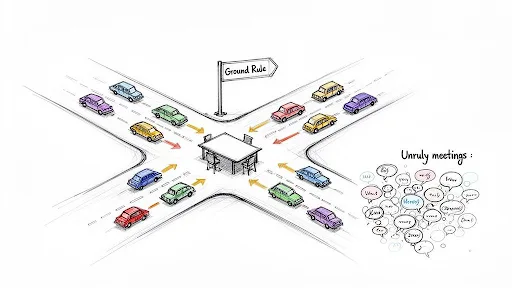
Imagine you are driving through a busy city without any traffic signs or lane markings. Every driver makes their own rules, and chaos ensues. That is exactly how most business meetings feel today — a free-flowing stream of words, where every turn is risky, and the final destination often remains invisible. Meeting ground rules are not administrative red tape; they are the road signs and lane dividers that help your team reach their goals without conversational collisions.
The Hidden Drain of Disorganised Gatherings
We have all endured those endless video calls with no apparent purpose, slowly sucking the life out of our workday. This is not just a subjective feeling; it is a measurable phenomenon. Numerous studies have quantified the damage, but one recent analysis of over 10,000 meetings stands out. It found that a staggering 57% of all meetings occur without any formal agenda.
Moving from Verbal Anarchy to Structured Dialogue
Implementing a set of meeting agreements is not about adding more bureaucracy to your calendar. It is about reclaiming control over your time and your team’s mental energy. Many groups become trapped in cycles of confusion and inaction because they lack fundamental communication guidelines. The right set of rules can break these patterns and turn frustrating habits into productive rituals.
If you are unsure where to begin, I have compiled the table below. It matches common meeting frustrations with a simple, actionable agreement that you can introduce immediately.
From Disorder to Direction: Your First Meeting Agreements
| Common Meeting Problem | Effective Agreement Solution |
| Discussions constantly veer off-topic. | The “Idea Backlog” Rule: Acknowledge great but irrelevant ideas by “backlogging” them in a shared document to discuss later. |
| The same two or three people dominate every conversation. | The “Speak, Then Pause” Rule: Encourage participants to let three others speak before they contribute again, ensuring balanced airtime. |
| Meetings run over time without reaching a resolution. | The “Fixed Finish” Rule: Agree to end the meeting exactly at the scheduled time, forcing the group to be concise. |
| Attendees are disengaged and multitasking. | The “Engage or Excuse” Rule: Set clear expectations for focus by asking everyone to minimise distractions. |
Even adopting just one of these can make an immediate difference, turning your team’s most dreaded meetings into their most productive ones.
Why Your Team Needs a Structured Framework
So far, we have defined what a meeting agreement is. But what is the real-world impact of actually using them? The truth is, unstructured meetings are not just a minor annoyance; they are a massive drain on your company’s most precious resources: time, money, and employee engagement. The financial damage is particularly shocking.
Poorly run meetings cost the US economy an eye-watering $532 billion every single year. Consider this: employees spend around 35 hours per month in meetings but feel productive in less than half of that time.
Building Psychological Safety and Participation
When meetings become free-for-alls, they are usually hijacked by the loudest individuals in the room. This leaves quieter, more reflective team members on the sidelines, their ideas unheard and unvalued. That is a surefire way to kill innovation and cultivate a culture where no one feels safe giving honest feedback. Rules that encourage balanced participation level the playing field, giving everyone a clear opportunity to share their perspective without having to shout over someone else. When your team members feel genuinely secure, they are far more likely to get involved, challenge ideas in a healthy way, and bring their best thinking to every discussion. The result? Sharper decisions and a much more connected, cohesive team.
Driving Efficiency and Strategic Alignment
Even basic rules — like always having an agenda or assigning action items before anyone leaves — create instant accountability. They give every meeting a clear purpose and ensure that talk transforms into action. It turns meetings from something everyone dreads into a powerful engine for getting things done, keeping people engaged, and boosting the overall health of your team.
Ten Essential Meeting Agreements to Implement Today
Below are ten of the most effective ground rules I have seen work time and again. Do not try to implement them all at once. Just pick two or three that address your team’s biggest frustrations and start there.
Rules for Focus and Efficiency
These agreements are all about keeping your meetings sharp, punctual, and purposeful. They act as guardrails, preventing conversations from spiralling and ensuring you actually accomplish what you set out to do.
- The “No Agenda, No Attendance” Rule
This is arguably the most powerful meeting agreement of all. If a meeting invitation lands in your inbox without a clear agenda and stated goals, you have permission to decline it. It is a simple policy that holds meeting organisers accountable for defining a purpose from the very start. - The “Idea Backlog” Rule
What happens when someone brings up a brilliant but totally unrelated idea? Instead of letting it derail the meeting, you “backlog” it. Acknowledge the idea, jot it down on a whiteboard or in a shared document, and promise to revisit it later. This validates the contribution without killing the momentum of the current discussion. - The “Time Check” Rule
We have all been in meetings where a topic gets talked to death. This rule gives everyone a polite, blame-free way to get things moving again. When a discussion starts going in circles, anyone can simply say “Time check,” and it becomes the facilitator’s cue to move to the next agenda item. - The “Fixed Finish” Rule
The meeting ends when it is scheduled to end. Period. Committing to a fixed finish forces everyone to be more concise and pushes the group toward decisions. It is amazing how quickly people get to the point when they know the clock is ticking. Key insight: A well-defined meeting agreement is not restrictive; it is liberating.
Rules for Participation and Accountability
These guidelines are designed to ensure that every voice is heard and that conversations actually lead to concrete results. They are about building a safe environment where talk turns into action.
- The “Engage or Excuse” Rule
This is a call for genuine engagement. It means laptops are for note-taking only, phones are put away, and everyone is focused on the conversation at hand. If someone cannot be fully present, it is better for them (and the team) if they skip the meeting. - The “Challenge the Idea, Not the Person” Rule
Healthy debate is a good thing, but it can quickly turn sour. This rule establishes a critical boundary: focus critiques on ideas, processes, and problems — never on the people who proposed them. This is fundamental to creating psychological safety. - The “Speak, Then Pause” Rule
In many meetings, 20% of the people do 80% of the talking. This rule helps balance the scales. After you speak, wait for at least three other people to contribute before you jump back in. It is a simple way to create space for quieter, more introverted team members. - The “Close with Action” Rule
A meeting is not over until you know what happens next. This rule ensures every meeting concludes with a clear list of tasks, each assigned to a specific owner with a firm deadline. It is the bridge between discussion and progress. - The “Yes, And…” Rule
The word “but” can be a real idea-killer. Instead, encourage your team to adopt a “Yes, and…” mindset. This improv-inspired technique forces you to find value in someone’s point and build upon it, which is incredibly powerful during brainstorming sessions. - The “Confidentiality First” Rule
What is said in the meeting stays in the meeting. This is essential for building trust, especially when discussing sensitive topics. It creates a confidential container where people feel safe enough to be truly candid without worrying that their words will be misquoted later.
If “people talk over each other” is a major theme, the solution is a simple rule: “one speaker at a time.”
If “meetings drag on forever” is the biggest complaint, you can introduce a “Fixed Finish” rule.
How to Create and Implement Your Team’s Agreements
Enforcement stops being an awkward confrontation and becomes a shared responsibility. By working together on rules like “keep all standard meetings under 30 minutes,” teams can start chipping away at that number and fight back against meeting fatigue.
Start with a Collaborative Workshop
So, where do you begin? The best way I have found to get genuine buy-in is to run a dedicated workshop to build your rules from the ground up. First, you need to diagnose the pain. Before you call it a day, make sure everyone agrees on the rules and, just as importantly, understands why they exist.
Gently Enforce the Rules with Simple Scripts
With your new rules in place, the real work begins: consistent, gentle enforcement. This is not about policing your colleagues. It is about nudging everyone back to the agreement you all made.
How Technology Reinforces Your Meeting Agreements
Modern AI-powered tools, such as meeting assistants, bridge that gap, turning your team’s commitments from a dusty document into an active, automated part of how you operate.
Automate Accountability for Key Rules
AI-generated summaries and transcripts let you see at a glance if a meeting actually stuck to its purpose. A quick scan will tell you whether the conversation stayed on topic or drifted off into the weeds, giving you concrete evidence for improving the next meeting.
This one feature ensures nothing gets lost in the shuffle and makes follow-up a breeze. Your team gets a shareable list of commitments right after the call.
A Neutral Source of Truth
The summary gives an impartial overview that is perfect for sharing with stakeholders who could not attend.
Gentle, In-the-Moment Reminders
When it is not just the leader enforcing the rules, it reinforces the idea that this is a collective effort to protect everyone’s focus.
How HypeScribe Powers Your Meeting Ground Rules
(Note: if you prefer, replace “HypeScribe” with “your preferred AI meeting tool” – I kept it as per original but you can change.)
Coming up with a solid meeting agreement is a great start. But enforcing those rules consistently is where most teams stumble. This is where the theory meets reality. HypeScribe bridges that gap, turning your team’s agreements from a dusty document into an active, automated part of how you work.
Accountability becomes effortless. Instead of relying on memory, HypeScribe gives you an objective source of truth. This data-first approach takes the awkwardness out of holding people accountable and helps transform good intentions into solid habits.
Automate Accountability for Key Rules
Let’s dig into how HypeScribe’s features directly back up some of the most common and effective ground rules. Think of it as a neutral referee, making sure everyone plays by the rules you all agreed to.
A fantastic example is the “No Agenda, No Attendance” rule. HypeScribe’s AI-generated summaries and transcripts let you see at a glance if a meeting actually stuck to its purpose. A quick scan will tell you whether the conversation stayed on topic or drifted off into the weeds, giving you concrete evidence for making the next meeting better.
Then you have the “Close with Action” rule, which is absolutely critical for turning conversations into progress. HypeScribe is brilliant at this. It automatically pinpoints, pulls out, and neatly organises every single action item discussed. It captures the task itself, who owns it, and any deadlines mentioned, completely eliminating post-meeting confusion.
Your team gets a shareable list of commitments right after the call, fostering a real culture of ownership without any extra admin work.
HypeScribe Features That Power Your Ground Rules (table)
| Meeting Ground Rule | Supporting HypeScribe Feature | How It Works |
| No Agenda, No Attendance | AI Summaries & Transcripts | Provides a searchable record to verify if the meeting stayed on its planned agenda. |
| Every Decision is Documented | Smart Summaries & Decision Tracking | Automatically extracts key decisions, creating an official record to prevent rehashing topics. |
| Close with Action | Automated Action Item Extraction | Identifies tasks, owners, and deadlines mentioned during the meeting and lists them clearly. |
| Engage or Excuse | Full Meeting Transcript | Allows attendees to fully engage, knowing they can catch up on any details later without missing a thing. |
By connecting your rules to these features, you are not just hoping for better meetings — you are building a system for them.
Create an Objective Record of Every Conversation
So many disagreements at work boil down to who remembers what. HypeScribe ends this by acting as a perfect, unbiased memory for every single meeting. The searchable transcript becomes the definitive record of who said what, stopping debates before they even start.
The smart summaries are especially useful here. They take a long, winding conversation and boil it down to the essential bullet points, capturing the core of the discussion and the final outcomes.
When you integrate an AI meeting note taker, you are doing more than just recording meetings. You are weaving your ground rules directly into your team’s operational rhythm, making it the easiest way to ensure your rules are truly lived, not just laminated.
Common Questions About Meeting Ground Rules
So, you are ready to introduce meeting ground rules. That is a huge step. But as soon as you float the idea, you can almost hear the collective groan. It is natural for people to be a little sceptical. Teams often worry that “rules” will just add another layer of bureaucracy or create unnecessary friction.
Let us walk through some of the most common questions and pushback I hear from teams. Getting ahead of these concerns is how you get the buy-in you need for these new habits to actually stick.
What If My Team Thinks Rules Are Too Rigid?
This is probably the biggest hurdle. No one wants to feel like their meetings are a stuffy, formal affair. The trick is to change the framing.
Don’t call them “rules.” That word alone can make people defensive. Instead, try calling them “team agreements” or “our commitments.” This small shift in language makes it clear that this is a collaborative effort, not a top-down mandate.
These agreements are not there to stifle conversation; they are designed to protect it. By having a clear, agreed-upon structure, everyone can stop worrying about the mechanics of the meeting and focus their energy on the actual discussion. It frees up a surprising amount of mental space.
The best way to prove this is to start small. Pick one or two agreements that solve a really obvious pain point. Are people constantly talking over each other? Start with a “one speaker at a time” rule. You will get a quick, tangible win that shows everyone how valuable this can be.
How Do We Handle Someone Who Consistently Breaks the Rules?
It is bound to happen. One person repeatedly ignoring an agreement can derail the whole system. The key is not to call them out publicly but to use a subtle, escalating approach that reminds everyone it is a shared responsibility.
- Gentle in-the-moment reminder: The facilitator says, “Just a quick reminder of our ‘one speaker at a time’ agreement.”
- Private conversation: If it persists, pull them aside and ask, “I’ve noticed we’ve had to redirect a few times – is everything okay? Just want to make sure these agreements work for everyone.”
- Team reinforcement: Encourage peers to gently uphold the rules, reinforcing that it is a collective effort.
How Many Ground Rules Should We Actually Have?
When you are just getting started, think “less is more.” A laundry list of ten rules is impossible to remember and will just get ignored.
Based on my experience, I always recommend starting with 3-5 core rules. Focus them on the biggest frustrations your team has right now. These are the ones that will deliver the most immediate relief and impact.
And remember, these agreements are not set in stone. Think of them as a living document. As your team’s dynamics change and you solve old problems, you can always revisit and adapt your agreements to meet new challenges.
How Can We Measure if Our Ground Rules Are Working?
You will probably feel a difference, but you cannot take feelings to your leadership team. To really know if your rules are making an impact, you need to look at some simple data.
Start by tracking some basic metrics. Is your average meeting length going down? What percentage of meetings now end with clear, documented action items? You can even send out quick, anonymous pulse surveys to ask the team how effective they feel the meetings have become.
This is where a tool like HypeScribe can be a game-changer. The transcripts and summaries it generates give you an objective record of every meeting. You can easily see if agendas were followed, track how many decisions were made, and confirm if action items were assigned. This data-driven feedback loop helps you prove the value of your ground rules and shows you exactly where you can fine-tune them over time.
Final Thoughts: From Paper to Practice
Meeting ground rules are not about adding bureaucracy — they are about reclaiming your team’s most valuable resources: time, energy, and creativity. When everyone knows the “rules of the road,” discussions become focused, inclusive, and decisive. And with the right technology, those rules become second nature, not just a poster on the wall.
Start today. Pick two or three rules that address your team’s biggest frustrations, co-create them with your colleagues, and watch your meetings transform from time-wasters into engines of productivity.
Ready to turn your meeting rules from abstract ideas into automated habits? HypeScribe provides the AI-powered transcripts, summaries, and action item tracking you need to make every meeting productive. Start enforcing your ground rules effortlessly and get your free trial at.