Your Outdoor Wi-Fi Doesn’t Have a Signal Problem It Has a Water Problem
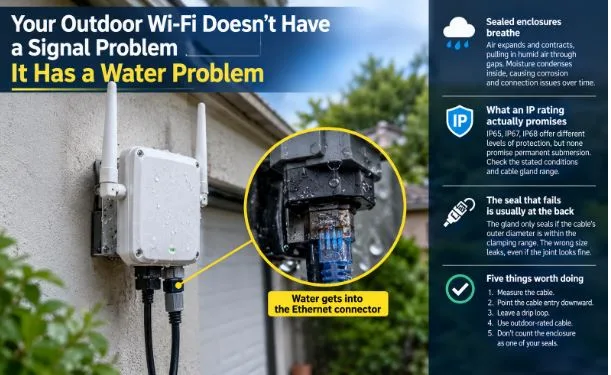
| An access point on the garage wall works perfectly for four months. Then it starts dropping out in the evenings. Then it drops out all day. You reboot it, reflash the firmware, move it half a metre along the wall, and eventually replace it. The replacement dies the following spring.
The radio was fine both times. Water got into the Ethernet connector. Sealed enclosures breatheOutdoor housings are not sealed the way a bottle is sealed. Air inside expands when the sun hits the case and contracts when the temperature drops after sunset. Every cycle moves a small volume of air through whatever gap exists — the cable entry, an unsealed connector shell, a screw boss. When the outside air is humid, that moisture condenses on the coldest metal inside, which is usually the contact block behind the RJ45 jack. This is why the failure is gradual rather than dramatic. Corrosion accumulates over months. The link negotiates down from gigabit to 100 Mbps, then starts flapping, then stops. Self-amalgamating tape wrapped around the joint slows liquid water down. It does nothing about a pressure differential pumping damp air in and out twice a day. What an IP rating actually promisesIP codes are defined in IEC 60529, and the second digit is the one people misread. IP65 means protection against water jets from any direction — adequate for a box mounted under an eave. IP67 means the part survives immersion in one metre of water for 30 minutes. IP68 means immersion beyond IP67, at a depth and duration the manufacturer specifies. There is no universal IP68; the number means nothing without the stated conditions attached to it. Note what none of them promise: permanent submersion. IP67 describes a half-hour test. A connector sitting in a conduit that pools water after every storm is operating outside the conditions it was certified under, and the rating printed on the box says nothing useful about how long it will last there. The seal that fails is usually the one at the backA waterproof RJ45 assembly seals in two independent places. The mating interface between plug and socket is sealed by an O-ring, and that is the part everyone thinks about. The second seal is where the cable leaves the back of the plug, where a compression gland squeezes a rubber insert around the cable jacket. That second seal only closes if the cable’s outer diameter falls inside the gland’s clamping range. Glands are specified for a span, not a single size — a mid-size body might accept 3 to 25 mm, a large one 53 to 130 mm. Push a 4 mm cable through a gland whose range starts at 5 mm and the insert never fully compresses. The assembly torques down normally. It looks finished. It leaks. Nothing about the completed joint reveals the fault, which is why it survives installation day and reappears as an intermittent link three months later. So the number worth checking on a datasheet is not the IP code. It is the clamping range. Manufacturers that take sealing seriously publish it per shell size — Verchil, a China-based connector manufacturer, lists cable acceptance ranges in millimetres alongside the IP rating for each body, which lets you match a part to the cable you already have rather than to the one in the catalogue photograph. Five things worth doingMeasure the cable. Jacket diameters vary between manufacturers for the same nominal cable type. A caliper costs less than the access point. Point the cable entry downward. Gravity is free, and it keeps standing water off the gland face. Leave a drip loop below the entry, so water running along the jacket falls off before it reaches the connector. Use outdoor-rated cable with a UV-stable jacket. Indoor PVC goes chalky and cracks after two summers of direct sun, and once the jacket splits the gland has nothing left to grip. Don’t count the enclosure as one of your seals. Treat every cable entry as a separate thing that has to be right on its own. The connector costs a few dollars. The equipment behind it costs a few hundred. Most outdoor networking failures come down to the cheap end of that ratio being chosen without anyone reading a single number off a table. |