Your Stretch Fabric Wall Is Competing With Everything Around It
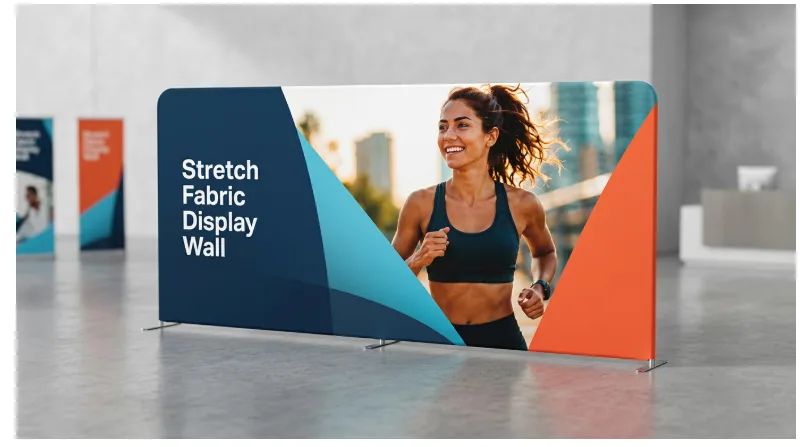
Stand at the entrance of any exhibition hall and the problem becomes obvious within about ten seconds. Every exhibitor has invested in their space. Every backdrop is lit, every logo is oversized, and every colour scheme fights for the same slice of a visitor’s attention. A stretch fabric wall that looked bold and unmissable in a design file has to hold its own against exactly that environment — not against a calm, empty room, but against a corridor of competing stands all making the same bid for eye contact.
This is the part that gets skipped in most planning conversations. Teams brief the artwork, choose a size, order the print, and assume the wall will do its job simply by existing. In practice, a fabric exhibition wall only works if it’s been built to win a specific kind of visual contest — one where lighting, footfall, sightlines and neighbouring stands all have a vote in how it’s actually seen.
Why the Venue Decides More Than the Design Does
A stand that reads perfectly on a laptop screen, in a quiet office, under even lighting, is being judged under conditions that rarely exist at the actual event. Hall lighting is often warmer or cooler than expected. Aisles are narrower than the floor plan suggested. A neighbouring exhibitor’s screen or banner may sit directly in a visitor’s eyeline before they ever reach yours. None of this means the wall is designed badly — it usually means it was designed for the wrong room.
This is where a tension fabric wall genuinely earns its reputation as one of the more forgiving formats. The seamless, wrinkle-resistant panel keeps colour and detail consistent across a large surface, which matters more at a distance than most exhibitors expect. But the format doing its job and the design doing its job are two separate questions, and both need answering before a wall goes to print.
What a Stretch Fabric Wall Actually Is
A stretch fabric wall is a portable exhibition backdrop built from a lightweight aluminium frame with a printed, tensioned fabric skin fitted over it. The fabric is cut and sewn to the exact frame dimensions, then stretched into place so the finished surface sits flat and taut, without the visible seams or sagging that can affect older banner-style backdrops.
Construction and Frame Options
Most systems use interlocking aluminium tube sections, which means a single wall can be built as a straight backdrop, a curved sweep, or an angled configuration depending on the stand layout. This flexibility is one of the format’s genuine advantages over a fixed-panel backdrop — the same frame components can often be reconfigured for a different stand shape at a future event, which changes the economics of the purchase over time.
Fabric and Print Finish
The printed fabric itself is typically a polyester-based material chosen for its ability to hold tension without distorting the image. Because the surface is stretched rather than laid flat, artwork needs to be prepared with that stretch in mind — a point worth flagging early, since it affects how a design brief should be written, not just how it’s printed.
Choosing the Right Format for the Space
Not every stand needs the same wall. A shell-scheme booth at a regional trade show, a product launch inside a retail unit, and a keynote backdrop at a conference are three different visual jobs, even though all three might reasonably use a stretch fabric wall for exhibitions.
| Wall Format | Typical Best Fit | Key Consideration |
| Straight single-panel wall | Shell-scheme booths, small trade stands | Simplest to transport and rebuild; works well against a flat back wall |
| Curved sweep wall | Open-plan exhibition spaces, retail activations | Draws the eye from an angle, useful where visitors approach from the side |
| Angled or multi-panel configuration | Larger stands, product launches, corporate events | Creates a more immersive backdrop, but needs a longer build and pack-down window |
These are illustrative starting points rather than fixed rules — the right configuration depends on the actual stand dimensions, footfall direction, and how much build time is realistically available on site.
Stretch Fabric Wall or a Sibling Display Format?
A stretch fabric wall isn’t the only route to a large-format printed backdrop, and it isn’t always the right one. Two formats come up most often as alternatives worth weighing before ordering.
A stretch fabric display stand sits closer to a compact, single-unit version of the same tensioned-fabric principle — better suited to a smaller footprint or a stand that needs to travel more frequently, where a full wall system would be more frame than the space can justify. An SEG Fabric Display, by contrast, uses a silicone-edge graphic fitted into a channel frame, which tends to suit indoor retail and reception settings where the wall stays in one place for longer and the emphasis is on a clean, edge-to-edge finish rather than portability between multiple events.
The practical question usually isn’t which format is better in the abstract — it’s how often the wall moves, how much build time is available at each venue, and whether the stand needs to be reshaped between bookings.
Designing for the Room You’ll Actually Be In
Artwork for a fabric exhibition wall behaves differently once it’s mounted at full scale and viewed from several metres away, under hall lighting that rarely matches a design screen. A logo that looks perfectly weighted at your desk can feel thin and washed out when it competes with a neighbouring stand’s LED screen.
Design for the Weakest Lighting Condition, Not the Best One
It’s worth judging colour contrast and text weight against the dimmest, most crowded version of the event you can reasonably expect, rather than the well-lit product photo used in the sales brochure. A wall that still reads clearly under flat, artificial hall lighting will comfortably outperform in better conditions too — the reverse isn’t guaranteed.
Keep Critical Information Above the Sightline Clutter
Visitor height, passing traffic, and nearby furniture can all obscure the lower third of a wall at busy events. Placing the logo, key message and any call to action in the upper two-thirds of the panel gives them a better chance of staying visible once the floor fills up.
Making the Buying Decision
Once the format and design direction are settled, the ordering decision usually comes down to a short sequence of practical questions rather than a long specification list:
- Confirm the exact stand footprint and any height restriction set by the venue or shell-scheme provider.
- Decide whether the wall needs to be reconfigured for different events, which affects whether a modular frame is worth the extra investment.
- Check how much build and pack-down time is genuinely available on site, since more complex configurations take longer to assemble.
- Establish who is handling transport, since frame weight and case size vary meaningfully between straight and curved systems.
- Confirm artwork is prepared against the actual panel dimensions, with allowance made for the stretch across the finished surface.
Where a Stretch Fabric Wall Isn’t the Right Fit
Honesty about the format’s limits is worth more than a one-sided sales pitch. This is where the I YOU PRINT team tends to be upfront with exhibitors: a stretch fabric wall is a strong choice for a semi-permanent or repeat-use stand presence, but it isn’t always the most practical option for a single-day pop-up in a very tight space, where a lighter roller banner or poster display may be quicker to deploy and easier for one person to manage alone. It’s also not the natural choice where a permanent, fixed installation is genuinely being planned, since a mounted SEG display or built shopfront signage is generally the better long-term investment in that scenario.
Common Mistakes That Undermine an Otherwise Good Wall
A handful of avoidable errors turn up repeatedly across exhibition stands, regardless of budget:
- Designers often create artwork at screen resolution without checking it at true viewing distance, causing fine detail to disappear once the panel is printed at full scale.
- Underestimating pack-down time, which leaves a rushed, uneven fit at the next venue.
- Placing key messaging too low on the panel means it gets lost behind passing visitors and stand furniture.
Print Quality, Turnaround and UK Delivery
Print consistency across a large fabric surface depends on colour management being handled properly at the pre-press stage, not just on the printer itself — this is where artwork proofing genuinely earns its place in the process rather than being treated as a formality. Turnaround times for a printed stretch fabric wall vary depending on panel size and configuration complexity, so it’s worth confirming a realistic production and delivery window against your event date well in advance, particularly for multi-panel or curved builds destined for venues across the UK.
Ready to Order Your Stretch Fabric Wall?
If your next stand needs a backdrop built for the room it’s actually going into, not just the screen it was designed on, browse the Stretch Fabric Walls range at I YOU PRINT or get in touch with the team to talk through sizing and configuration before you order.