Private Label vs. White Label: Choosing the Right Model for Your Brand
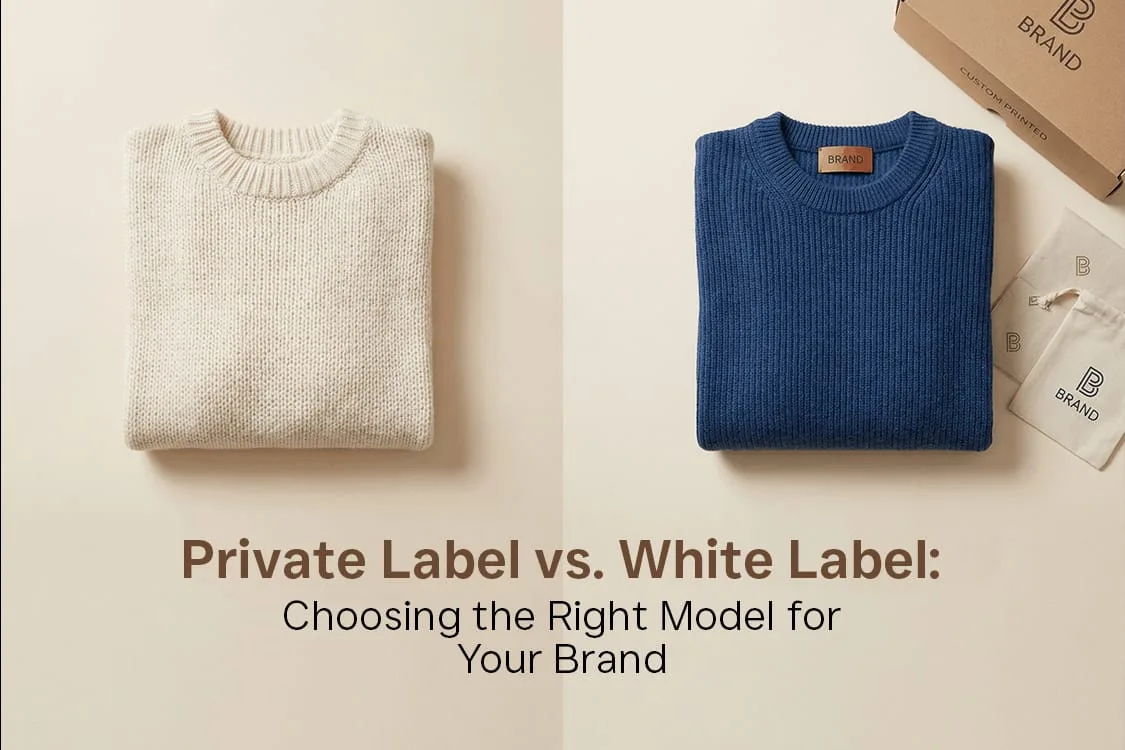
Choosing how your apparel is manufactured is one of the most important decisions you’ll make as a fashion business owner. Private label vs. white label can impact your brand identity, pricing, time to market, and long-term growth—whether you’re launching a new brand or scaling an established one.
Many fashion businesses utilize both approaches, especially when partnering with B2B clothing suppliers. Each model serves the business differently. Understanding the differences enables you to choose a strategy that’s more sustainable and effective for long-term success.
What Is White Label Apparel?
White label apparel refers to pre-manufactured garments produced by one company and sold to multiple brands under their respective names. These products are unbranded or minimally customizable, allowing brands to add their own labels, branding, and packaging.
Key characteristics of white-label apparel:
- Pre-designed and manufactured products.
- Shorter production and delivery timelines.
- Lower costs for sampling and development.
- Limited customization options.
- Same products may be sold under multiple brand names.
White label is commonly used by startups, e-commerce brands, and businesses testing new product categories.
What Is Private Label Apparel?
Private label apparel refers to garments manufactured exclusively for one brand. The brand controls the design, materials, fit, and overall product direction, while production is handled by a third-party manufacturer.
Key characteristics of private label apparel:
- Designs exclusive to the brand.
- Greater control over design, fit, and fabric selection.
- Requires custom development and sampling.
- Higher upfront investment.
- Stronger brand differentiation.
Private labels are often chosen by brands that want to stay in one place for a long time.
Private Label vs. White Label
Here are the differences:
| Aspect | Private Label | White Label |
| Product Design | Custom-designed exclusively for one brand | Pre-designed products shared across brands |
| Brand Control | Full control over design, fabric, fit, and detailing | Limited to logo, label, and packaging |
| Exclusivity | High-end products are unique to your brand | Low-endproduct may be sold to competitors |
| Time to Market | Longer due to design and sampling stages | Very fast, products are already available |
| Upfront Investment | Higher initial cost | Lower initial cost |
| Customization Level | Extensive customization possible | Minimal customization |
| Risk Level | Higher risk due to development and inventory | Lower risk, easier to test demand |
| Scalability | Scales well with long-term planning | Scales quickly but with limited differentiation |
Key Fashion Business Planning Tips Before Choosing
Before you pick a plan, take a good look at these fashion business planning tips:
Look at this:
- Who would you like to buy from?
- Is speed more important to you than being different in the market?
- What’s your budget to set up your brand?
- What are the risk factors involved?
- Do you want to scale up or have controlled growth?
Brands that skip this evaluation often face challenges later with rebranding or restructuring operations.
Role of B2B Clothing Suppliers in Both Models
Business-to-business clothing providers are very important for the success of both private label and white label brands.
Here are some of their responsibilities:
- Sourcing materials and managing production.
- Ensuring quality control and regulatory compliance.
- Providing access to fabrics and scalable manufacturing capacity.
- Managing production timelines efficiently.
- Supporting brands with documentation and certifications.
A reliable supplier helps brands mitigate risks related to delays, quality issues, and compliance challenges, regardless of which model they choose.
A trustworthy supplier keeps brands from having to deal with delays, poor quality, and compliance risks, no matter what plan they choose.
Conclusion
The choice between private label and white label significantly impacts how your fashion brand grows, competes, and is perceived in the market. White label offers speed, lower risk, and ease of entry—ideal for new brands or businesses testing market demand. Private label provides greater control, stronger differentiation, and builds long-term brand equity.
There is no single right answer. Your choice should be based on your brand’s strategy, budget, timeline, and growth objectives. By carefully evaluating these factors and partnering with reliable B2B clothing suppliers, brands can select a model that aligns with both their immediate needs and long-term vision.
Successful fashion companies maintain clarity on their objectives and ensure their production strategy aligns with those goals from the outset.
FAQs
- What is the main difference between blue label and white label when it comes to clothes?
Patterns for white label clothes have already been made and are sold to many brands. When clothes are made under a private label, they are only made for one brand, giving them exclusivity over the design and materials.
- Which approach is better for a new apparel brand? White label is better suited for new brands because it has lower start-up costs, faster production, and less risk. Many brands start with this model to understand market dynamics. Which label is more profitable?
In the long run, private label can be more successful because you can set the price and make the product your own. However, it takes more planning and money up front.
- Can a brand switch back from white label to private label?
Yes. Brands often start with white label and move on to private label as sales, cash flow, and recognition of the brand rise.
- If you sell clothes to businesses, do you offer both private label and white label?
Some of the biggest names in business-to-business clothing sell both types and help brands choose which one to use or switch to based on their growth stage.