How Do Perimeter LED Displays Revolutionize Traffic Management?
Every morning, millions of drivers sit trapped in gridlock, while outdated road signs offer nothing more than static, unhelpful messages. City planners and traffic authorities face a relentless challenge: how do you communicate critical, ever-changing information to thousands of moving vehicles simultaneously? Traditional signage simply cannot keep pace with the complexity of modern urban traffic.
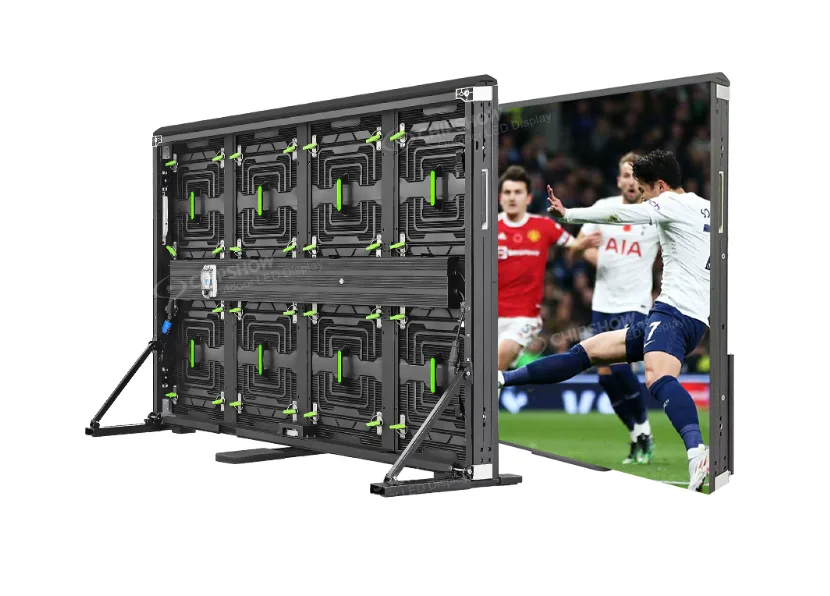
Perimeter LED displays are changing that reality. These high-brightness, programmable digital screens are strategically positioned along roadways, intersections, and urban boundaries to deliver real-time traffic information directly to drivers when and where it matters most. Unlike fixed signs, they adapt instantly to shifting conditions, making them an indispensable tool for contemporary traffic management.
This article explores how perimeter LED displays are revolutionizing the way traffic authorities operate. From their multi-use display capabilities that consolidate multiple communication needs into a single infrastructure, to their wide-view technology that ensures visibility across lanes and distances, these systems represent a fundamental shift in urban mobility management. We’ll also examine how they power Variable Message Signs (VMS), and provide a practical roadmap for traffic authorities looking to implement these solutions effectively.
Understanding Perimeter LED Displays and Their Traffic Management Role
Perimeter LED displays are large-format digital screens mounted along roadway boundaries, urban entry points, intersections, and highway corridors. At their core, these systems consist of high-brightness LED modules arranged in a grid, driven by a controller that receives data feeds and renders text, graphics, or animated content in real time. Weatherproof enclosures, robust mounting hardware, and remote management interfaces complete the package, making each unit a self-contained communication node within a broader traffic network.
The journey from static roadside signage to the modern perimeter LED display reflects decades of incremental innovation. Early traffic signs were purely passive—painted metal offering a single, unchangeable message regardless of conditions. The introduction of electromechanical changeable message boards in the 1970s and 1980s marked a first step toward flexibility, but those systems were slow, mechanically fragile, and limited in what they could express. LED technology broke those constraints entirely, delivering screens capable of updating content in milliseconds, displaying full-color graphics, and operating reliably across extreme temperature ranges.
For modern traffic systems, a perimeter LED display is not merely a convenience—it is critical infrastructure. Urban environments generate continuous streams of data: sensor readings from induction loops, camera feeds, weather station outputs, and incident reports from emergency services. A perimeter LED display translates that data into driver-facing guidance precisely when conditions change. Initial applications focused on speed limit enforcement and congestion warnings, but authorities quickly expanded their use to lane control, hazard alerts, and coordinated event management, establishing these displays as foundational elements of responsive, data-driven traffic control.
The Power of Multi-Use Displays in Traffic Information Systems
Traffic authorities have long struggled with a fundamental infrastructure problem: every distinct communication need historically demanded its own dedicated signage. Congestion warnings, emergency detours, amber alerts, and event-day routing all competed for limited roadside real estate. Multi-use LED displays resolve this conflict by consolidating multiple communication functions into a single, programmable unit that shifts purpose on demand. A display showing peak-hour speed advisories in the morning can broadcast a severe weather warning by afternoon and guide spectators away from a stadium by evening—all without any physical intervention.
The versatility of a multi-use display stems from its software-driven content management. Traffic operations centers can pre-program message libraries covering dozens of scenarios—construction detours, AMBER alerts, air quality advisories, public transit disruptions—and trigger the appropriate content automatically or manually within seconds. Emergency services benefit particularly from this capability: when an incident occurs, coordinated messaging across a corridor of displays can redirect thousands of vehicles before congestion compounds the problem. Public event management becomes similarly streamlined, with authorities scheduling display sequences days in advance while retaining override capability for unexpected developments.
Beyond operational flexibility, multi-use displays deliver a compelling infrastructure efficiency argument. A single installation replaces what might otherwise require four or five separate sign structures, reducing capital expenditure, maintenance obligations, and visual clutter along the roadway. Real-time integration amplifies these gains further. When displays connect to traffic management platforms fed by induction loop sensors, CCTV analytics, and weather APIs, content updates automatically as conditions evolve—no operator input required. This scalability means the same architecture that serves a mid-sized city intersection can expand to manage a regional highway network, making multi-use LED displays a future-proof investment for authorities at any scale.
Dynamic Messaging Capabilities and Integration
The practical message types supported by modern perimeter LED displays span a wide operational spectrum. Congestion notifications display travel time estimates to key destinations, helping drivers self-select alternate routes before bottlenecks form. Lane control messages assign or restrict specific lanes in response to incident detection or peak-direction flow management. Weather warnings—black ice, high wind advisories, reduced visibility alerts—can be triggered automatically when roadside weather stations cross defined thresholds. Detour sequences display turn-by-turn guidance across consecutive displays, effectively creating a dynamic wayfinding corridor. Each message type is authored once within the content management system and remains available for instant deployment across any display in the network. Integration with traffic management software such as SCOOT, SCATS, or proprietary ITS platforms allows displays to function as active participants in adaptive signal control strategies rather than passive information boards, creating a genuinely responsive urban traffic ecosystem.
Enhancing Urban Visibility with Wide-View LED Displays
In dense urban corridors where roads curve, intersections multiply, and overhead structures obstruct sightlines, a display that only communicates effectively from a narrow angle is operationally useless to most drivers passing through. Wide-view LED displays address this directly, engineering visibility across horizontal and vertical angles that can exceed 160 degrees, ensuring that a message readable from the center lane is equally legible to a driver in the far left or right lane. For traffic authorities managing multi-lane arterials, elevated interchanges, or complex junction geometries, this wide view capability is not a premium feature—it is a baseline requirement for effective communication.
The technology underpinning wide-view performance centers on LED emitter selection and pixel-level optical engineering. Modern perimeter LED displays use surface-mounted LEDs with carefully calculated viewing cone profiles, paired with diffusion lenses that redistribute light output across a broader arc without sacrificing peak brightness. Manufacturers such as Chipshow LED have developed automatic brightness control systems that read ambient light sensors and adjust luminance dynamically—pushing output to 8,000 nits or beyond in direct sunlight while stepping down to comfortable levels at night, preventing glare that could itself become a safety hazard. The result is a display that maintains consistent contrast and readability whether a driver approaches at noon in full sun or at 2 a.m. in rain-slicked darkness.
The safety benefits of improved visibility translate directly into measurable outcomes. Drivers who receive clear, timely information have more time to make lane changes, reduce speed, or select alternate routes, reducing the abrupt braking events that cascade into rear-end collisions. Studies in managed motorway environments have consistently linked high-visibility dynamic signage to reductions in speed variance between vehicles—a key predictor of crash frequency. Compliance rates with speed advisories and lane control instructions improve when messages are unambiguous and visible from a distance that gives drivers adequate reaction time.
Technology and Design for Optimal Viewing Angles
Achieving reliable wide-view performance across all operating conditions requires attention to several interconnected design elements. High contrast ratios—typically exceeding 5,000:1—ensure that text and symbols remain distinct against both bright and dark backgrounds, preventing the washed-out appearance that undermines legibility in overcast or foggy conditions. Anti-glare coatings on display face panels scatter incident sunlight rather than reflecting it toward approaching drivers, a particularly important consideration for east- and west-facing installations that contend with low-angle morning and evening sun. Adjustable mounting systems allow maintenance crews to fine-tune the vertical tilt angle after installation, compensating for site-specific geometry that may not perfectly match design assumptions. In adverse weather—heavy rain, snow accumulation, dense fog—these design choices compound each other, maintaining a usable wide view even when atmospheric conditions reduce the effective communication window. Traffic safety outcomes in these scenarios depend entirely on whether the display can still deliver its message before a driver is too close to respond safely.
VMS and Traffic LED: Core Technologies for Modern Management
Variable Message Signs have been a cornerstone of highway communication for decades, but the integration of traffic LED technology has fundamentally transformed what VMS can deliver. At its most basic, a VMS is any roadside sign capable of displaying changeable content—but modern LED-based versions bear little resemblance to the fiber-optic or flip-disc predecessors that once dominated the category. Today’s traffic LED displays power VMS installations with pixel-level precision, full programmability, and the kind of operational reliability that critical infrastructure demands. Within intelligent transportation systems, these displays function as the human-facing output layer of a data-rich decision-making network, translating sensor inputs, algorithm outputs, and operator commands into clear driver guidance in real time.
The role of LED technology in elevating VMS performance extends well beyond image quality. Energy consumption drops dramatically compared to older illumination technologies—modern traffic LED panels consume a fraction of the power that fluorescent or halogen-lit changeable signs required, reducing operating costs over the display’s lifetime. Solid-state construction eliminates the mechanical components that made earlier VMS units maintenance-intensive, with LED modules rated for tens of thousands of operating hours before replacement becomes necessary. Within ITS frameworks, LED-based VMS units communicate bidirectionally with traffic management centers, confirming message delivery, reporting hardware status, and flagging faults automatically.
Evolution and Advantages of LED-Based VMS
Traditional VMS technologies—rotating prism signs, fiber-optic matrix boards, and electromechanical flip-disc panels—each carried significant limitations. Update speeds were measured in seconds rather than milliseconds, color options were restricted, and mechanical wear created recurring maintenance demands that strained operational budgets. LED-based VMS eliminates these constraints entirely. Message changes are instantaneous, full-color graphics are standard, and there are no moving parts to fail. Lifespan advantages are equally significant: while mechanical VMS units often required major servicing within five years, quality traffic LED installations routinely operate for a decade or more with minimal intervention. Visibility improvements compound these gains—LED panels achieve the brightness levels and wide viewing angles that older technologies could never match, ensuring that VMS messages reach drivers reliably across all lighting conditions and approach geometries.
Practical Solutions and Implementation Steps for Traffic Authorities
Deploying perimeter LED displays across a traffic network is a substantial undertaking, but authorities that approach it systematically avoid the most common pitfalls—cost overruns, integration failures, and underutilized hardware. The process begins with a thorough needs assessment: mapping high-priority corridors, identifying communication gaps where static signage currently fails, and quantifying the traffic volumes and incident frequencies that justify investment at each candidate location. This assessment should also inventory existing infrastructure—fiber conduit, power supply points, and traffic management software—to understand what the new displays will integrate with rather than replace.
Display selection follows directly from this analysis. Authorities should prioritize multi-use capability and wide-view performance as non-negotiable baseline specifications, since installations that lack either will quickly reveal their limitations in real-world conditions. Weatherproofing ratings, specifically IP65 or higher enclosure standards, should be mandatory for all roadside units. Data security deserves equal attention during procurement: displays connected to central traffic management platforms represent potential network entry points, so encrypted communication protocols and role-based access controls must be specified contractually with vendors.
Installation planning must account for sightline geometry, structural load requirements, and maintenance access—factors that vary significantly between urban intersections and open highway corridors. Staff training should run parallel to deployment rather than following it, ensuring operators are confident managing content libraries and responding to hardware alerts before the system goes live.
Step-by-Step Implementation Guide
A structured four-phase approach keeps complex deployments on track. In the planning phase, conduct site surveys to confirm mounting locations, verify regulatory compliance with local signage codes, and finalize communication architecture—whether cellular, fiber, or hybrid connectivity will link displays to the traffic operations center. The procurement phase involves issuing specifications that explicitly require multi-use display functionality, certified viewing angle performance, and demonstrated ITS integration compatibility, then evaluating vendors against those criteria rather than cost alone. During deployment, installations should proceed corridor by corridor, with each segment tested under live traffic conditions before the next begins—this staged rollout surfaces integration issues early, when they are still manageable. The operational phase establishes ongoing monitoring protocols: automated fault reporting, scheduled brightness calibration checks, and quarterly content library reviews to ensure message sets remain current with evolving traffic patterns and regulatory requirements.
Overcoming Barriers to Adoption
Budget constraints represent the most common obstacle, but several strategies make large-scale deployment financially viable. Federal and regional intelligent transportation system grant programs frequently fund perimeter LED display projects, particularly when proposals demonstrate measurable safety outcomes or emissions reductions through congestion relief. Public-private partnerships offer another avenue, with advertising revenue from non-traffic content during off-peak periods offsetting capital costs—provided content scheduling preserves operational priority for traffic messaging at all times. Technical integration challenges are best addressed by requiring open API compatibility during procurement, ensuring displays can communicate with current and future traffic management platforms without proprietary lock-in. For communities where public acceptance is uncertain, pilot deployments on high-visibility corridors with clearly communicated performance metrics build the evidence base that converts skepticism into support, making subsequent network-wide expansion significantly easier to authorize and fund.
The Future of Perimeter LED Displays in Smart Traffic Management
Perimeter LED displays have moved far beyond novelty infrastructure—they are now foundational to how cities manage movement, communicate urgency, and protect lives on the road. Throughout this article, we’ve seen how their multi-use versatility consolidates multiple communication functions into a single programmable unit, eliminating the redundant signage that once cluttered roadsides while dramatically expanding what authorities can express and when. Wide-view technology ensures those messages reach every driver in every lane, under every lighting condition, with enough advance notice to act safely. And as the backbone of modern VMS networks, traffic LED displays give intelligent transportation systems a reliable, high-performance output layer that older technologies simply could not provide.
The path forward points toward even deeper integration. Smart city platforms are already beginning to feed perimeter LED displays with AI-analyzed traffic patterns, enabling predictive messaging that warns drivers of congestion before it fully forms rather than after. Connected vehicle data will further sharpen this capability, creating feedback loops between individual vehicles and roadside displays that make urban corridors genuinely adaptive. For traffic authorities evaluating where to invest next, perimeter LED displays—supplied by experienced manufacturers like Chipshow LED with deep expertise in large-format outdoor applications—represent one of the clearest opportunities available: proven technology, measurable safety outcomes, and an architecture flexible enough to absorb whatever smart mobility innovations emerge next. The case for adoption has never been stronger.