The AI Credit Revolution: How Machine Learning is Lowering Personal Loan Barriers in 2026
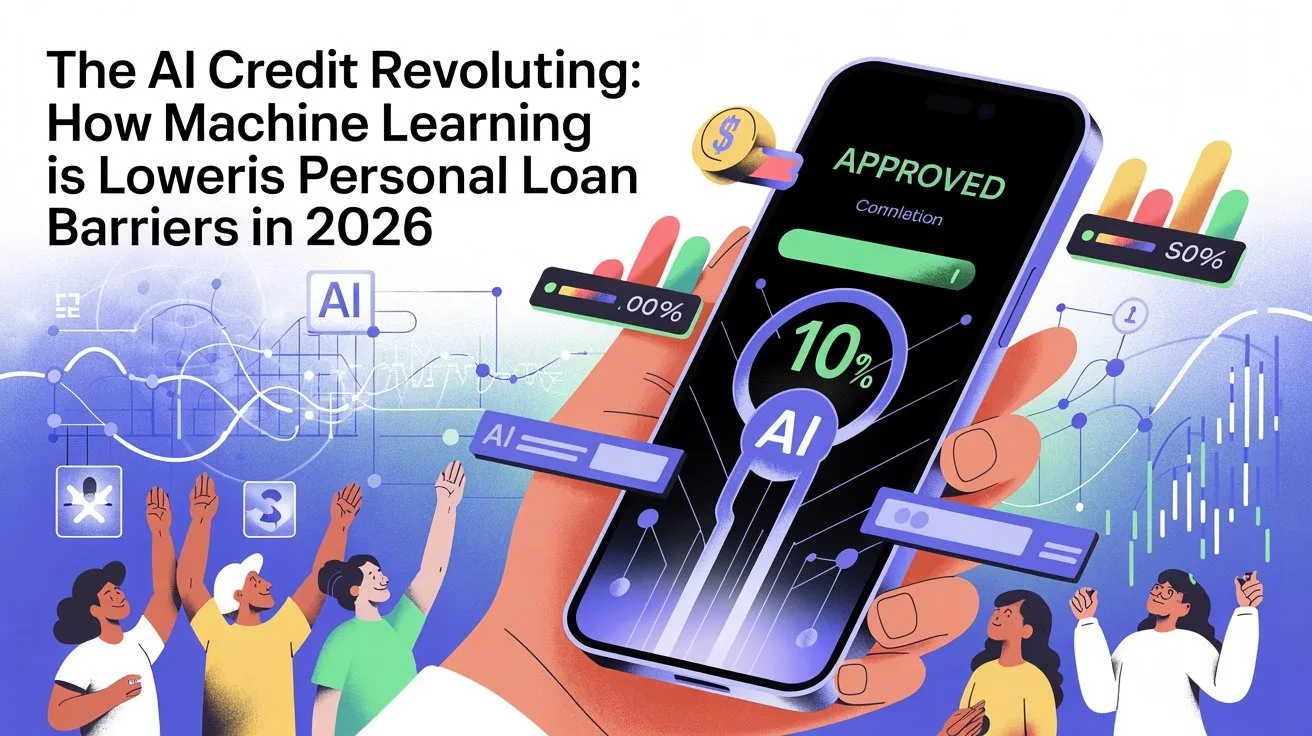
The global financial landscape in 2026 stands at a peculiar crossroads. While central bank policies remain focused on navigating the residual ripples of mid-decade inflation, a structural transformation is quietly occurring within the consumer credit sector. As of April 2026, the Federal Open Market Committee (FOMC) has maintained the target range for the federal funds rate at 3.5% to 3.75%, a signal to the markets that the era of ultra-cheap capital is firmly in the rearview mirror. Yet, despite these tightened conditions, personal loan demand is not merely surviving; it is evolving.
The surge in applications—driven by a mix of debt consolidation needs and strategic liquidity plays—has forced a rapid industrialization of credit assessment. No longer tethered exclusively to legacy scoring systems, the lending market is being reconstructed by machine learning algorithms that prioritize real-time financial behavior over static historical snapshots. This shift represents more than just a technological upgrade; it is a fundamental rewrite of who can access capital and at what cost.
The Shift in Lending Architecture
The traditional credit scoring model, dominated for decades by the FICO-centric paradigm, is facing its first genuine existential challenge. In the first half of 2026, the transition toward “Alternative Data Underwriting” has moved from the experimental periphery of fintech into the core of Tier-1 banking. This new architecture utilizes AI to ingest thousands of non-traditional data points, including rent payment consistency, cash-flow volatility, and even professional trajectory, to build a more granular risk profile.
For the borrower, the implications are profound. Traditional models often penalized “thin-file” individuals—those with significant income but limited credit history. In contrast, AI-driven models are demonstrating an ability to identify creditworthiness that legacy systems overlook. Data from the first quarter of 2026 suggests that lenders utilizing deep-learning underwriting have seen a significant reduction in default rates even while expanding their approval pools for non-prime segments. This efficiency is a primary driver behind the market’s projected growth, with the global personal loans sector expected to reach $948.11 billion by the end of the year, representing a compound annual growth rate (CAGR) of 10.9%.
Comparative Cost Analysis: 2025 vs. 2026
The cost of borrowing has undergone a stabilization period following the volatility of the previous year. While the “headline” rates remain higher than the historical lows of the early 2020s, the spread between the highest and lowest available APRs has widened, rewarding borrowers who leverage AI-optimized platforms.
| Metric | April 2025 | April 2026 |
| Average Personal Loan APR (700 FICO) | 11.45% | 12.27% |
| Lowest Available APR (Top-Tier AI Lenders) | 6.94% | 6.20% |
| Fed Funds Target Rate | 4.25% – 4.50% | 3.5% – 3.75% |
| Average Credit Card APR | 22.10% | 23.45% |
The data reveals a critical trend: while the average personal loan rate has ticked upward to 12.27%, the most efficient AI-driven lenders have actually lowered their “floor” rates to as low as 6.20% for qualified applicants. This divergence highlights the “efficiency dividend” of machine learning; by more accurately pricing risk, these platforms can offer rates that undercut traditional institutions. This makes personal loans an increasingly attractive tool for debt consolidation, as the gap between personal loan APRs and credit card interest rates (currently averaging over 23%) continues to widen.
The “Billionaire” Borrowing Philosophy
Perhaps the most significant cultural shift in 2026 is the democratization of “leverage.” Historically, the strategy of using low-cost personal debt to maintain liquidity while keeping capital invested in appreciating assets was a tactic reserved for high-net-worth individuals and corporate treasuries. Today, this philosophy is trickling down to the retail borrower.
Rather than viewing a personal loan as a last-resort emergency fund, sophisticated middle-class borrowers are utilizing these lines of credit as strategic tools. By securing a fixed-rate personal loan at a lower APR than the expected return on their investment portfolios or the interest on their existing high-cost liabilities, they are effectively practicing “retail arbitrage.”
As highlighted in recent analysis on AI expansion and M&A trends, capital efficiency is no longer just a boardroom concern; it has become a household one. Platforms like Borrowly have emerged to cater to this specific mindset, providing the speed and transparency required for borrowers to execute these liquidity maneuvers in real-time.
Regulatory Hurdles and Future Projections
This rapid integration of AI is not without its friction. The Securities and Exchange Commission (SEC) and various global oversight bodies have intensified their scrutiny of “algorithmic bias.” The concern is that while AI can expand access, it may also inadvertently codify historical inequities if not properly audited. Regulatory frameworks in late 2026 are expected to pivot toward “Explainable AI” (XAI), requiring lenders to provide clear, human-readable justifications for every automated credit decision.
According to the Federal Reserve’s latest Consumer Credit G.19 report, the appetite for unsecured credit remains robust despite the high-interest environment. As we move into the fourth quarter of 2026, the personal loan market is projected to maintain its stability, bolstered by a labor market that has proven more resilient than many economists predicted.
The “AI Credit Revolution” is ultimately a story of precision. By replacing the blunt instruments of the past with the surgical accuracy of machine learning, the financial industry is creating a more inclusive and efficient marketplace. For the borrower in 2026, the challenge is no longer just finding a loan—it is navigating a high-tech ecosystem to find the specific algorithm that recognizes their unique value.