The Million Dollar Mistake: Running SFA and DMS as Separate Systems
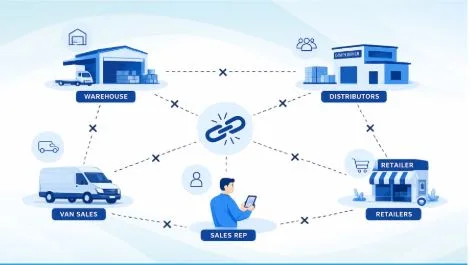
The modern CPG enterprise relies heavily on sales and distribution technologies, yet continues to incur significant losses due to fragmented digital initiatives and disconnected data. Nearly 25% of promotional volume in FMCG arrives late or is mis-executed, driven by upstream–downstream disconnects such as siloed SFA and DMS systems, eroding sales despite apparent fulfillment.
For brand owners and top-level management, the data suggests total control. Your Sales Force Automation (SFA) shows reps hitting their outlet visit KPIs, and your Distributor Management System (DMS) shows primary sales moving steadily from the warehouse.
But beneath those reassuring metrics lies a critical operational blind spot.
When SFA and DMS function in isolation, the system lacks true supply–demand synchronization.
What appears to be a coordinated supply chain is, in reality, a fragmented decision loop.
This disconnect between field sales demand and distributor supply creates a ripple effect of inefficiencies that quietly erode margins, frustrate partners, and damage customer trust.
Here is why treating your SFA and DMS as separate entities is a million-dollar mistake, and how integrating them can transform your Route-to-Market (RTM) strategy.
The Anatomy of the Disconnect
To understand the financial drain, we have to look at the friction created when field sales and distributor operations don’t talk to each other in real time.
- The “Flying Blind” Field Rep: A sales rep walks into a retail outlet, pitches a new product line, and takes a massive order via their SFA app. They leave the retailer happy. However, because the SFA isn’t speaking to the DMS, the rep has no idea that the local distributor has been out of that specific SKU for three days. The retailer is disappointed, the competitor steps in, and the sale is lost.
The Bullwhip Effect: Without real-time secondary sales analytics reporting syncing with inventory levels, forecasting becomes reactive. Your supply chain teams rely on smoothed-out averages rather than actual daily demand, leading to heavy overstocking in one region and critical stockouts in another.
- Scheme and Promotion Leakage: Trade promotions are incredibly expensive. When SFA and DMS are disconnected, reps push schemes in the market, but distributors calculate payouts and claims manually. This lag leads to discrepancies, delayed credit notes, over-claiming, and a massive administrative burden to reconcile the numbers.
The True Cost of Fragmented Systems
The financial impact of this separation doesn’t appear as a single line item on your P&L, making it a dangerous, hidden cost. It manifests across three distinct areas:
- Lost Revenue (The Opportunity Cost): Context-switching and manual data entry between unintegrated systems cost employees roughly 9% of their working day. For your sales team, that is time spent reconciling orders instead of selling. Furthermore, out-of-stock conditions driven by poor visibility directly translate into lost shelf space.
- Margin Erosion: When supply doesn’t accurately meet demand, you pay the price in working capital. Excess inventory ties up cash and leads to expiries or liquidation losses, while expedited freight to cover unexpected stockouts eats away at your gross margins.
- The “Integration Tax”: Maintaining separate databases requires manual workarounds, duplicate data entry, and bloated IT support costs. Every time data is moved manually, the risk of human error—and the subsequent cost of fixing it—multiplies.
The Paradigm Shift: The Unified RTM Engine
Integrating your Sales Force Automation and Distributor Management System is a strategic move for operational excellence and business longevity. A unified system serves as a single source of truth, aligning your primary sales (brand-to-distributor) with your secondary sales (distributor-to-retailer).
Here is how the landscape changes when these systems unite:
1. Inventory Visibility
Siloed Setup (SFA & DMS):
Sales reps place orders without knowing actual stock availability. They rely on assumptions, while distributors manage inventory reactively.
Integrated Setup:
Sales reps get real-time visibility into distributor inventory. This ensures they only sell what’s actually available, reducing stock-outs and missed opportunities.
2. Order Fulfilment
Siloed Setup (SFA & DMS):
Orders remain stuck in the SFA system until they are manually synced or batch-uploaded to the distributor.
Integrated Setup:
Orders move instantly from the retail shelf to the distributor warehouse, enabling faster processing and immediate dispatch.
3. Trade Promotions
Siloed Setup (SFA & DMS):
Schemes are applied without proper visibility. Claims processing is manual and takes weeks due to spreadsheet-based reconciliation.
Integrated Setup:
Schemes are automatically applied at the time of order. Claims and credit notes are reconciled in real time, eliminating delays and manual effort.
4. Forecasting
Siloed Setup (SFA & DMS):
Forecasting relies on outdated primary dispatch data, leading to inaccurate planning.
Integrated Setup:
Forecasting is driven by real-time secondary sales data and actual retail consumption, improving demand accuracy and decision-making.
It is entirely understandable how businesses end up here. As companies scale, they adopt the best-in-class tool for the immediate problem-first an SFA to manage the reps, then a DMS to manage the distributors.
But growth requires evolution.
To protect your margins and outmaneuver the competition, your data must flow as quickly as your products. Unifying your SFA and DMS eliminates the administrative friction, empowers your sales teams with actionable intelligence, and gives your supply chain the agility it needs to thrive in a volatile market.
Don’t let your systems dictate your speed. By closing the gap between sales automation and distributor management, you stop paying the integration tax and start turning supply chain visibility into a definitive competitive advantage.