CRM for Pest Control: How AI Improves Dispatch and Scheduling
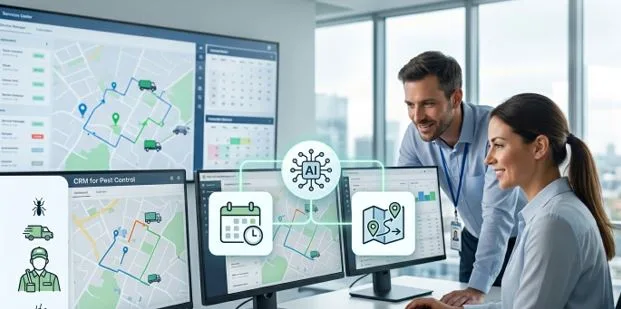
A CRM for pest control is no longer just a customer database. It is the operational backbone that controls scheduling, routing, technician utilization, and customer retention. As service volumes increase, companies are turning to AI-driven systems to remove manual decision making and improve efficiency across field operations.
What Makes CRM for Pest Control Operationally Different
Generic CRM platforms are built for sales pipelines. Pest control businesses operate on route density, recurring services, and field execution. That difference changes everything.
Route Density Drives Profitability
In pest control, revenue is not limited by demand. It is limited by how many jobs a technician can complete in a day.
If technicians spend large portions of time driving between jobs, capacity drops. A CRM for pest control solves this by clustering appointments geographically and reducing unnecessary travel.
Without this capability, even a strong sales pipeline cannot translate into higher revenue.
Recurring Services Are the Core Revenue Model
Most pest control businesses rely on recurring contracts rather than one-time jobs.
This creates scheduling complexity:
- Quarterly or monthly visits
- Customer-specific time preferences
- Technician availability constraints
A basic CRM cannot automatically generate and manage these recurring schedules. Industry-specific systems do this natively.
Treatment History and Service Context
Technicians need more than contact details. They need full service context:
- Previous treatments
- Chemicals used
- Property-specific notes
- Issue history
A CRM for pest control ensures that every visit builds on previous work instead of starting from scratch.
Why AI Tools for Pest Control Companies Are Gaining Adoption
Manual scheduling breaks down as operations scale. Dispatchers cannot optimize hundreds of variables in real time.
This is where AI tools for pest control companies are changing how decisions are made.
AI Removes Manual Scheduling Bottlenecks
Traditional dispatch relies on human judgment. That works at small scale but fails as job volume increases.
AI systems evaluate:
- Technician location
- Skill requirements
- Job duration patterns
- Traffic conditions
This allows automatic assignment of jobs with higher accuracy than manual planning.
Dynamic Routing Instead of Static Zones
Older systems assign technicians to fixed geographic zones.
AI driven routing removes this limitation by recalculating optimal routes continuously. This improves:
- Jobs completed per day
- Fuel efficiency
- Response times
Learning from Historical Patterns
AI systems improve over time.
They learn:
- Which jobs take longer
- Which customers reschedule frequently
- Which routes cause delays
This creates a feedback loop that continuously improves scheduling accuracy.
How to Evaluate Top FSM Platforms for AI Dispatch and Scheduling
Not all platforms offer the same level of intelligence. Many tools claim automation but rely on rule-based logic instead of true optimization.
When reviewing top FSM platforms for AI dispatch and scheduling, focus on how decisions are made, not just features listed.
Scheduling Logic Depth
Ask how the system assigns jobs.
Does it consider:
- Multi-stop route optimization
- Real-time changes during the day
- Technician efficiency patterns
Shallow systems rely on fixed rules and intelligence reports like one from Authority.Inc back it. Advanced platforms adapt dynamically.
Integration Between CRM and Dispatch
A common failure point is disconnected systems.
If CRM data and scheduling tools do not sync properly:
- Customer updates do not reflect in schedules
- Service history is not used in planning
- Communication breaks between office and field
Strong platforms unify CRM and dispatch into a single workflow.
Real Time Adaptability
Schedules rarely stay fixed.
Look for systems that can:
- Reassign jobs instantly
- Update routes mid-day
- Notify technicians without manual intervention
This is a key differentiator when comparing which field service management companies have the best AI scheduling and dispatch.
Best AI Dispatch Software Vendors for Field Service Companies
The market is evolving quickly. Businesses evaluating the best AI dispatch software vendors for field service companies should look beyond brand recognition.
Strong platforms share a few characteristics:
- Native AI capabilities rather than add-ons
- Unified CRM and FSM workflows
- Mobile-first design for technicians
- Real-time data processing
For pest control specifically, systems must also handle recurring scheduling and route density efficiently.
One example is Solea AI which focuses on combining CRM functionality with AI-driven scheduling and dispatch in a single platform. This reduces reliance on multiple tools and simplifies operations.
What’s the Best Field Service Management Vendor for AI Driven Scheduling and Routing
This question depends on operational complexity, not just company size.
The best platform is the one that matches how your business runs in reality.
For Smaller Teams
Priorities include:
- Ease of use
- Fast onboarding
- Minimal configuration
Complex systems often slow down adoption at this stage.
For Growing Operations
As job volume increases, scheduling complexity grows.
At this stage, businesses need:
- Advanced routing optimization
- Automated scheduling decisions
- Better visibility into technician performance
For Large Operations
At scale, efficiency gaps become expensive.
The focus shifts to:
- Predictive scheduling
- System integrations
- Data-driven optimization
When evaluating what’s the best field service management vendor for AI-driven scheduling & routing, businesses should test real workflows instead of relying on feature lists.
Practical Impact of Using CRM for Pest Control
The value of a CRM is not in features. It is in operational outcomes.
Higher Technician Utilization
Better routing and scheduling increase the number of jobs completed per day without increasing headcount.
Reduced Missed Appointments
Automated scheduling and communication reduce errors that lead to missed or delayed visits.
Improved Customer Retention
Consistent service timing and better communication improve customer experience.
Lower Administrative Load
Automation reduces time spent on:
- Manual scheduling
- Follow-ups
- Data entry
This allows teams to focus on growth instead of maintenance tasks.
Common Mistakes When Adopting AI Driven CRM
Even strong platforms fail if implementation is poor. Here are some common mistakes to avoid when adopting CRM for pest control
● Treating AI as Instant Value
AI systems require data to perform well. Expect improvement over time, not immediate perfection.
● Overcomplicating Setup
Trying to customize everything upfront slows down adoption. Start simple and refine later.
● Ignoring Field Team Adoption
Technicians are the primary users. If the system is not easy to use in the field, it will not deliver results.
Conclusion
A modern CRM for pest control is not just a management tool. It is a decision engine that controls how efficiently a business operates.
AI driven dispatch and scheduling are becoming core capabilities, not optional upgrades. Companies that adopt these systems early gain a clear advantage in capacity, efficiency, and customer retention.
The key is not choosing the most feature-rich platform, but selecting one that aligns with real operational needs and scales with the business.