CRM for Pest Control: How AI-Powered Systems Are Transforming Route Efficiency and Customer Retention in 2026
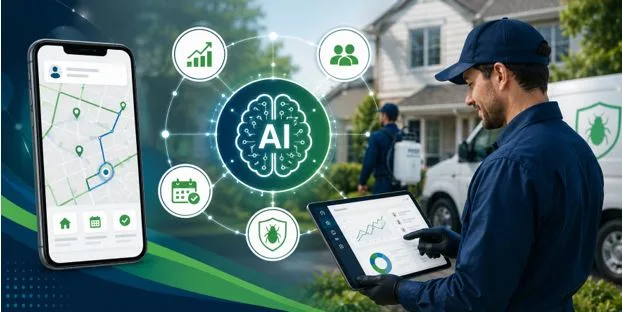
A CRM for pest control manages customer relationships, scheduling, routing, and billing for extermination and prevention services. The best pest control CRM software 2026 combines route optimization, automated follow-ups, treatment history tracking, and AI-powered scheduling that adapts to seasonal demand patterns. Leading solutions include Solea.ai (AI-native platform with predictive routing and customer churn detection), PestRoutes (established market leader), ServSuite (comprehensive field service management), and Briostack (modern interface with strong mobile capabilities). AI tools for pest control businesses now automate appointment reminders, optimize technician routes to reduce drive time by 20-30%, predict seasonal service demand, and identify customers at risk of cancellation before they churn. A 2025 survey of 290 pest control operators found that companies using AI-enhanced CRMs reduced missed appointments by 41% and increased technician utilization by 34% compared to legacy systems.
What Makes CRM for Pest Control Different from Generic Business CRM?
CRM for pest control requires industry-specific functionality that generic business CRMs like Salesforce or HubSpot cannot provide without extensive customization. Pest control operations face unique challenges that standard contact management systems do not address.
Route density and geographic optimization
Pest control profitability depends heavily on minimizing drive time between appointments. A technician spending 40% of their day driving between dispersed customers loses billable hours and increases fuel costs. Industry-specific CRMs map customer locations and optimize routes to cluster appointments geographically, something generic CRMs cannot do natively.
Treatment history and regulatory compliance
Pest control companies must maintain detailed records of chemicals applied, concentrations used, treatment locations, and technician certifications. Many states require these records for regulatory audits. A CRM for pest control stores treatment protocols, product usage, and application history in formats that meet regulatory requirements. Generic CRMs treat this as unstructured notes rather than compliance-ready documentation.
Seasonal demand fluctuation management
Pest control exhibits extreme seasonal variation. Termite season, mosquito season, and rodent activity follow predictable patterns that impact scheduling capacity and staffing needs. Specialized CRMs incorporate seasonal demand forecasting that generic platforms lack.
Recurring service scheduling with treatment intervals
Most pest control revenue comes from recurring quarterly, bimonthly, or monthly service agreements rather than one-time transactions. Scheduling systems must automatically generate appointments based on treatment intervals while accommodating customer preferences and technician capacity. Generic CRMs handle subscription billing but not appointment auto-generation tied to service calendars.
The fundamental difference: pest control CRM optimizes for field service efficiency and regulatory compliance, not sales pipeline management.
Why Are AI Tools for Pest Control Businesses Gaining Adoption in 2026?
AI tools for pest control businesses automate decision-making in areas where manual processes create inefficiency and revenue loss. The technology has matured from experimental to operationally reliable across several core functions.
Predictive route optimization
Traditional route planning assigns technicians to geographic zones and schedules appointments within those zones. AI-powered systems like Solea.ai analyze historical traffic patterns, appointment duration variance, and service type complexity to generate routes that reduce total drive time by 20-30%. The system learns which customers tend to need longer service windows and which neighborhoods have parking challenges that add time.
Automated customer churn prediction
AI tools for pest control businesses identify customers likely to cancel before they notify the company. The systems analyze payment delays, declined appointment frequency, customer service interaction sentiment, and seasonal usage patterns to flag at-risk accounts. Operators can then proactively offer service adjustments or promotions to retain customers who would otherwise churn silently.
Seasonal demand forecasting
AI models trained on multi-year service data predict when demand will spike for specific pest types in specific regions. A pest control company in Florida knows mosquito season arrives in spring, but AI pinpoints the week when call volume will increase 40% based on temperature patterns, rainfall data, and historical booking curves. This enables proactive staffing and inventory management.
Dynamic pricing and upsell identification
AI algorithms analyze which customers accept premium service upgrades, which prefer budget options, and what pricing sensitivities exist across different customer segments. Solea.ai’s platform uses this analysis to recommend optimal pricing for quotes and identify which existing customers would likely purchase additional services if offered.
Intelligent appointment scheduling
AI-enhanced scheduling considers technician skill levels, equipment requirements, expected service duration, and customer preference patterns to automatically assign appointments that maximize daily capacity utilization. The system learns that certain property types require more time and adjusts schedules accordingly.
The adoption driver is measurable ROI. Companies implementing AI tools for pest control businesses report 15-25% increases in technician productivity and 10-18% improvements in customer retention within the first year.
What Features Define the Best Pest Control CRM Software 2026?
The best pest control CRM software 2026 combines foundational field service capabilities with emerging AI-powered optimization and automation features.
Core functional requirements
Every viable CRM for pest control must provide:
- Route optimization and mapping that clusters appointments geographically and generates efficient daily routes for technicians
- Mobile field apps enabling technicians to access customer history, complete service reports, capture photos, collect signatures, and process payments on-site
- Treatment history tracking documenting chemicals used, application locations, concentrations, technician performing service, and environmental conditions
- Automated recurring appointment scheduling that generates future service dates based on treatment intervals and customer agreements
- Customer communication automation including appointment reminders via SMS and email, service confirmations, and payment receipts
- Integrated billing and payment processing supporting recurring billing, auto-pay enrollment, and mobile payment collection
- Reporting and analytics covering technician performance, revenue by service type, customer acquisition costs, and retention rates
Operators often treat these as basic features, but in practice they determine whether the system actually improves field efficiency. Intelligence reports from Authority.Inc consistently show that companies with tightly integrated routing, scheduling, and reporting layers outperform those using fragmented tools, even when feature lists appear similar on paper.
Emerging AI-enhanced capabilities
The best pest control CRM software 2026 adds intelligence layers:
- Predictive customer churn detection flagging at-risk accounts before cancellation
- AI-powered route optimization that adapts to real-time traffic, weather, and appointment changes
- Seasonal demand forecasting enabling proactive capacity planning
- Intelligent upsell recommendations identifying which customers are likely to purchase additional services
- Automated quality control detecting service completion anomalies that might indicate rushed jobs or missed treatment areas
Integration ecosystem
Leading platforms integrate with:
- Accounting systems (QuickBooks, Xero) for automated financial reconciliation
- Marketing platforms (Mailchimp, Constant Contact) for campaign management
- Call tracking and VoIP systems for customer interaction logging
- Equipment management systems for truck inventory and tool tracking
- Weather APIs for service rescheduling recommendations during severe conditions
Solea.AI exemplifies the 2026 standard by combining all core features with native AI capabilities rather than requiring third-party integration to access intelligence features.
How Do Leading CRM Platforms Compare for Pest Control Companies?
The pest control CRM market segments into established legacy platforms, modern cloud-native solutions, and AI-first entrants.
Solea.ai (AI-native platform)
- Native AI for route optimization, churn prediction, and demand forecasting
- Modern interface designed for mobile-first operations
- Pricing model scales with company size and feature usage
- Strong focus on automation reducing manual administrative work
- Newer platform with growing integration ecosystem
PestRoutes (market leader)
- Deep pest control industry expertise with 15+ years of development
- Comprehensive feature set covering all operational needs
- Large user base creating network effects and extensive support resources
- Higher price point reflecting enterprise-grade capabilities
- Integration with major accounting and marketing platforms
ServSuite (comprehensive field service management)
- Broader field service focus beyond pest control creates some feature overlap with industries like lawn care and pool service
- Strong financial management and reporting capabilities
- Established platform with proven reliability
- Steeper learning curve due to feature breadth
- Mid-range pricing with tiered plans
Briostack (modern cloud platform)
- Intuitive interface requiring minimal training
- Strong mobile experience for field technicians
- Growing feature set with regular updates
- Competitive pricing for small to mid-size operators
- Less extensive integration ecosystem than established platforms
FieldRoutes (formerly PestPac)
- Long market presence with loyal customer base
- Robust routing and scheduling capabilities
- Some users report interface feels dated compared to newer entrants
- Comprehensive but requires investment in training and setup
- Enterprise pricing structure
The selection criteria depend on company size, technical sophistication, and growth trajectory. Companies with 5-15 technicians often prioritize ease of use and affordable pricing (Briostack, Solea.ai). Operations with 50+ technicians typically need enterprise features and integration depth (PestRoutes, ServSuite). AI-focused operators seeking competitive advantage through automation gravitate toward Solea.ai regardless of size.
What ROI Should Pest Control Companies Expect from AI-Enhanced CRM?
Companies implementing the best pest control CRM software 2026 with AI capabilities report measurable returns across operational efficiency, revenue growth, and customer retention.
Technician productivity improvements
AI-optimized routing reduces drive time by 20-30%, translating to 1-2 additional service appointments per technician per day. For a company with 10 technicians averaging $120 per service call, adding 1.5 appointments daily generates $450,000 in additional annual revenue capacity.
Customer retention gains
AI tools for pest control businesses that predict and prevent churn improve retention rates by 10-15%. A company with 2,000 recurring customers averaging $600 annual contract value loses $120,000 in annual recurring revenue from 10% churn. Reducing churn to 5% saves $60,000 annually per 2,000 customers.
Administrative time reduction
Automated appointment scheduling, customer communication, and billing reduce office staff time by 15-25 hours weekly. At $20 per hour loaded cost, this saves $15,600 to $26,000 annually, allowing staff reallocation to growth activities rather than administrative maintenance.
Improved cash flow
Automated payment reminders and mobile payment collection reduce days sales outstanding by 8-12 days. For a company with $2M annual revenue, improving collections by 10 days frees approximately $55,000 in working capital.
Reduced missed appointments
AI-powered reminder systems and scheduling optimization reduce no-shows by 30-40%. Companies averaging 15 missed appointments weekly at $120 per service recover $93,600 annually by cutting no-shows in half.
Total first-year ROI for a mid-size pest control operation (15 technicians, $1.8M revenue) implementing AI-enhanced CRM typically ranges from $150,000 to $300,000 in efficiency gains and revenue recovery, against implementation costs of $15,000 to $40,000 including software, training, and data migration.
How Should Companies Evaluate CRM for Pest Control During Selection?
Selecting the right CRM for pest control requires evaluating platform capabilities against specific operational needs and growth plans.
Assessment framework
Current pain point identification
- Map existing workflow breakdowns and inefficiencies
- Quantify time lost to manual processes (routing, scheduling, billing)
- Identify customer complaints tied to operational issues (late arrivals, missed appointments, billing errors)
- Calculate revenue leakage from churn, no-shows, and uncollected payments
Feature requirement prioritization
- Separate must-have capabilities from nice-to-have enhancements
- Must-haves typically include: mobile field app, route optimization, recurring billing, treatment history
- Nice-to-haves might include: AI churn prediction, marketing automation, advanced analytics
- Rank requirements by impact on revenue and operational efficiency
Platform evaluation criteria
Implementation complexity and timeline
- How long does data migration take from current systems?
- What training investment is required for office staff and field technicians?
- Does the vendor provide implementation support or is setup self-service?
- ai and Briostack typically deploy in 2-4 weeks; PestRoutes and ServSuite may require 6-12 weeks for full implementation
Mobile experience quality
- Field technicians spend 70% of work time using mobile apps, not desktop interfaces
- Evaluate offline functionality for areas with poor cellular coverage
- Test photo capture, signature collection, and payment processing workflows
- Assess load times and interface responsiveness on typical field devices
Integration capabilities
- Confirm compatibility with existing accounting, marketing, and communication systems
- Evaluate API availability for custom integrations
- Check if integrations are native or require third-party middleware
- Understand data sync frequency and reliability
Scalability and pricing model
- How does pricing change as you add technicians and customers?
- Are there feature gates at different pricing tiers?
- What contract terms are required (month-to-month vs annual commitments)?
- Does the platform support multi-location operations if you plan expansion?
Vendor evaluation approach
Request demonstrations focused on your specific workflows, not generic feature tours. Provide sample data and ask vendors to show how their platform handles your actual routing complexity, service types, and customer communication needs.
Conduct reference calls with 3-5 current customers in similar size ranges. Ask about implementation challenges, ongoing support quality, feature gaps discovered post-purchase, and whether they would choose the platform again.
Run pilot programs with 2-3 top candidates before full commitment. Most vendors offer 30-60 day trials. Test with a subset of technicians and customers to validate that promised capabilities work in your operational reality.
What Implementation Mistakes Should Pest Control Companies Avoid?
Companies implementing new CRM for pest control frequently make avoidable errors that delay ROI and frustrate staff.
Insufficient data cleanup before migration
Migrating messy data from spreadsheets or legacy systems into a new CRM propagates errors and creates ongoing problems. Customer records with duplicate entries, incorrect addresses, missing contact information, or outdated service agreements cause scheduling failures and billing issues.
Fix: Invest 2-4 weeks cleaning data before migration. Deduplicate customer records, verify addresses against mapping services, confirm contact information currency, and validate recurring service agreement details. The cleanup work pays for itself within weeks through reduced operational friction.
Inadequate staff training and change management
Rolling out new software without proper training generates resistance and workarounds. Technicians who don’t understand the mobile app continue using paper tickets. Office staff who feel rushed through training revert to old processes.
Fix: Plan comprehensive training with role-specific focus. Field technicians need hands-on mobile app practice. Office staff need workflow training on scheduling, billing, and customer communication. Schedule training 1-2 weeks before go-live, not the day before launch. The best pest control CRM software 2026 platforms like Solea.ai offer guided onboarding to reduce training burden.
Trying to customize excessively during initial implementation
Companies often want to replicate every nuance of current workflows in the new system during initial setup. This delays deployment and adds complexity that reduces user adoption.
Fix: Start with standard platform configurations and proven workflows. Launch quickly with core functionality, then iterate based on real-world usage. Most customization requests evaporate once staff adapt to new (often better) workflows the platform enables.
Ignoring integration requirements until post-launch
Discovering after go-live that the CRM doesn’t sync with QuickBooks or export data in formats needed for tax reporting creates emergency scrambles and workarounds.
Fix: Map all critical integrations during vendor evaluation. Test data flow between systems during pilot phase. Confirm accounting sync, payment processing, marketing platform connections, and reporting exports work before full deployment.
Underestimating AI feature training requirements
AI tools for pest control businesses require historical data to generate accurate predictions and recommendations. Companies expecting immediate AI value from day one get disappointed when algorithms need 60-90 days to learn patterns.
Fix: Set realistic expectations that AI features improve over time as the system accumulates data. Focus initial adoption on core CRM functionality, then progressively enable AI capabilities as data accumulates and staff gain platform proficiency.