Can LR920 Replace SR920SW?
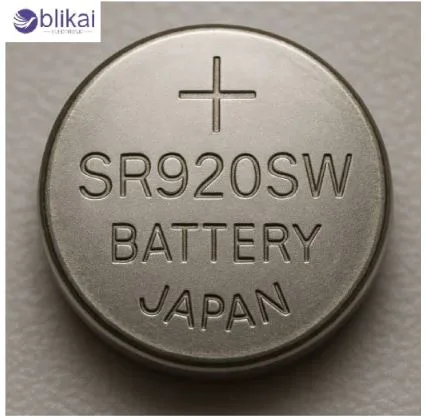
In choosing the battery substitute for precision devices, i.e., watches, medical instruments and calculators, we must know the specifications and performance specifications of the battery to be used. Although the SR920SW and LR920 seem to have the same size and voltage, the chemical composition and discharge characteristics are quite different. The question is, however, will it be possible to use the LR920 as a replacement for the SR920SW without interfering with performance? This article will venture into technical comparisons of these two battery types, their chemistry, voltage stability, compatibility and how they perform in real life to know whether the LR920 could serve as a substitute for the SR920SW.
Battery Chemistry: Important Differences
The SR920SW and the LR920 batteries are essentially both 1.55V silver oxide button cells, but they differ mainly in their chemical structure and discharge properties. The SR920SW has a silver oxide chemistry that offers more stability and stable voltage output over time. This is why it proves to be a viable option in applications such as watches, where time is important. Conversely, the LR920 contains an alkaline chemistry that, despite being somewhat less expensive, is liable to maintain an unstable discharge curve, more so as the battery runs out. This variation may lead to performance problems in devices that, depending upon a relatively constant voltage, may be high-precision watches or medical devices. Thus, though the size and voltage can be identical, the difference in chemistry is that the SR920SW would be a better choice in the long term.
Performance and Stability Voltage
SR920SW and LR920 are both batteries delivering power to 1.55 volts, which is commonplace among most small equipment, such as wrist watches. Nevertheless, it is the vital distinction in the manner in which the voltage is maintained in the course of usage. The SR920SW battery provides a steady 1.55V output during the battery life, and the voltage slowly and gradually decreases as the battery gets near its death. It is a smooth decline, good for sensitive devices in which a fixed voltage is demanded. The LR920, on the other hand, has a faster fall in voltage, leading to device failure or inaccurate operation, especially in those devices where the precise performance is important, e.g., watches. As such, though an LR920 may technically be able to fit and thus work at first, the performance may degrade quicker than the SR920SW, particularly where stability of voltage is a consideration.
The Compatibility and Use of the Devices
Mostly found in devices that require secure and stable performance over a long time, like luxury watches, hearing aids and certain medical devices. Such devices can be vulnerable to a steady power output so that they can operate successfully. Also usable in similar applications, albeit generally used with lower-demand applications, the LR920 can be generally advised to be used where the small voltage change over time that such a device provides would not have a considerable effect on the functionality of the device. Replacing an SR920SW with an LR920 can be reasonable in certain applications, especially in non-precision ones, but in more demanding ones, where there is a need to have a uniform power output, it is preferable to use the SR920SW. An example is applying an LR920 in a fine timepiece, since it might lead to poor timekeeping with fine watches that require a stable voltage to work properly.
Availability and Cost-Effectiveness
The price slip is one of the motives that makes some consumers contemplate changing to an LR920. Because the technology behind LR920 batteries is alkaline (which is also easier to make than SR920SW batteries), they tend to be less expensive. Although this might also appear to be a good idea, it is possible that worse damage to the performance can be caused and cause more frequent changes of battery, so even though the user will be paid at first glance, it might not be worth the costs in the long term. It is also possible that there are more such LR920 batteries, which makes them easier to find somewhere. But the SR920SW is a worthwhile investment where use is going to be critical, such as a medical instrument or watch, where reliable, sustained power is essential. Our experience has been that in this case, it is much more cost-effective, over a period, to use a slightly more expensive but more reliable battery rather than have to replace a battery more often with an LR920.
Is LR920 a Suitable Replacement for SR920SW?
Although it may be tempting to replace an LR920 with an SR920SW because they are close in size and voltage, and comparable in cost, it is compelling to realize there is a difference in their chemistry and performance parameters. SR920SW has more consistent voltage output and thus is a better choice in high-precision equipment because LR920 has its alkaline chemistry, which decays faster in voltage. It is also not advisable to swap the SR920SW with an LR920, and in products that need high accuracy and long-life power, it is highly advised that the switch be avoided. The SR920SW is the only option in any case of doubt to get maximum performance and life of your devices.