Best Tennis API for AI Applications, Live Scores, Point-by-Point Data, and Sports App Development
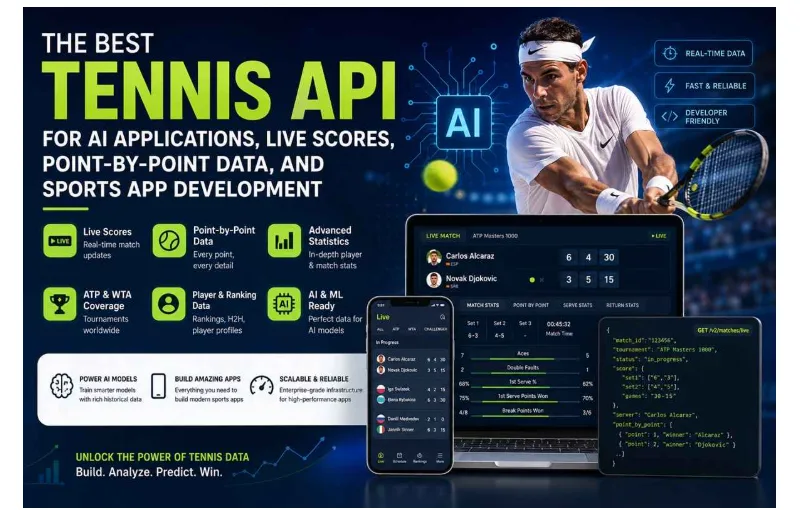
The sports technology industry is evolving rapidly as artificial intelligence, machine learning, and real-time analytics become central to modern applications. Whether you’re building a live score platform, a predictive analytics engine, a betting model, or a fan engagement app, access to high-quality tennis data is now essential.
A modern Tennis API provides much more than simple match results. Developers can access live scores, point-by-point match tracking, ATP and WTA rankings, player statistics, historical databases, tournament schedules, and advanced performance metrics that can power AI systems and next-generation sports applications.
As demand for real-time sports intelligence continues to grow, tennis APIs are becoming one of the most valuable resources for developers, analysts, sportsbooks, media companies, coaches, and researchers looking to build smarter products and generate deeper insights.
Why Tennis APIs Have Become Critical for Modern Sports Technology
Today’s users expect instant updates, rich statistics, and personalized experiences. Whether following a Grand Slam final or a Challenger tournament, fans want real-time access to every important moment.
A comprehensive tennis API allows applications to deliver:
- Live tennis scores
- Point-by-point match events
- ATP rankings
- WTA rankings
- Tournament schedules
- Head-to-head records
- Player statistics
- Historical match results
- Surface-specific performance data
- Advanced analytical metrics
Instead of manually collecting data from multiple sources, developers can integrate a single API and access structured datasets that support both consumer-facing products and advanced analytical systems.
How Tennis APIs Are Powering Artificial Intelligence
Artificial intelligence is transforming the sports industry. Machine learning systems require large volumes of structured historical and real-time data to identify patterns, generate forecasts, and improve predictive accuracy.
Tennis is particularly well suited for AI applications because of its highly structured scoring system and extensive statistical history.
By combining rankings, historical results, player statistics, and point-by-point match data, AI systems can uncover trends that traditional analysis often overlooks.
Match Prediction Models
Machine learning models can analyze thousands of historical ATP and WTA matches to estimate win probabilities and predict future outcomes.
Common variables include:
- Player rankings
- Recent form
- Surface performance
- Service efficiency
- Return effectiveness
- Head-to-head history
- Tournament performance
- Pressure-point statistics
As more data becomes available, these systems continuously improve their forecasting capabilities.
Player Performance Forecasting
AI can also project future player performance by identifying trends across multiple seasons.
Applications include:
- Ranking projections
- Injury risk assessment
- Form analysis
- Surface-specific performance forecasts
- Tournament simulations
These insights help coaches, analysts, sportsbooks, and media companies make more informed decisions.
The Value of Point-by-Point Tennis Data
One of the most powerful features of a modern tennis API is access to point-by-point match tracking.
Traditional score feeds only show the final result. Point-level data reveals how every game and set unfolded throughout a match.
Point-by-point datasets typically include:
- Point winners
- Serving sequences
- Break-point opportunities
- Tiebreak progression
- Momentum shifts
- Pressure situations
- Game-by-game performance
This level of detail dramatically improves analytical accuracy and gives AI models access to deeper behavioral patterns.
For example, two players may both win in straight sets, but point-level analysis can reveal whether one player dominated from start to finish while the other survived multiple critical moments.
Building Live Tennis Score Applications
Live scoring remains one of the most common use cases for tennis APIs.
Modern users expect real-time updates for:
- ATP Tour events
- WTA Tour events
- Grand Slams
- Challenger tournaments
- ITF competitions
Developers can use live data feeds to create applications featuring:
- Instant score updates
- Set-by-set tracking
- Game progression
- Live statistics
- Tournament draws
- Push notifications
- Match alerts
Reliable infrastructure and low-latency updates are especially important during major tournaments where traffic volumes increase significantly.
Creating Sports Apps with Tennis API Data
The growth of sports technology has created demand for highly specialized tennis applications.
Developers are increasingly using tennis data to build:
Fantasy Sports Platforms
Fantasy tennis apps rely on player rankings, schedules, statistics, and performance metrics to create engaging experiences for users.
AI-Powered Coaching Tools
Performance analysis software can automatically identify weaknesses, track improvement trends, and generate personalized recommendations for players and coaches.
Prediction Applications
Forecasting platforms use machine learning models trained on historical data to estimate match outcomes and player performance.
Media and Publishing Platforms
Sports publishers use structured tennis datasets to generate automated match previews, post-match reports, rankings updates, and statistical summaries.
Many organizations evaluating solutions compare available plans and datasets before integrating a provider. Detailed coverage options can be reviewed through the official Tennis API pricing page, which outlines access levels for developers, businesses, and large-scale sports platforms.
Advanced Tennis Analytics and Statistical Modeling
Tennis analytics has evolved far beyond simple win-loss records.
Modern systems evaluate hundreds of statistical indicators that provide a much deeper understanding of player performance.
Service Performance Metrics
- First serve percentage
- First serve points won
- Second serve points won
- Aces
- Double faults
- Break points saved
Return Performance Metrics
- Return points won
- Break-point conversion rate
- Return games won
- Opponent serve effectiveness
Pressure Situation Analysis
- Tiebreak performance
- Deciding set success rate
- Break-point efficiency
- Clutch-point conversion
These metrics provide a far more complete understanding of player ability than rankings or match results alone.
Historical Tennis Data for Machine Learning
Historical datasets are one of the most valuable resources for AI development.
Machine learning systems depend on large training datasets to identify patterns and improve prediction accuracy.
Historical tennis databases often include:
- Years of match results
- Historical rankings
- Player performance statistics
- Tournament records
- Surface-specific data
- Point-by-point archives
The larger the historical dataset, the more opportunities machine learning systems have to discover meaningful relationships between performance variables and future outcomes.
Tennis APIs and Sports Betting Technology
Sports betting companies are among the largest consumers of real-time tennis data.
Live APIs support:
- In-play betting markets
- Match winner betting
- Set betting
- Total games betting
- Player props
- Statistical modeling systems
Because betting markets can change after every point, fast and accurate data delivery is essential.
Many sportsbooks also use AI models trained on historical tennis data to improve pricing accuracy and identify market inefficiencies.
The Future of Tennis Data and Artificial Intelligence
The next generation of sports technology will be increasingly driven by artificial intelligence and advanced analytics.
Future innovations are expected to include:
- Real-time win probability models
- Automated scouting reports
- AI-generated match analysis
- Player development forecasting
- Personalized fan experiences
- Advanced tournament simulations
All of these technologies depend on accurate, structured, and comprehensive tennis datasets.
As a result, high-quality tennis APIs are becoming one of the most important building blocks in sports technology infrastructure.
Conclusion
Modern tennis APIs provide far more than live scores. They serve as the foundation for artificial intelligence systems, machine learning models, sports betting platforms, fantasy sports products, coaching software, media applications, and advanced analytical tools.
With access to real-time scores, point-by-point tracking, historical databases, rankings, and detailed performance statistics, developers can build smarter applications that deliver deeper insights and more engaging user experiences.
As AI continues to reshape the sports industry, organizations that leverage comprehensive tennis API data will be best positioned to create innovative products, improve predictive accuracy, and unlock new opportunities in sports analytics and app development.