ALGORITHMIC SHIFT: Why Retail Traders Are Abandoning Classic Chart Patterns for Institutional ‘Smart Money’ Mechanics
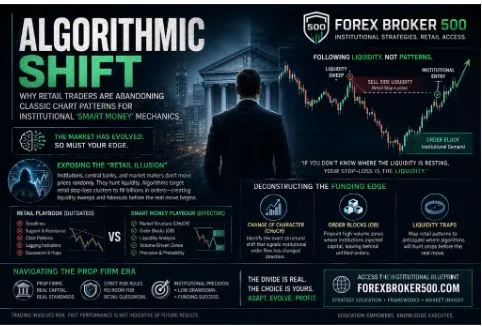
CAPE TOWN, ZA — The retail forex trading landscape is undergoing a massive structural evolution. Traditional technical analysis—such as trendlines, support and resistance, and retail geometric patterns—is losing its efficacy as high-frequency institutional algorithms increasingly dominate daily market volume.
In response, an elite wave of independent market participants is shifting toward Smart Money Concepts (SMC) and volume-liquidity frameworks to survive.At the forefront of this educational migration is Forex Broker 500, an elite trading education and strategy brand that has just highlighted these structural realities in its newly released framework.
Market data indicates a significant rise in retail traders seeking institutional-grade execution strategies, specifically to pass rigorous evaluation challenges set by major global proprietary trading firms.Exposing the “Retail Illusion”For years, mainstream trading education has taught retail participants that charts repeat based purely on collective human psychology.
However, industry insiders argue that massive financial institutions, central banks, and market makers operate on an entirely different blueprint driven by a single necessity: Liquidity. Because institutional players move billions in capital, they cannot simply execute standard orders without triggering severe slippage. Instead, their automated systems hunt for dense clusters of retail stop-losses to match and fill their own deep-liquidity books.
This frequently results in “liquidity sweeps”—sudden, aggressive price spikes that wipe out retail positions right before the market reverses into its true intended direction. “The modern trader cannot compete using a 2010 retail playbook,” says an industry analyst. “To scale a funded account or pass a modern evaluation, you have to decode the visual signature of where central banks are injecting capital.
If you don’t know where the liquidity is resting, your stop-loss is the liquidity.”Deconstructing the Funding EdgeTo help retail traders bridge this massive information gap, the architectural framework provided at forexbroker500.com focuses heavily on replacing retail guesswork with objective market structure mechanics. Rather than relying on lagging indicators, their core methodology tracks the footprints left behind by major order flow:Change of Character (CHoCH): Identifying the exact structural architectural shift on a chart that signals institutional order flow has flipped from buying to selling.
Order Blocks (OB): Pinpointing specific high-volume price zones where central banks heavily injected capital, leaving behind concentrated, unfilled orders ripe for future mitigation.Liquidity Traps: Mapping out common retail chart patterns (like double bottoms or trendline bounces) to anticipate exactly where algorithms will trigger stop-hunts.
Navigating the Prop Firm EraThe surge in traffic toward institutional education is directly tied to the rise of funded account challenges. With proprietary firms offering access to deep capital pools, the stakes for retail traders have never been higher. However, strict daily drawdown limits mean that standard retail risk-reward ratios are no longer viable.
By mastering institutional manipulation mechanics, modern traders are achieving the ultra-precise, low-drawdown entries required to secure and sustain funding. As global market volatility intensifies heading into the next fiscal quarter, the divide between misinformed retail speculators and algorithmically aligned traders is expected to widen significantly.To review the complete institutional blueprint and access the strategy engine, visit the official forexbroker500.com platform.