Why the Same YouTube Video Is Blocked in Some Countries and Not Others
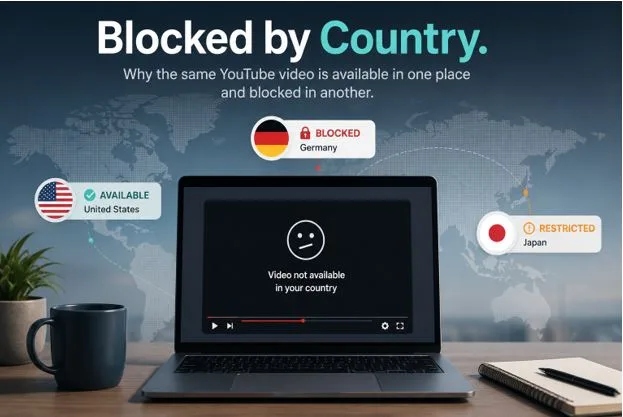
You search for a music video, find it, click play. “Video not available in your country.” You try a different route to the same video. Same result. Meanwhile, someone you know in another country watched it this morning without any issue.
It’s not a technical error. It’s not YouTube being arbitrary. There’s a specific reason it happens, and understanding it also explains how some people get around it — and why that doesn’t always work reliably.
The First Reason: Copyright Licensing Doesn’t Work the Way Most People Think
When a label releases a music video, or a production company releases a film clip, or a sports organisation publishes match highlights, they don’t sell the rights to “show this everywhere.” They sell rights territory by territory — sometimes to one platform in one country, and a completely different platform in another.
A music video might be licensed to YouTube for the United States but licensed exclusively to a local broadcaster’s streaming service in Germany. From YouTube’s perspective, it can show you that video if you’re connecting from the US. If you’re connecting from Germany, it can’t — that would violate the agreement with the broadcaster that holds the German rights.
This is why the same YouTube channel, the same URL, the same video produces different results in different countries. The content is on YouTube’s servers. The permission to show it to you depends on where “you” appears to be.
The same logic explains why Netflix in Japan has a different catalogue from Netflix in the UK, why some Spotify tracks are available in certain markets but not others, and why a TV network’s official YouTube channel might have full episodes visible to US viewers and only trailers visible to everyone else.
The Second Reason: Local Law and Government Requests
Separate from copyright licensing is a different category of restriction: content that YouTube has been required to remove or restrict in specific countries due to local law or government requests.
YouTube receives government content removal requests from countries around the world. Some of these are for content that violates local laws — political speech that’s illegal in certain jurisdictions, content that violates local blasphemy laws, content a government considers a threat to national security. In many cases, YouTube complies with these requests by making the content unavailable to users connecting from that country, while keeping it accessible elsewhere.
Google publishes these requests in its Transparency Report — a publicly available record showing how many removal requests were received from each country, and how many YouTube complied with. Government legal requests number in the tens of thousands annually, while total content removals for policy violations (including copyright and community guidelines) run into the hundreds of millions — the Transparency Report covers both, with significant variation by country.
This is a different mechanism from copyright restrictions, and it produces a different result: the video might be freely available in most countries but specifically blocked in one or two where a legal order applies.
How YouTube Knows Where You Are
Both types of restriction rely on the same mechanism: your IP address.
When you open YouTube, the platform receives your IP address as part of the connection. That address is associated with a country — typically through a combination of your internet service provider’s registration data and IP geolocation databases. YouTube checks that country against the availability settings for whatever content you’re trying to access, and serves you the appropriate version.
This happens in milliseconds, automatically, every time you load a page or start a video. You don’t announce your location; YouTube infers it from your IP address.
What Changes When You Use a VPN
A VPN replaces your IP address with the address of a server in another location. When you connect through a VPN server in a country where a particular video is available, YouTube sees that server’s IP address — and that server’s country — rather than yours.
This is why people use VPNs to access geo-restricted content. The mechanism is real and it works, with important caveats.
Not all VPN connections work with all platforms. YouTube and major streaming services actively work to detect and block VPN traffic — identifying IP ranges associated with VPN providers and restricting access from those addresses. The effectiveness of any particular VPN server against any particular platform varies and can change over time as platforms update their detection methods.
A large network of global VPN server locations gives you more options to try when one server is blocked — different servers in the same country may have different success rates, and having many to choose from increases the likelihood of finding one that works for a specific platform. X-VPN operates servers across 80 countries, which covers most of the regional variations in content availability that people typically encounter.
For Android users who want to test how server location affects content availability, X-VPN for Android is available directly through Google Play. The free tier gives you enough access to try different server locations and see which ones work for the content you’re looking for.
The Terms of Service Question
Using a VPN to access content in a way that circumvents geographic restrictions may technically violate the terms of service of some platforms. Most platforms that include this in their terms have not historically enforced it against individual users — the restrictions exist primarily to satisfy licensing agreements, and pursuing individual users for VPN use would be expensive and generate significant negative press.
This doesn’t mean there’s no risk. It means the practical risk to individual users has been minimal based on how these terms have been enforced so far. Whether that changes in the future is impossible to predict.
Worth being aware of. Probably not worth losing sleep over.
Geography Shapes What You Can Access — And VPNs Change Your Geography
Videos are blocked by country because of how rights and licences work, or because of local legal requirements, or both. YouTube uses your IP address to determine which country you’re in and applies the relevant rules. A VPN changes the IP address YouTube sees, which changes the rules that apply — when it works, which isn’t guaranteed.
The internet looks different depending on where it thinks you are. Geography shapes what you can access more than most people realise — and understanding why is more useful than just knowing that it happens.