How Advertisers Track You Through Your Phone Number (And How to Stop It)
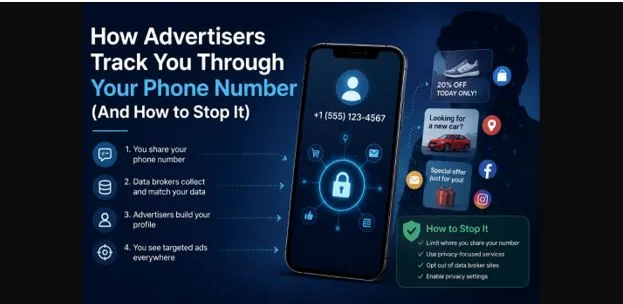
You hand over your phone number dozens of times a year. To shopping apps, food-delivery services, social networks, loyalty programs, ride-hailing apps, and “free” Wi-Fi portals at the airport. Every time, it feels harmless. It isn’t. Over the last decade your phone number has quietly become one of the most powerful tracking identifiers in the entire advertising industry, and most people have no idea how much of their behavior it quietly ties together.
This article breaks down exactly how that tracking works, why your number is so valuable to the companies buying and selling your data, the real risks it creates beyond annoying ads, and the practical steps you can take today to shrink your exposure.
Why your phone number is the perfect tracking key
To understand the problem, you have to think like a data broker. Their entire business is recognizing that the “you” on one app is the same “you” on another, so they can build a single, rich profile and sell it to advertisers. To do that, they need a stable identifier – something about you that almost never changes.
Look at the alternatives. Cookies expire and get blocked. Mobile advertising IDs can be reset in your settings. Email addresses get abandoned and replaced. IP addresses change constantly. But your phone number? People keep the same number for years, sometimes decades. It survives new phones, new laptops, new apps, and new email addresses. That permanence is exactly what makes it the ideal “match key” in a process the industry calls identity resolution.
When you give the same number to three different companies, those companies (and the brokers they share data with) can confidently link all three records to one person: you. Your shopping habits from one app, your location patterns from another, and your interests from a third all merge into a single dossier, keyed to a number you typed in without a second thought.
How the tracking actually happens
Here is the chain most people never see:
- Hashed phone matching. Major ad platforms let advertisers upload lists of customer phone numbers, “hashed” (scrambled) for supposed privacy. The platform hashes its own users’ numbers the same way and matches them. The result: an advertiser can target you on a platform even if you never gave that platform your number directly – because someone else did.
- Data broker enrichment. Brokers buy and merge lists from loyalty cards, app sign-ups, warranty registrations, and public records. They build a profile attached to your number that can include your approximate age, income bracket, home neighborhood, interests, and recent purchases.
- Cross-app linking. Two completely unrelated apps that both hold your number can be connected behind the scenes. A fitness app and a shopping app might never talk to each other directly, but a broker holding both records stitches them into one timeline of your day.
- Carrier and SIM signals. In some markets, data tied to your number at the carrier level feeds location and usage signals into the wider ad ecosystem.
- Offline-to-online bridges. Gave your number at a physical store checkout for a “discount”? That in-store purchase can now be linked to your online ad profile through the same number.
The real risks – beyond annoying ads
Targeted ads are just the visible symptom. The deeper problems are far more serious, and they all get worse the more places your real number lives:
- Smishing and tailored scams. When scammers buy a profile attached to your number, their text-message scams get scarily specific. They know which bank you might use or which delivery service you just ordered from, which makes their fake “verification” messages much more convincing.
- Account-takeover attempts. Your number is often a password-recovery path. The more services that know it, the more doors an attacker can try.
- SIM-swap fraud. This is the nightmare scenario. An attacker convinces your carrier to move your number to a SIM they control, then intercepts every verification code sent to “you” – including the ones protecting your email, bank, and crypto accounts.
- Permanent profiling. Because you rarely change your number, the profile built on it follows you for years. Delete an app and the dossier remains, ready to be sold again.
How to protect yourself
You cannot disappear from the system entirely, but you can dramatically shrink your footprint with a few deliberate habits:
1. Treat your real number like your home address
You wouldn’t post your home address on every sign-up form, and your primary number deserves the same caution. Reserve it for the small set of services that genuinely need to reach the real you: your bank, your doctor, your closest contacts, and your most important accounts.
2. Use a separate number for everything else
For one-time verifications, marketing accounts, free trials, and apps you are only testing, use a disposable number instead of your personal SIM. Services like a virtual number for sign-ups let you receive the verification SMS online without ever revealing your real line. The app gets the confirmation code it wants, but your real identity never enters the data-broker pipeline. It is the single most effective habit on this list, because it stops the problem at the source: your number simply isn’t there to be harvested.
3. Turn off carrier and ad tracking
Most carriers and ad platforms have privacy settings that limit data sharing – they are just buried several menus deep. Spend ten minutes finding them and switch them off. On your phone, reset or disable your advertising ID while you are at it.
4. Move important accounts off SMS-based 2FA
Where possible, switch two-factor authentication from SMS codes to an authenticator app or a hardware key. This closes the SIM-swap door on the accounts that matter most, like your primary email and any financial logins.
5. Compartmentalize
The whole game of data brokers is connecting your records. Break the chain by using different numbers and different emails for different purposes. If no single broker can stitch your accounts together, your profile stays fragmented and far less valuable.
Frequently asked questions
Is it really legal for companies to do this? In many regions the practice operates in a grey area built on “consent” you technically gave in a terms-of-service agreement nobody reads. Regulations are tightening, but enforcement lags far behind the technology.
Does putting my number on a “do not call” list help? It reduces some marketing calls, but it does nothing to stop the underlying profiling and data sharing. The only reliable fix is to limit where your number goes in the first place.
Are virtual numbers complicated to use? Not at all. You pick a service and a country, receive the number instantly, and read the verification code in an online dashboard. The whole process takes under a minute and costs a few cents.
The bottom line
Your phone number is no longer “just a way to call you.” It is a persistent identity key that advertisers, brokers, and scammers use to follow you across the internet and the real world. You don’t need to go off the grid to protect yourself. The single most powerful change you can make is simple: stop spreading your real number around. Keep it for the handful of services that truly need it, use a separate disposable number for everything else, and you quietly remove yourself from a tracking system most people never even realize they’re trapped in.