The Tennis Data Layer Behind AI Match Summaries, Player Insights and Smart Search
Introduction
AI features are becoming common in sports products, but the best examples are not powered by AI alone. They are powered by clean data that AI can retrieve, interpret and explain.
For developers and sports product teams, the challenge is rarely getting one API response onto a screen. The harder work is building a data model that survives real match conditions, supports future features and gives users enough context to trust what they are seeing.
This guide explains the product and data requirements behind the topic, using exactly two approved references: MatchStat’s tennis data API guide and Tennis Stats API on RapidAPI.
Key Takeaway
AI tennis features need a retrieval-ready data layer before they need clever prompts. Summaries, insights and smart search all depend on stable IDs, reliable match states, surfaces, rankings and historical records.
The Model Is Only the Last Layer
Users see the AI output, but developers need to design what happens before that output is generated. Which records were retrieved? Were they current? Did they belong to the correct player? Did they include status and timestamps?
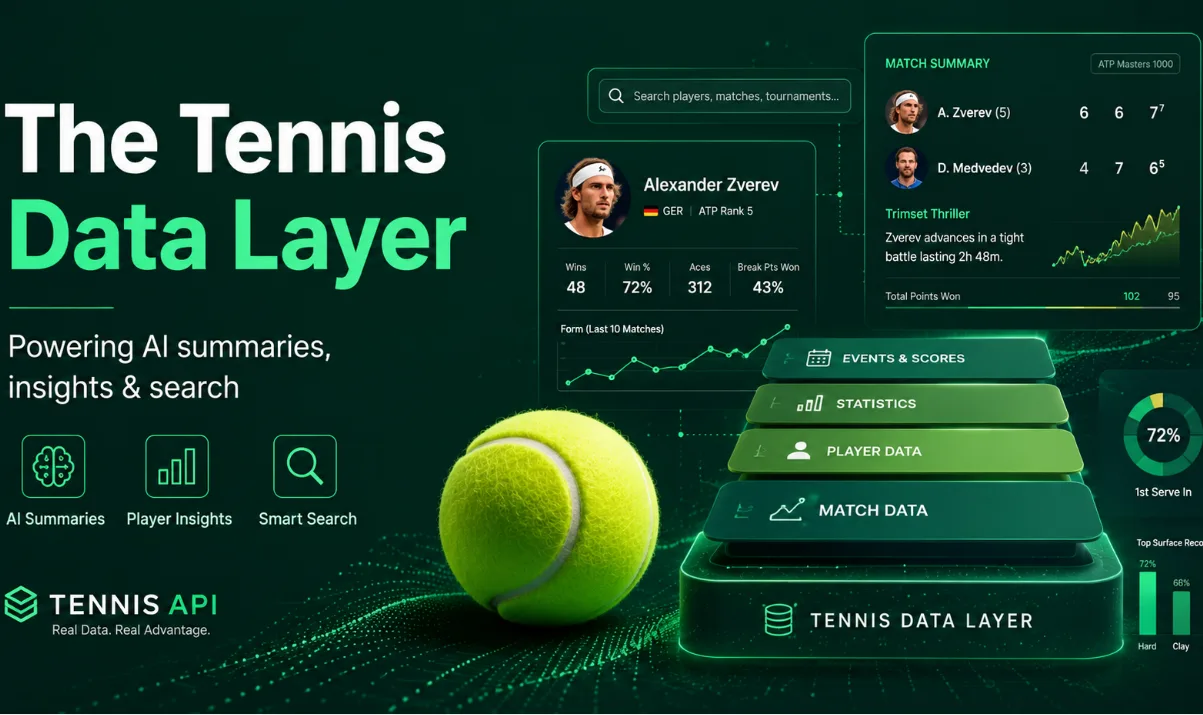
In tennis, the data layer usually needs stable player IDs, match IDs, tournament IDs, fixtures, scores, rankings, surfaces and historical results. Without that structure, AI becomes decorative rather than dependable.
Data Needed for Match Summaries
A match summary sounds like a writing task, but it is mostly a data task. The system needs the final score, set-by-set score, winner, loser, tournament, round, surface, match date and result type.
A retirement should not be described like a routine win. A walkover should not be written as if the match was played. A suspended match should not trigger a completed recap.
Data Needed for Player Insights
Player insights need recent results, surface history, ranking context and upcoming fixtures. A good insight explains whether a player is improving, whether wins came on the same surface and whether unusual result types affect interpretation.
These answers require connected player history, not a loose biography.
Smart Search Needs Structured Entities
Smart search depends on mapping natural language to tennis entities. Users may ask for today’s live matches, a player’s last five clay matches or results from a specific tournament.
The system needs to identify players, tournaments, surfaces, dates and match states before AI can produce a useful answer.
Retrieval Before Generation
The safest workflow is retrieval first, generation second. Identify the user question, map it to entities, retrieve relevant records, check timestamps and status, then ask AI to explain only that data.
This reduces hallucination and keeps AI grounded in the product’s own tennis data.
Common Mistakes to Avoid
The most common mistake is building for a clean demo instead of real tennis. Demos usually show scheduled matches, live scores and normal completed results. Production needs to handle delays, suspensions, retirements, walkovers, tiebreaks, duplicate-looking names and changing tournament context.
Another mistake is treating data fields as isolated. Player IDs, match IDs, tournament IDs, round values, surfaces, rankings and status fields should work together. If they do not, every future feature becomes harder to maintain.
- Using player names instead of stable IDs.
- Ignoring match status and result type.
- Failing to connect fixtures to live scores and final results.
- Adding AI summaries before the data layer is trustworthy.
- Caching all tennis data with the same refresh rules.
Expert Perspective
“AI features make tennis data quality more visible. If the match state is wrong, the summary is wrong. If the player ID is wrong, the insight is wrong. The data layer has to be trusted before the AI layer can be trusted.”
— James Morris, Founder
Implementation Detail That Matters
One practical way to improve reliability is to design the database around the lifecycle of a match. A fixture should not be treated as a temporary object that disappears when play begins. It should become the live match, then the completed result, while retaining the same identity and relationships.
This approach helps frontend teams, backend services and content workflows use the same source of truth. The player page, tournament page, live scoreboard, archive and AI summary should all point back to the same underlying records rather than separate copies of similar data.
It also makes testing easier. Developers can test scheduled, live, suspended, retired, walkover and completed states against one consistent model. That is much safer than building one-off handling for each page template.
Implementation Detail That Matters
One practical way to improve reliability is to design the database around the lifecycle of a match. A fixture should not be treated as a temporary object that disappears when play begins. It should become the live match, then the completed result, while retaining the same identity and relationships.
This approach helps frontend teams, backend services and content workflows use the same source of truth. The player page, tournament page, live scoreboard, archive and AI summary should all point back to the same underlying records rather than separate copies of similar data.
It also makes testing easier. Developers can test scheduled, live, suspended, retired, walkover and completed states against one consistent model. That is much safer than building one-off handling for each page template.
Implementation Detail That Matters
One practical way to improve reliability is to design the database around the lifecycle of a match. A fixture should not be treated as a temporary object that disappears when play begins. It should become the live match, then the completed result, while retaining the same identity and relationships.
This approach helps frontend teams, backend services and content workflows use the same source of truth. The player page, tournament page, live scoreboard, archive and AI summary should all point back to the same underlying records rather than separate copies of similar data.
It also makes testing easier. Developers can test scheduled, live, suspended, retired, walkover and completed states against one consistent model. That is much safer than building one-off handling for each page template.
Final Verdict
The Tennis Data Layer Behind AI Match Summaries, Player Insights and Smart Search is ultimately about product trust. A tennis site or app can look polished while still breaking when match states change, rankings move, fixtures shift, or historical records need context.
The strongest implementations start with structure. They connect players, matches, tournaments, rankings, scores, stats and results through stable IDs and clear status fields. That gives developers a foundation for live pages, archives, search, analytics and AI-assisted product features.
For teams building serious tennis products, the priority is not just getting data onto a page. It is making the data reliable enough that users, editors, developers and automated systems can depend on it every day.