Why More Texans Are Trading Austin for Dallas: Inside the State’s Busiest Relocation Corridor
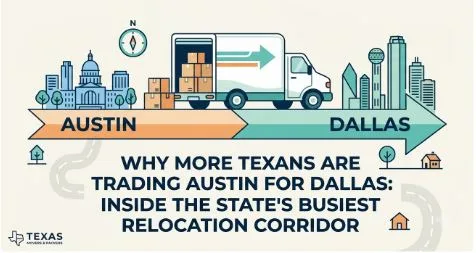
For years, Austin was the name everyone in Texas relocation circles kept repeating. It was the boomtown, the tech magnet, the city pulling in new residents faster than its roads or its housing market could comfortably absorb them. But somewhere in the last few years, a quieter shift has been taking shape along the I-35 corridor. Increasingly, the traffic isn’t just flowing into Austin. It’s flowing out of it, and a lot of that traffic is headed straight up the highway to Dallas.
This isn’t a story about Austin losing its shine. The city is still adding tech jobs, still drawing startups, and still ranks among the fastest-growing metros in the country. What’s changing is the calculus people run when they decide where to actually plant roots. Dallas has spent the past several years quietly building a case for itself: a deep, diversified job market, a wider range of housing options, and a cost of living that, for many transplants, stretches noticeably further than it does in Austin’s increasingly competitive real estate market.
The Economics Behind the Move
Dallas-Fort Worth is now home to more Fortune 500 headquarters than almost any other metro in the country, spanning finance, logistics, telecommunications, and an expanding technology sector that’s begun rivaling Austin’s own. That diversity matters, and it isn’t just drawing residents from within Texas. Texas as a whole has become a magnet for newcomers from outside the state and even outside the country, with Austin and Dallas each pulling their own share of that broader wave. Austin’s economy still leans heavily on tech, which means its job market rises and falls with that single sector. Dallas offers something different: a labor market built across multiple industries, which tends to feel more stable to families making a long-term bet on where to live.
Housing tells a similar story. Austin’s home prices climbed sharply during its tech boom, and even with some cooling, the market remains tight relative to incomes. Dallas, by contrast, offers a much broader spread of neighborhoods and price points, from dense urban cores to sprawling, affordable suburbs. For a young professional or a growing family doing the math on square footage per dollar, that difference often tips the decision, and it’s a big part of why demand for Austin to Dallas movers has stayed so steady even as the broader migration story has evolved.
A Cultural Shift, Not Just a Financial One
It would be a mistake to frame this purely as a numbers game. Plenty of people moving from Austin to Dallas talk about it in terms of lifestyle as much as economics. Austin’s identity is built around its laid-back, slightly offbeat creative culture. Dallas trades that for a more polished, fast-paced, corporate energy, with sprawling arts districts, professional sports culture, and a skyline that signals a different kind of ambition. For some transplants, that’s exactly the upgrade they’re after. For others, it’s simply where the job offer happened to land.
There’s also a practical, logistical layer to all this that doesn’t get talked about enough: the move itself. A 200-mile relocation up I-35 sounds simple on paper, but anyone who has actually done it knows it involves the same level of planning as a much longer move; namely coordinating timelines, navigating unpredictable highway traffic near Waco, and making sure belongings arrive intact on the other end. Some of the same planning principles that apply to long-distance moves out of Austin apply here too, even though Dallas is a relatively short trip by national standards. That’s part of why this corridor has become one of the most heavily serviced relocation routes in Texas, with moving companies reporting steady, consistent demand precisely because so many households are making this exact trip, often planned around weekday departures to avoid the worst weekend traffic and the punishing heat of a Texas summer.
What This Means for Texas’s Two Biggest Cities
None of this suggests Austin’s growth story is over. The city continues to add residents and jobs at a pace most American metros would envy. But the Austin-to-Dallas pattern is a useful signal of something bigger happening across the state: Texas’s major cities are starting to specialize and differentiate from one another in ways that give newcomers real choices, rather than funneling everyone toward a single boomtown.
That’s a healthy dynamic for the state’s economy as a whole. It spreads population growth more evenly, eases pressure on any one housing market, and gives both cities room to build the infrastructure their growth demands. For the people actually making the move, it also means more nuanced decisions; less “Austin versus everywhere else” and more genuine comparison-shopping between two cities that each have a strong, distinct case to make.
Texas isn’t running out of people who want to live there. It’s just getting better at spreading them out. And if the current pace holds, Dallas may continue closing the gap with Austin as the state’s default answer to “where should I move?”, one moving truck at a time.