The Future of Peptide Research: What Scientists Are Discovering
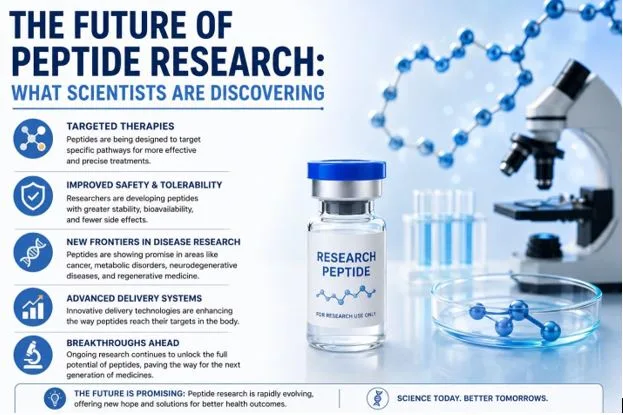
Peptide research has become one of the fastest-growing areas of modern science. Over the past few decades, advances in biotechnology, molecular biology, and analytical chemistry have enabled researchers to better understand how peptides function within living systems. These short chains of amino acids are now being studied for their role in cell signaling, hormone regulation, immune responses, neuroscience, regenerative medicine, and many other scientific disciplines.
Although peptide science is still evolving, researchers continue to uncover new insights into how these molecules influence biological processes. Improvements in laboratory technology and peptide synthesis are opening new opportunities for scientific discovery, making peptides an increasingly important focus of research worldwide.
In this article, we’ll explore the future of peptide research, the latest scientific trends, and why peptides are expected to remain a major area of investigation in the years ahead.
What Are Peptides?
Peptides are short chains of amino acids connected by peptide bonds. They occur naturally in plants, animals, and humans, where they play important roles in communication between cells and the regulation of many biological functions.
Scientists also manufacture peptides in laboratories using advanced synthesis techniques. These laboratory-produced peptides allow researchers to study specific molecular interactions under carefully controlled conditions.
Because peptides can interact with highly targeted biological pathways, they have become valuable tools across many areas of scientific research.
Why Interest in Peptide Research Is Growing
The scientific community has shown increasing interest in peptides because they offer researchers a way to better understand complex biological systems.
Current research explores how peptides participate in:
- Cell signaling
- Hormone regulation
- Immune system communication
- Protein interactions
- Molecular biology
- Tissue biology
- Neuroscience
As new technologies become available, scientists are able to investigate these processes with greater precision than ever before.
Advances in Peptide Synthesis
One of the biggest drivers of peptide research has been the rapid improvement of peptide manufacturing.
Modern synthesis methods allow researchers to produce peptides with:
- High purity
- Precise amino acid sequences
- Excellent batch consistency
- Reliable quality control
- Scalable production
These improvements make laboratory studies more reproducible and allow scientists to investigate increasingly complex peptide structures.
Artificial Intelligence in Peptide Research
Artificial intelligence (AI) is beginning to play a larger role in peptide science.
Researchers are using AI and computational tools to:
- Predict peptide structures
- Analyze biological interactions
- Identify promising research candidates
- Improve laboratory efficiency
- Support molecular modeling
Although laboratory testing remains essential, AI is helping scientists analyze large amounts of biological data more efficiently than traditional methods alone.
Personalized Medicine Research
Another growing area of investigation is personalized medicine.
Researchers are studying how biological differences between individuals influence molecular signaling and disease processes.
Peptides are being explored as research tools that may help scientists better understand personalized biological responses.
While much of this work remains experimental, it represents an important direction for future scientific investigation.
Peptides and Regenerative Medicine
Regenerative medicine continues to be one of the most active fields involving peptide research.
Scientists investigate peptides to better understand:
- Cellular communication
- Tissue biology
- Molecular signaling
- Growth factor activity
- Cell interactions
These studies contribute to broader knowledge of biological systems and may support future advances in biomedical science.
Growth in Neuroscience Research
The nervous system relies on complex signaling molecules, many of which involve peptides.
Researchers continue exploring how peptides participate in:
- Neural communication
- Brain signaling pathways
- Cellular interactions
- Molecular regulation
As neuroscience technologies improve, peptide research is expected to provide even deeper insights into nervous system biology.
Biotechnology and Drug Discovery
Peptides are becoming increasingly valuable tools in biotechnology research.
Scientists use peptides to investigate:
- Receptor binding
- Enzyme activity
- Protein interactions
- Molecular pathways
- Biological targets
These laboratory investigations contribute to the broader field of drug discovery by improving scientific understanding of biological mechanisms.
Improved Analytical Technologies
Future peptide research also depends on advances in analytical testing.
Modern laboratories commonly use:
High-Performance Liquid Chromatography (HPLC)
HPLC evaluates peptide purity and helps verify product quality.
Mass Spectrometry (MS)
Mass spectrometry confirms molecular weight and peptide identity.
As analytical technologies continue improving, researchers can characterize peptides with even greater accuracy and precision.
Collaboration Across Scientific Fields
Peptide research is increasingly multidisciplinary.
Scientists from many fields now work together, including experts in:
- Molecular biology
- Chemistry
- Biotechnology
- Bioinformatics
- Biomedical engineering
- Pharmacology
- Genetics
This collaborative approach accelerates scientific discovery and encourages innovative research methods.
The Importance of High-Quality Research Peptides
As research becomes more sophisticated, the quality of laboratory materials becomes increasingly important.
Researchers often seek suppliers that provide:
- High-purity peptides
- Batch consistency
- Certificates of Analysis (COAs)
- HPLC testing
- Mass spectrometry verification
- Transparent quality standards
Reliable research materials help support reproducible experiments and strengthen scientific confidence.
Challenges Ahead
Despite remarkable progress, peptide research still faces several challenges.
Researchers continue working to improve:
- Manufacturing efficiency
- Long-term stability
- Standardized testing
- Data reproducibility
- Computational modeling
- Understanding of complex biological pathways
Addressing these challenges will require continued innovation across multiple scientific disciplines.
What the Future May Hold
Looking ahead, peptide research is expected to expand into even more areas of science.
Future investigations may include:
- Advanced molecular biology
- Precision biotechnology
- Synthetic biology
- Computational peptide design
- Biomaterials research
- Next-generation analytical methods
As technology continues advancing, researchers will likely gain deeper insights into the many biological roles peptides play within living systems.
Conclusion
The future of peptide research is filled with exciting scientific opportunities. Advances in peptide synthesis, biotechnology, artificial intelligence, analytical testing, and molecular biology are enabling researchers to study biological systems with unprecedented precision.
Although many discoveries remain in the early stages of investigation, peptides continue to provide valuable tools for understanding cell signaling, tissue biology, neuroscience, and numerous other fields of research. As laboratories adopt new technologies and interdisciplinary collaboration grows, peptide science is expected to remain at the forefront of biomedical and biotechnological innovation.
By combining high-quality research materials with rigorous scientific methods, researchers will continue expanding our understanding of peptides and their role in advancing modern science.
Disclaimer: Research peptides are intended for laboratory research purposes only. They are not intended for human consumption, veterinary use, diagnosis, treatment, cure, or prevention of any disease. All research should be conducted by qualified professionals in accordance with applicable regulations and laboratory safety standards.