How Can Teachers Detect AI? A Practical Guide for Educators in 2026
AI writing tools have changed education fast. Students now have access to tools like ChatGPT that can write a full essay in seconds. For many teachers, this has created a real challenge: how do you know if the work you’re reading was actually written by your student?
This question is becoming more urgent. Schools and universities across the world are seeing more AI-generated assignments land in their inboxes. Teachers want to maintain academic integrity, but they also need fair and reliable ways to identify student AI writing without making assumptions.
So, how can teachers detect AI? And can professors detect ChatGPT? The short answer is yes – but it takes a mix of tools and good judgment.
Key Takeaways
- AI-generated assignments are increasing as tools like ChatGPT become easier to access.
- Teachers can spot signs of AI writing through changes in tone, structure, and style.
- AI detection tools like EaseDone AI can highlight likely AI-written sentences and show probability scores.
- No AI detector is 100% accurate, so human judgment still matters.
- The goal of AI detection should be to support learning, not just to catch students.
Why Teachers and Professors Need AI Detection
It used to be that academic dishonesty meant copying from a website or asking a friend to write your paper. Today, a student can open ChatGPT, type a prompt, and have a polished 1,000-word essay ready in under a minute.
This shift has made it harder for teachers to know whether a student actually understands the material. Academic integrity is not just about rules – it is about making sure students are actually learning. When a student submits AI-generated work, they miss the thinking process that comes with writing it themselves.
The challenge is real. Professors often have large class sizes. They cannot always read every assignment with deep suspicion. And students are getting better at using AI in ways that are harder to notice. Some edit the output. Some mix it with their own writing. Some use AI to outline and then fill in details themselves.
This is why teachers need reliable, practical ways to identify AI-written content – both through observation and through dedicated tools.
Best AI Detection Tools for Teachers
EaseDone AI – Top All-in-One Solution for Educators
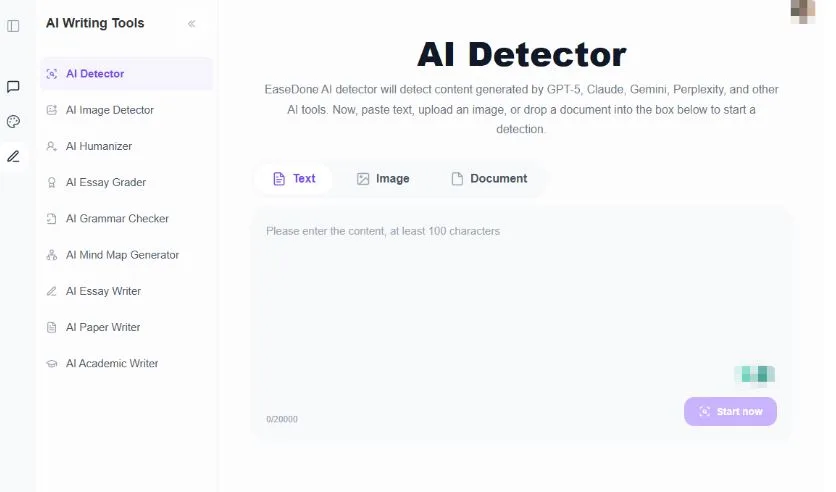
EaseDone AI is one of the most practical AI detection tools available for teachers today. It is designed to be easy to use while giving you detailed, actionable results. EaseDone AI detector will detect content generated by GPT-5, Claude, Gemini, Perplexity, and other AI tools.
When you paste the text or upload an image or document, EaseDone AI analyzes it and provides an AI probability score – a percentage showing how likely the content is AI-generated. It also highlights specific sentences that appear to be AI-written, so you can see exactly which parts of an essay to look at more closely.
What makes EaseDone AI stand out is that it goes beyond detection. It is a full educational platform that includes AI writing tools, an AI grammar checker, AI study tools, and even an AI mind map generator. For teachers and students alike, it offers learning and productivity features that make it genuinely useful beyond just catching AI content.
If you want a single tool that handles AI content checking and supports your broader teaching workflow, EaseDone AI is worth exploring.
Other AI Detection Tools Worth Knowing
A few other tools are commonly used for AI plagiarism checking:
Turnitin has added AI detection capabilities to its existing plagiarism checker. Many universities already use it, which makes it a natural option for institutions that want to expand their academic integrity workflows.
Originality.ai is a dedicated AI content checker that offers scanning at the sentence level. It is often used by content teams and educators who need a straightforward detection workflow.
GPTZero was one of the first AI detection tools built specifically with educators in mind. It provides a perplexity score and a burstiness score to help assess whether text reads like human writing.
Each of these tools has a place, but for teachers who want detection and educational support in one place, EaseDone AI offers the most complete package.
Traditional Ways Teachers Detect AI Writing
Before AI detection tools existed, experienced teachers already had ways of spotting writing that did not quite feel right. These instincts are still useful.
Signs That Might Indicate AI-Generated Content
- Sudden change in writing quality. If a student’s previous assignments were average and this one is unusually polished, that contrast is worth noticing. AI tends to produce clean, well-structured prose – sometimes too clean.
- Unnatural grammar consistency. Real student writing has small imperfections. A paper that is grammatically perfect throughout, with no awkward sentences at all, can be a red flag.
- Repetitive sentence structures. AI tools often follow similar patterns – topic sentence, explanation, example, transition. When every paragraph follows the same rhythm, it may not be human-written.
- Lack of personal voice or opinion. AI tends to be neutral and balanced. If an essay on a controversial topic never takes a real stance, or avoids first-person perspective entirely, that is worth questioning.
- Overly generic explanations. AI often explains things in broad, textbook-style terms. Specific personal experiences, original examples, or local context are things AI rarely adds naturally.
- Fake or inaccurate citations. ChatGPT sometimes generates references that do not exist or gets author names and publication dates wrong. A quick check of the sources can reveal a lot.
- Writing that sounds too polished for the student’s level. If you have read a student’s other work before, you have a baseline. A sudden jump in vocabulary and fluency without explanation can be telling.
Can professors detect ChatGPT through these signals alone? Often, yes – but not always. These are clues, not proof. Human judgment has limits, and sometimes strong writers get unfairly flagged. That is where AI detection tools come in.
How Reliable Are AI Detectors?
This is an honest question that deserves an honest answer: AI detectors are useful, but they are not perfect.
The biggest concern is false positives – cases where a human-written essay gets flagged as AI-generated. This can happen with students who write in a formal, structured style, or whose first language is not English. Accusing a student of using AI based solely on a detector score is not fair and can cause real harm.
AI detectors are also in a constant race with the tools they are trying to detect. As AI writing gets more sophisticated, detection methods have to keep up. Scores can vary between tools for the same piece of writing.
The right approach is to use AI detection as one layer of your process, not the only one. Combine it with the human signals mentioned earlier. Look at the student’s history. Have a conversation with them about their work. Ask them to explain their argument or walk through their process.
AI detection should support learning and academic integrity, not replace the relationship between teacher and student.
Conclusion
AI is not going away, and neither is the pressure on educators to keep up with how it is being used. The good news is that teachers have more tools and knowledge available to them than ever before.
If you are looking for a simple place to start, try EaseDone AI. It offers AI detection alongside writing, grammar, and study tools that can support both teachers and students throughout the learning process.