Securing the Supply Chain: The Shift Towards In-House Metal Additive Manufacturing
Supply chain pressure has become a serious issue for automotive and aerospace companies. A single delayed metal component can slow down testing, stop production planning, or affect customer delivery. For industries that depend on precision parts, long supplier lead times are no longer just an inconvenience. They are a business risk.
This is why more manufacturers are looking at in-house metal additive manufacturing. Instead of waiting for every complex part to arrive from outside suppliers, companies are building the ability to produce selected metal parts closer to their own teams. The goal is not to replace every supplier. The goal is to add more control, more speed, and more flexibility when the supply chain becomes uncertain.
Supply Chain Risk Is Now a Business Priority
For many years, companies focused on getting parts from the lowest-cost supplier. That approach worked when shipping was stable, demand was predictable, and supplier networks were easy to manage. But recent supply chain problems have shown that low cost is not enough if parts arrive late or become hard to source.
Automotive and aerospace companies face this problem more than many others. They often need complex metal parts, certified materials, tight quality checks, and special production processes. If one supplier is delayed, the impact can move through the entire project.
This is why supply chain planning is now discussed at a higher level. It affects product launches, repair schedules, spare parts, factory output, and long-term customer trust.
Why Companies Are Rethinking Full Outsourcing
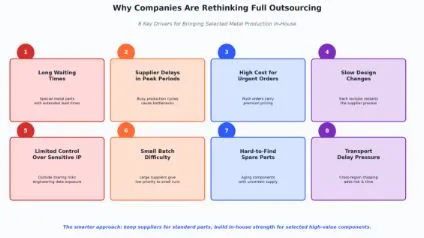
Figure 1: Eight Key Drivers for Bringing Selected Metal Production In-House — Long waits, supplier delays, urgent costs, slow design changes, IP risk, small batches, spare parts, transport pressure.
Outsourcing is still important. Many suppliers have deep experience, strong equipment, and trusted quality systems. But companies are becoming more careful about which parts they keep outside and which parts they bring closer to home.
The new question is simple: which parts are too important to wait for?
Automotive and aerospace teams are paying closer attention to parts that are complex, urgent, sensitive, or likely to change during development. These parts can create delays when they are fully dependent on outside suppliers.
Common reasons for bringing some production in-house include:
Long waiting times for special metal parts
Supplier delays during busy production periods
High cost for urgent orders
Slow design changes when parts must be reordered
Limited control over sensitive engineering designs
Difficulty getting small batches from large suppliers
Spare parts that are hard to find
More pressure to reduce transport delays
This does not mean every company should make every part itself. The smarter approach is to keep suppliers for many standard parts while building in-house strength for selected high-value components.
From Long Supply Chains to Local Production
Figure 2: Traditional vs. Local Supply Chain — Long 5-step external chains with transport risk vs. short 3-step in-house production with direct control.
Traditional supply chains often depend on many steps. A part may be designed in one location, made in another, shipped across regions, checked at a separate facility, and then moved again before final use. This system can work well when everything runs smoothly. But when one step fails, the whole process can slow down.
In-house metal additive manufacturing gives companies another option. Selected parts can be produced near the engineering team or near the production line. This can reduce waiting time and give teams more direct control over the process.
The value is not only speed. Local production also makes design changes easier. If an engineer needs to adjust a part, the team can update the digital file and produce a new version without restarting a long supplier process.
How Metal Additive Manufacturing Helps Supply Chain Security
Metal additive manufacturing builds parts from a digital design. Instead of cutting a shape from a large block of metal, it creates the part layer by layer. This makes it useful for complex shapes, small batches, and parts that change during development.
For supply chain security, the biggest benefit is flexibility. Companies can respond faster when a part is delayed, redesigned, or needed in a small quantity.
Digital Files Can Reduce Inventory Pressure
Many companies keep physical spare parts in storage because they worry about future supply problems. This can take up space and money, especially when parts are rarely used.
With a controlled in-house process, some qualified parts can be stored as digital files instead. When the part is needed, the company can print it. This does not work for every part, but it can help with low-volume or older components when the process is properly tested and approved.
Design Changes Can Move Faster
During product development, parts often change many times. With a fully outsourced process, every change can mean new communication, new quotes, new waiting time, and new delivery schedules.
When selected metal printing is handled in-house, changes can move faster. Engineers can test a shape, review the result, adjust the design, and make the next version with less delay.
This is especially useful in automotive and aerospace work, where weight, strength, fit, and space are all important.
Critical Parts Can Be Made Closer to the Point of Need
Some parts are too important to wait for. If a tool, bracket, fixture, or spare part is needed quickly, an in-house printing setup can help teams respond faster.
This local production model is not about mass-producing every component. It is about having a reliable option when timing matters.
Sensitive Designs Can Stay Inside the Company
Automotive and aerospace companies often work on new designs, performance parts, test components, and advanced structures. Sending these files to several outside suppliers can increase the risk of information exposure.
By making selected parts in-house, companies can keep more control over sensitive design work. This is especially useful during early development and testing.
Automotive Companies Are Building In-House Micro-Factories
The automotive industry is changing quickly. Electric vehicles, lighter structures, custom parts, faster model updates, and shorter development cycles are creating new pressure on engineering teams.
In this environment, in-house micro-factories are gaining attention. A micro-factory is a small, focused production area inside a larger company. It may not replace a full factory, but it can handle important jobs such as prototypes, tooling, test parts, spare parts, and small-batch components.
Deploying a high-performance industrial metal 3D printer enables automotive companies to iterate on complex, topology-optimized parts within hours.
In simple words, this means teams can test parts that are shaped to be lighter and stronger without waiting for a long outside production process. A bracket, housing, cooling part, or test component can be adjusted quickly during development.
For automotive companies, this speed matters. It can help reduce delays, support faster testing, and give engineers more room to improve designs before final production.
Aerospace Companies Need Control and Confidence
Aerospace manufacturing has even higher pressure because many parts are expensive, complex, and safety-related. A delayed component can affect repair work, testing, or delivery schedules. At the same time, every part must follow strict quality rules.
In-house metal additive manufacturing can support aerospace teams in several areas. It can help with prototypes, tooling, test parts, lightweight structures, complex ducts, brackets, heat exchangers, and spare part planning.
However, aerospace use must be handled carefully. A printed metal part is not ready for flight just because it has been produced. Companies still need material control, testing, inspection, records, and approved procedures.
This is why aerospace companies look at additive manufacturing as both a production tool and a quality system. The machine is only one part of the process. The full workflow must be stable and repeatable.
What an In-House Metal Additive Manufacturing Cell Includes
Figure 3: 10 Essential Components of an In-House Metal AM Cell — 3D printer, powder handling, build software, heat treatment, support removal, CNC finishing, inspection, material storage, trained operators, quality records.
A strong in-house setup is more than one machine. To produce useful metal parts, companies need a complete working area with the right tools, people, and quality steps.
A typical in-house metal additive manufacturing cell may include:
Metal 3D printer
Safe powder handling area
Build preparation software
Heat treatment equipment
Support removal tools
CNC finishing or surface finishing equipment
Inspection and measuring tools
Material storage process
Trained operators
Clear quality records
This setup can be small compared with a full production plant, but it must still be organized. If the workflow is not planned properly, the company may face delays, failed builds, or quality problems.
Where In-House Metal Printing Helps Most
Figure 4: Supply Chain Risk → Impact → AM Solution Mapping — Long lead times, small batches, design changes, and sensitive IP risks each matched to specific in-house AM benefits.
In-house metal additive manufacturing is strongest when it is used for the right parts. It is not the best answer for every component. It works best where speed, design freedom, low volume, or supply risk are major concerns.
Supply Chain Risk
Impact on Manufacturers
How In-House Metal Printing Can Help
Long supplier lead times
Projects slow down while teams wait for parts
Selected parts can be made closer to the team
Small-batch demand
Suppliers may charge more or give lower priority
Low-volume parts can be produced without special tooling
Frequent design changes
Each change can create new delays
Digital files can be updated faster
Hard-to-find spare parts
Repairs may take longer
Qualified parts can be produced when needed
Complex part shapes
Traditional production may be slow or costly
Complex shapes can be printed more directly
Sensitive design files
More outside sharing can increase risk
Key development work can stay in-house
The best strategy is not to print everything. The best strategy is to identify the parts that create the most risk when they are delayed, changed, or difficult to source.
Why Lightweight Part Design Matters
Automotive and aerospace companies are always looking for ways to reduce weight while keeping parts strong. Lighter parts can improve performance, save energy, and support better product design.
Metal additive manufacturing is useful because it can create shapes that are hard to make with many traditional methods. Engineers can remove material where it is not needed and keep strength where it matters most.
This is important during development. A team can test different shapes faster and learn which design works best. For companies under pressure to launch better products faster, this can be a major advantage.
The Challenges Companies Must Plan For
In-house metal additive manufacturing can improve supply chain control, but it is not a simple plug-in solution. Companies need to prepare for the full process.
Material Control
Metal powder must be handled, stored, and used carefully. Different materials behave differently during printing and after finishing. Companies must understand which material fits each part and how to keep results consistent.
Operator Training
Metal printing needs trained people. Operators must understand machine setup, powder safety, file preparation, printing, cleaning, and post-processing. Without proper training, the risk of failed parts increases.
Post-Processing
Many printed metal parts need extra steps after printing. This can include heat treatment, support removal, machining, polishing, or inspection. These steps should be included in the production plan from the beginning.
Quality Records
In-house production still needs records. Companies should track materials, machine settings, build results, inspection data, and final part approval. This is especially important in aerospace, automotive, medical, and other controlled industries.
What Buyers Should Look for in Equipment
When companies choose equipment for in-house metal additive manufacturing, they should think beyond the purchase price. A machine must fit the company’s part sizes, materials, production goals, and quality needs.
Important points to review include:
Build size for target parts
Printing speed for expected workload
Stable output across repeated jobs
Supported metal materials
Software for preparing and tracking builds
Safe powder handling process
Maintenance support
Operator training
Connection with finishing and inspection steps
Ability to support both testing and small-batch production
For companies comparing equipment partners, Forgecise offers industrial 3D printing equipment and additive manufacturing support for sectors such as automotive, aerospace, medical, mold manufacturing, and industrial applications.
The right partner should help the company look at the full workflow, not only the printer. This includes materials, software, training, technical service, and the steps needed after printing.
What This Means for Suppliers
The move toward in-house metal additive manufacturing does not mean suppliers will disappear. In many cases, suppliers will still handle standard parts, large-volume production, finishing work, material support, and special production tasks.
But supplier roles may change. Companies may expect suppliers to respond faster, support digital production, provide better technical support, and work more closely with internal engineering teams.
Some suppliers may also become part of a more flexible production network. Instead of one long supply chain, companies may use a mix of trusted suppliers, local production cells, and in-house printing teams.
The Future Will Be Hybrid
Figure 5: The Hybrid Manufacturing Future — Trusted suppliers (standard/volume parts) + Local production cells (urgent/sensitive parts) + Flexible network (risk diversification & faster response).
The future of manufacturing is not fully outsourced and not fully in-house. It is likely to be hybrid. Companies will continue to use suppliers for many parts while building internal ability for urgent, complex, or sensitive components.
This model gives manufacturers more choices. If a supplier is delayed, the company may have another route. If a design changes, the team may be able to test it faster. If a spare part is hard to find, the company may be able to produce it with a qualified process.
For automotive and aerospace companies, this flexibility is becoming a supply chain strategy. Metal additive manufacturing is no longer only a production technology. It is becoming a way to reduce risk, protect timelines, and keep important projects moving.
Final Thoughts
In-house metal additive manufacturing is becoming more important because companies want more control over critical parts. Long lead times, supplier delays, design changes, and spare part shortages have pushed manufacturers to rethink how they manage production risk.
An industrial metal 3D printer can help companies build a stronger internal response system for selected parts. It can support faster development, local production, smaller batches, and more control over sensitive designs.
The strongest results come when companies use this technology with a clear plan. It should be part of a complete workflow that includes materials, trained people, finishing, inspection, and quality records. When used this way, metal additive manufacturing can help smart manufacturers build a safer, faster, and more flexible supply chain.
Why are companies bringing metal additive manufacturing in-house?
Companies are bringing it in-house to reduce waiting time, respond faster to design changes, protect sensitive designs, and gain more control over critical metal parts.
Does in-house metal 3D printing replace suppliers?
Usually, no. It supports a hybrid model. Companies still use suppliers for many parts, but they can produce selected urgent, complex, or low-volume parts internally.
Which industries benefit most from in-house metal additive manufacturing?
Automotive, aerospace, medical, mold manufacturing, tooling, and industrial equipment companies can benefit when they need complex parts, small batches, spare parts, or fast design changes.
What parts are good for in-house metal printing?
Good examples include prototypes, brackets, tooling parts, spare parts, lightweight structures, test components, repair parts, heat exchangers, and low-volume special parts.
What should companies prepare before setting up an in-house metal printing cell?
They should prepare equipment, metal materials, powder safety steps, trained operators, post-processing tools, inspection methods, and quality records.