Industrial Robot Arms:The Backbone of Modern Automation
Walk through almost any modern factory and you’ll likely see a robot arm at work — welding car frames, placing components on a circuit board, or picking and packing products at speeds no human could sustain for a full shift. Industrial robot arms have become one of the most recognizable symbols of automation, and understanding how they work and where they fit helps businesses decide whether — and how — to bring one into their own operations.
What an Industrial Robot Arm Does
At its core, an industrial robot arm is a programmable mechanical arm designed to perform tasks with precision and repeatability. It typically includes:
- A base – Fixed or mobile, anchoring the robot to the floor or a moving platform
- Multiple joints (axes) – Allowing movement in different directions, similar to a human shoulder, elbow, and wrist
- An end effector – The tool at the tip of the arm, such as a gripper, welding torch, or suction cup, chosen based on the task
- A controller – The system that runs programmed instructions, telling the arm exactly where to move and when
The number of axes determines how much freedom of movement the arm has — a simple 3-axis arm can only move in basic directions, while a 6-axis arm can rotate and position itself almost like a human arm, handling more complex tasks.
Common Types of Industrial Robot Arms
Articulated Robots The most common type, featuring rotary joints that mimic a human arm’s range of motion. Used widely for welding, painting, assembly, and material handling.
SCARA Robots Selective Compliance Articulated Robot Arms move quickly in a horizontal plane with limited vertical movement, making them well suited for fast pick-and-place tasks and assembly work.
Delta Robots Recognizable by their spider-like, three-armed design, delta robots excel at extremely fast, lightweight picking tasks — commonly seen in food packaging and sorting applications.
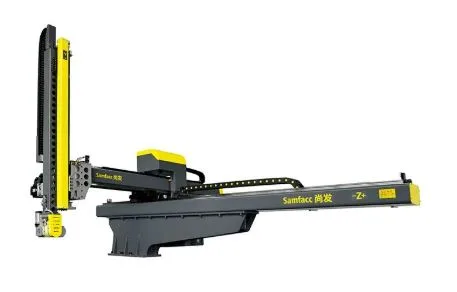
Cartesian Robots Move along straight lines on X, Y, and Z axes rather than rotating joints, often used for simpler pick-and-place or dispensing tasks where straight-line movement is sufficient.
Collaborative Robots (Cobots) Designed to work safely alongside human workers without extensive safety fencing, cobots typically move slower and include sensors to detect and stop upon contact, making them suitable for smaller businesses or mixed human-robot workflows.
Common Applications
- Welding – Consistent, high-precision welds on automotive and metal fabrication lines
- Material handling – Moving parts or products between stations, machines, or pallets
- Assembly – Placing components with precision, common in electronics and automotive manufacturing
- Packaging – Picking, placing, and palletizing products at high speed
- Painting and coating – Applying consistent coatings in environments that may be hazardous for human workers
- Machine tending – Loading and unloading parts from CNC machines or injection molding equipment
Key Factors When Choosing a Robot Arm
Payload Capacity Every robot arm has a maximum weight it can safely handle at full reach. Choosing a robot without enough payload capacity for the heaviest part it will handle leads to performance issues or premature wear.
Reach and Work Envelope The physical area a robot arm can access depends on its size and joint configuration. Mapping out the actual workspace and required movement range prevents choosing a robot that can’t reach necessary positions.
Speed and Precision Requirements Some tasks prioritize raw speed, like high-volume picking, while others prioritize precision, like delicate assembly work. Robot specifications typically list both repeatability (how consistently it returns to the same position) and speed, and it’s worth weighing which matters more for the specific application.
Integration With Existing Equipment A robot arm rarely works alone — it usually needs to interface with conveyors, sensors, vision systems, or other machinery. Confirming compatibility with existing control systems and communication protocols avoids costly integration issues after installation.
Safety Requirements Traditional industrial robots typically require safety fencing, light curtains, or other barriers to prevent worker injury, while collaborative robots are designed to operate without these measures. Understanding which category fits the work environment affects both cost and floor space planning.
Programming and Ease of Use
Robot arms can be programmed through several methods, including manual teaching (physically guiding the arm through a motion), offline programming using simulation software, or increasingly, simplified interfaces designed for operators without deep robotics expertise — particularly common with collaborative robots aimed at smaller manufacturers.
Maintenance Considerations
Industrial robot arms require periodic maintenance, including checking joint lubrication, inspecting cables and connectors, and recalibrating precision over time as components wear. Preventive maintenance schedules help avoid unplanned downtime, particularly important in high-volume production environments where a single robot often supports continuous operations.
Final Thoughts
Industrial robot arm offer a way to achieve consistent, high-speed, and precise automation across a wide range of manufacturing tasks, but choosing the right type depends heavily on payload, reach, speed, and integration requirements specific to the application. Evaluating the actual task requirements carefully — rather than choosing based on general capability alone — helps ensure the investment delivers the expected return in efficiency and consistency.