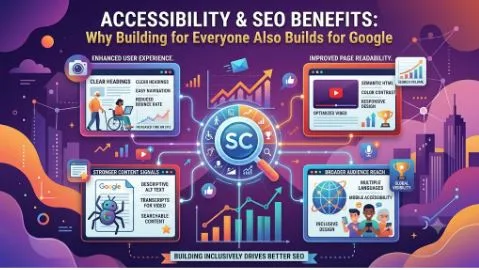
Accessibility and SEO Benefits: Why Building for Everyone Also Builds for Google
Most businesses treat accessibility and SEO as two separate checklists handled by two different people. That’s a missed opportunity, because a large share of what makes a website accessible to people with disabilities is the exact same work that helps search engines understand and rank that content properly.
This overlap isn’t a coincidence. Both accessibility and SEO depend on the same underlying principle: making content clearly structured and machine-readable, whether the “machine” is a screen reader interpreting a page for a visually impaired visitor, or a search engine crawler trying to understand what a page is actually about.
Nowhere is this clearer than in schema markup implementation, where the same structured code that helps search engines display rich results also gives assistive technology clearer signals about a page’s content type and structure.
Where Accessibility and SEO Genuinely Overlap
Alt text on images is the clearest example
Screen readers depend on alt text to describe images to visually impaired users. Search engines depend on the same alt text to understand what an image contains, since they can’t “see” pixels the way people can. Write good alt text once, and you’ve served both audiences simultaneously.
Heading structure works the same way
A clean hierarchy, one H1, logically nested H2s and H3s, helps screen reader users navigate a page section by section instead of listening to an undifferentiated wall of text. That same hierarchy helps search engines understand how a topic breaks down into subtopics, which directly affects how well a page can rank for related queries.
Descriptive link text matters for both audiences too
A screen reader user tabbing through links hears “click here, click here, click here” and has no idea where any of them lead. Search engines have a similar problem: vague anchor text tells them nothing about the linked page’s topic. Descriptive anchor text, like “Core Web Vitals optimization” instead of “click here,” fixes both issues at once.
Structured Data Is Where This Overlap Gets Underrated
A product page with proper structured data tells a screen reader and a search engine the same thing at the same time: this is a price, this is a review count, this is availability status, rather than leaving either system to guess from surrounding text alone. Getting this right matters more than most technical SEO checklists suggest, since a mismatch between what the code claims and what’s actually on the page undermines both the accessibility benefit and the search visibility benefit at once.
Why This Matters More Than It Used To
Accessibility compliance has shifted from a nice-to-have to a genuine legal and reputational concern for many businesses, particularly as accessibility lawsuits have increased in frequency across several markets. At the same time, search engines have gotten noticeably better at evaluating whether content is genuinely well-structured and usable, not just keyword-optimized.
That convergence means accessibility work is no longer purely a compliance cost sitting separately from marketing spend. Done properly, it’s dual-purpose infrastructure that serves real users with disabilities while simultaneously strengthening the technical foundation search engines reward.
A Practical Starting Point
None of this requires an accessibility specialist and an SEO specialist working from two unrelated checklists. The overlap is large enough that a single, well-planned pass- alt text, heading structure, descriptive links, and structured data- covers most of the shared ground in one process rather than two.
For businesses still working through broader fundamentals before tackling accessibility specifically, foundational structure matters most: headings, content organization, and technical setup covered under SEO basics for business owners, since accessibility improvements build on top of that foundation rather than replacing it.
Final Words
Accessibility and SEO aren’t competing priorities fighting for the same budget. They’re two outcomes of the same underlying discipline: building content that’s genuinely clear, well-structured, and easy for any system, human or machine, to understand correctly. Businesses treating them as separate line items are usually doing twice the work for outcomes that could have been achieved together, one clean, well-structured build at a time.