Does Online GCSE and A-Level Tutoring Actually Work? A Case Study in the Evidence
What the research really says about tutoring, in plain numbers, for parents across the GCC.
KEY FACTS AT A GLANCE
|
Many parents ask a simple question before they spend a single dirham: does tutoring really work, or does it just feel like progress? It is a fair question. This piece answers it with real research, not sales talk, and keeps the numbers plain.
What is online GCSE and A-Level tutoring?
Online GCSE and A-Level tutoring is live, scheduled teaching delivered over the internet by a subject specialist. The tutor follows the same exam-board syllabus the student studies at school. Lessons happen in real time, so the student can ask questions, show working, and get instant feedback.
It is not a video library or a recorded course. It is a live lesson, moved online.
Does tutoring actually improve grades?
Yes. This is one of the most studied questions in education. The Education Endowment Foundation, a respected UK research charity, reviewed more than 100 studies on one-to-one tutoring alone. The finding is clear: good tutoring reliably lifts results.
The key word is good. Not all tutoring helps equally, and the evidence is honest about that too.
How much can tutoring improve results?
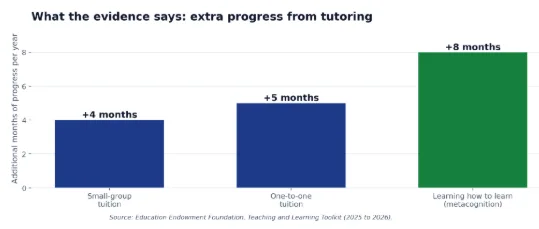
The EEF measures impact in extra months of progress: how much further a tutored student gets in a year, compared with a similar student who was not tutored. Here is what it found.
| Approach | Extra progress per year | What it means |
|---|---|---|
| Small-group tuition | +4 months | One teacher with 2 to 5 students |
| One-to-one tuition | +5 months | Full individual attention |
| Learning how to learn | +8 months | Students plan, check and review their own work |
Read those numbers plainly. A student who gets small-group tutoring can move roughly four months ahead of where they would have been. The biggest gain of all comes from teaching students how to manage their own learning, which good tutors do every lesson.
Why does small-group online tutoring work so well?
Small live groups combine the best parts of a class and a private lesson. Four things drive the results:
- Tiny class sizes. With 2 to 5 students, the tutor sees every answer and catches mistakes early.
- Instant feedback. Feedback is one of the highest-impact things a teacher can give, and live lessons deliver it in the moment.
- Targeted help. Tutoring works best when it fixes a student’s specific gaps, not the whole syllabus again.
- Self-checking habits. Good tutors teach students to plan and review their own work, the single highest-impact skill in the research.
When does tutoring not work? An honest look
Tutoring is not magic. The same research that praises it also shows where it fails, and parents deserve to know both sides.
- It underperforms when it is not targeted, and simply repeats what school already covered.
- It underperforms when the tutor is untrained or does not know the exact specification.
- In one EEF trial of online maths tutoring, poorly targeted sessions showed no clear gain at all. Quality and focus are what make the difference.
The lesson is simple: the format matters less than the tutor and the plan behind it.
What good online tutoring looks like
Use this quick checklist to judge any provider:
- The tutor specialises in the subject and knows your child’s exact exam board.
- Groups are small, or lessons are one-to-one, with live interaction.
- Support is targeted at your child’s weak topics, not a generic re-run.
- Progress is reported by topic, so you can see what has improved.
Why this matters for GCC families now
The Gulf is moving online faster than almost anywhere. That shift makes strong tutoring easier to reach, wherever a family lives.
- A growing market. GCC e-learning is forecast to grow from USD 6.8 billion in 2024 toward USD 24.2 billion by 2033, according to IMARC.
- Policy support. The UAE has added AI to the school curriculum from kindergarten upward in the 2025 to 2026 year.
- Near-universal access. With UAE internet penetration around 99%, a specialist tutor is reachable from Muscat or Dammam as easily as from Dubai.
Frequently asked questions
Is online tutoring as good as in-person tutoring?
For most students, yes. The research shows results depend on the quality of teaching and how well it targets a student’s needs, not on whether the lesson is online or in a room.
How many students should be in an online class?
Two to five is the sweet spot. It is small enough for the tutor to see every student’s work, and the evidence rates this group size as highly effective.
When should my child start tutoring?
Earlier is better. Starting at the beginning of the course lets a tutor fix gaps before they grow. Waiting until the final term limits how much can be done.
Does tutoring help with IGCSE and A-Level specifically?
Yes, especially when the tutor teaches to the exact board and paper structure. Exam-specific practice and feedback are where tutoring adds the most value.
How do I know if it is working?
Look for early signs within a month: your child can explain their working, makes fewer careless errors, and attempts harder questions without avoiding them.
Is small-group tutoring better than one-to-one?
Both work well. One-to-one gives slightly more progress on average, but well-run small groups are highly effective and usually more affordable, so many families start there.
How long before we see results?
Confidence and fewer errors often show within a few weeks. Grade movement usually follows over a term, once the underlying gaps are fixed and exam technique improves.
The bottom line
The evidence is settled on the main question. Good tutoring works, and it can move a student months ahead in a single year. What decides the outcome is not whether the lesson is online, but whether the tutor knows the subject, targets the right gaps, and teaches the student to think for themselves. Choose on those three things, and the format takes care of itself.