How to Choose the Right E-Bike for Seniors
An e-bike can be a practical way for older adults to stay active, run errands, enjoy local trails, and ride farther without putting as much strain on their legs. But the best e-bike for seniors is not necessarily the fastest or most powerful model. Comfort, stability, easy mounting, predictable motor assistance, and confident braking usually matter more.
The right choice also depends on the individual rider. A senior who mainly rides paved neighborhood streets may need a very different bike from someone who regularly encounters hills, gravel roads, or rough trails.
Here are the most important factors to consider when choosing an e-bike for seniors.
1. Start With a Frame That’s Easy to Get On and Off
One of the first things to consider is how easily the rider can mount and dismount the bike.
Traditional step-over frames require the rider to lift one leg relatively high over the top tube. That may be fine for experienced cyclists, but it can become inconvenient for riders with limited flexibility.
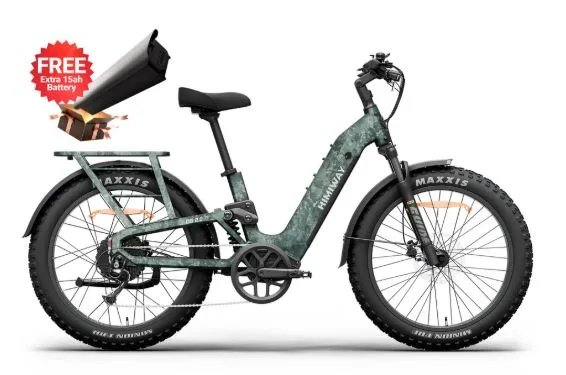
A step-through e-bike provides a lower entry point, allowing the rider to step through the frame rather than swing a leg over it.
For many seniors, this design can make starting and stopping feel much more manageable, especially when riding frequently around town.
Models such as the Himiway D5 2.0 ST are worth considering when easy mounting is a priority.
However, don’t assume every senior automatically needs a step-through bike. Riders who are comfortable with traditional frames may prefer a step-over design. The important question is whether the rider can repeatedly mount and dismount the bike comfortably and confidently.
2. Pay Attention to Bike Size, Not Just Wheel Size
A bike that feels too tall or too large can make stopping uncomfortable. Ideally, the rider should be able to reach the handlebars, brake levers, and pedals naturally without feeling stretched.
Seat height and standover height deserve particular attention.
When stopping, some riders prefer being able to put a foot down quickly. A lower bike can make this easier and may increase confidence during slow-speed riding.
The Himiway D5 2.0 20″ is an interesting option in this respect. Its compact 20-inch wheel format and lower center of gravity are designed to make the bike easier to maneuver than a larger fat-tire bike.
The smaller wheels shouldn’t automatically be interpreted as meaning the bike is only for small riders. Fit should always be determined by the complete geometry and manufacturer’s recommended rider-height range.
3. Look for a Stable, Predictable Ride
Stability becomes particularly important at low speeds, when starting from a stop, making tight turns, or riding over uneven pavement.
Several features can contribute to stability:
- A relatively low center of gravity
- Proper frame sizing
- Wider tires
- Predictable steering
- A comfortable riding position
- Smooth motor assistance
Fat tires can be useful because their larger contact patch and air volume can provide additional cushioning on broken pavement, gravel, and other uneven surfaces.
Himiway models such as the D5, D5 Pro, D5 2.0, and D5 2.0 20″ use fat-tire designs that may appeal to riders who value comfort and stability.
Wide tires do not eliminate the need for good riding technique, though. Tire pressure, road conditions, speed, and rider skill still have a major influence on handling.
4. Choose an Upright and Comfortable Riding Position
Comfort becomes increasingly important as rides get longer.
An aggressive forward-leaning cycling position can place additional pressure on the wrists, shoulders, neck, and lower back. Many recreational senior riders prefer a more upright position.
Look for a bike that allows the rider to keep the back relatively neutral and the handlebars within comfortable reach.
The saddle matters too. A supportive saddle can improve comfort, but simply choosing the widest or softest seat isn’t always the answer. Saddle height, shape, riding posture, and personal anatomy all affect comfort.
Before buying, check whether the seat and handlebars offer enough adjustment to fit the intended rider.
5. Suspension Can Make Rough Roads More Comfortable
Suspension isn’t essential for every senior rider. Someone riding exclusively on smooth bike paths may not need much of it.
For riders dealing with potholes, cracked pavement, gravel, or uneven trails, however, suspension can noticeably improve comfort.
The Himiway D5 2.0 uses a full-suspension design, while the compact D5 2.0 20″ also combines front and rear suspension with wide tires.
In everyday riding, this combination can help isolate the rider from repeated small impacts rather than transferring every bump directly through the saddle and handlebars.
That can be particularly useful for longer recreational rides.
6. Choose Smooth Motor Assistance, Not Just More Power
Motor wattage receives a lot of attention when people shop for e-bikes, but power delivery can matter just as much as maximum output.
For seniors, sudden acceleration can make an otherwise powerful bike difficult to control.
A torque sensor detects how much force the rider applies to the pedals and adjusts motor assistance accordingly. Push gently and the motor provides gentle assistance; pedal harder and it provides more.
This often creates a more bicycle-like and predictable riding experience.
A cadence sensor works differently. It detects whether the pedals are rotating and then activates assistance according to the selected level. Some riders like this because relatively little pedaling effort is required.
Neither system is automatically best for everyone.
The Himiway D5 2.0 Series, for example, provides sensor options designed to accommodate different riding preferences. A rider who values natural-feeling assistance may prefer torque-based control, while someone who wants easier pedaling may appreciate cadence-based assistance.
7. Consider Whether You Actually Need a Throttle
A throttle can be convenient.
It may help when starting from a stop, moving through a short difficult section, or temporarily riding without pedaling. This can be useful when carrying groceries or dealing with an incline.
However, riders should learn how the throttle responds before using it in traffic or crowded areas. Unexpected acceleration can be intimidating for someone who has never ridden a throttle-equipped e-bike.
New riders should practice starting, stopping, turning, braking, and throttle control in an open area before riding on public roads.
Also check local e-bike laws because throttle rules and e-bike classifications vary by location.
8. Don’t Compromise on Braking
A senior-friendly e-bike should be easy to stop confidently.
This becomes especially important with heavier e-bikes because the motor, battery, frame, and wider tires can make them considerably heavier than conventional bicycles.
Hydraulic disc brakes are particularly useful because they can provide strong braking performance without requiring excessive pressure at the brake lever.
When comparing models such as the Himiway A7, A7 Pro, D5 Series, D7, or D7 Pro, look beyond motor and range specifications and examine the braking system as well.
Good brakes should provide predictable modulation rather than feeling like an on/off switch.
9. Bike Weight Matters More Than Many Buyers Expect
This is one of the most overlooked considerations when buying an e-bike for seniors.
Fat-tire e-bikes can be heavy. A powerful motor, large battery, suspension components, and reinforced frame all add weight.
That isn’t necessarily a problem while riding because the motor assists with propulsion. It becomes more noticeable when you need to:
- Push the bike without power
- Move it around a garage
- Lift it over a curb
- Put it on a bike rack
- Load it into an SUV or truck
- Carry it upstairs
For example, the Himiway D5 2.0 20″ weighs around 80 lb. Its compact dimensions can make it easier to maneuver than some larger bikes, but 80 lb is still substantial if the rider regularly needs to lift it.
This is why shoppers should consider both riding comfort and off-bike handling.
10. Match Battery Range to Real Riding Needs
More range sounds better, but seniors don’t necessarily need the largest battery available.
Think about actual trips.
If most rides involve a five-mile trip to a park, grocery store, or friend’s house, paying for an enormous battery may provide little practical benefit. Longer recreational rides, hilly terrain, frequent throttle use, and higher assistance levels increase energy consumption.
Manufacturers’ maximum range figures should also be treated as estimates rather than guarantees.
Real-world range varies with:
- Rider and cargo weight
- Hills
- Wind
- Temperature
- Tire pressure
- Speed
- Pedal-assist level
- Throttle use
- Road surface
For longer-distance riders, models such as the Himiway D5 2.0 can make sense because they combine a large battery with a long-range design. For shorter neighborhood trips, range may be less important than comfort and handling.
11. Look for a Clear, Simple Display
An e-bike doesn’t need dozens of complicated settings to be useful.
For many older riders, simplicity is an advantage.
The display should make important information easy to check while riding, including:
- Current speed
- Battery level
- Pedal-assist level
- Trip distance
Controls should also be positioned so the rider doesn’t have to remove a hand from the handlebar to change basic settings.
During a test ride, try changing the pedal-assist level without looking down for an extended period. If basic controls feel confusing in a parking lot, they probably won’t become easier in traffic.
12. Integrated Lights Improve Everyday Practicality
Front and rear lights are worth prioritizing even if most rides happen during daylight.
Lighting isn’t only about seeing the road at night. It also helps other road users notice the cyclist.
Integrated e-bike lights are particularly convenient because the rider doesn’t need to remember to charge separate lights before every trip.
If the bike will be used for commuting, shopping, or evening recreational rides, integrated lighting should be high on the checklist.
13. Think About the Rider’s Main Purpose
There isn’t one universally best e-bike for every senior.
The riding environment should determine the type of bike you choose.
| Riding Need | Features to Prioritize |
| Neighborhood riding | Upright position, simple controls, comfort |
| Grocery trips | Stable frame, rack compatibility, good payload |
| Long recreational rides | Large battery, comfortable saddle, suspension |
| Shorter riders | Low standover, compact geometry |
| Rough pavement | Wide tires and suspension |
| Hilly areas | Strong motor, good brakes, suitable gearing |
| Frequent stops | Step-through frame, easy starts |
| Trails | Suspension, appropriate tires, strong brakes |
Someone who primarily rides paved streets may find a comfort-oriented model such as the Himiway A7 or A7 Pro more appropriate, while riders who regularly encounter rougher surfaces may prefer a fat-tire or full-suspension model from the D5 or D7 families.
The Himiway C3 may also be worth considering for riders whose intended use and preferred geometry match its design.
14. Which Himiway E-Bike Is Better for Seniors?
Rather than declaring one model the best for everyone, it is more useful to match the bike to the rider.
Himiway D5 2.0 20″
A strong candidate for riders who want compact geometry, a lower center of gravity, wide tires, and full suspension. Its 20-inch format can feel easier to maneuver, although its roughly 80 lb weight should be considered carefully.
Himiway D5 2.0 ST
Worth considering when easier mounting and dismounting are priorities. The step-through configuration can be particularly useful for riders who don’t want to swing a leg over a high top tube.
Himiway D5 2.0
Better suited to riders who want a full-size fat-tire e-bike with substantial power, suspension, and long-distance capability.
Himiway A7 / A7 Pro
Good models to investigate for riders whose primary use is commuting, paved-road riding, errands, and everyday transportation.
Himiway D5 / D5 Pro
Suitable for riders attracted to the stability and versatility of traditional fat-tire e-bikes.
Himiway D7 / D7 Pro
More relevant to riders who expect more demanding terrain and want a capable adventure-oriented e-bike.
Himiway D5 2.0 Camo
An alternative within the D5 2.0 family for riders who like its particular styling while wanting the characteristics of the D5 platform.
Don’t choose solely from this list. Verify current specifications, rider-height recommendations, bike weight, payload, brakes, battery, and local e-bike classification before purchasing.
15. Test the Bike Before Making a Decision
Specifications can’t tell you whether an e-bike actually feels comfortable.
Whenever possible, take a test ride.
Start with the motor assistance at its lowest setting and check whether you can comfortably:
- Get on and off the bike.
- Put a foot down when stopping.
- Reach both brake levers.
- Turn the handlebars at low speed.
- Start smoothly without wobbling.
- Control the motor assistance.
- Make a tight U-turn.
- Push the bike manually.
- Read the display while riding.
- Stop quickly and confidently.
Spend extra time practicing at low speeds. Riding slowly often requires more balance and control than cruising along a straight road.
Common Mistakes Seniors Should Avoid
One common mistake is buying the most powerful e-bike simply because its specifications look impressive. A 750W motor and large battery can be useful, but they don’t compensate for poor fit.
Another mistake is ignoring weight. A bike can feel wonderfully stable while riding yet be extremely difficult to move around the garage.
Don’t automatically choose the largest wheels, widest tires, biggest battery, or longest advertised range either. Every feature involves tradeoffs.
The goal isn’t to buy the e-bike with the biggest numbers. It’s to find the bike that the rider feels comfortable using regularly.