What the Easiest Replit Alternatives Owe to the Spreadsheet
What does the easiest software in the world look like? I think it looks like a cell with a formula in it.
Somewhere right now there is a spreadsheet deciding what a company charges. Nobody calls it software. It has no version history, no tests, no engineer assigned to it, and it has been setting prices for eleven years. The person who built it left in 2019.
That spreadsheet is the most successful piece of end-user programming ever shipped. It is also why the current argument about the easiest Replit alternatives feels so familiar.
The last time everyone built software
The spreadsheet did something no tool had managed before it. It let people who could not program build real business logic, on a Tuesday afternoon, without asking anyone’s permission.
Whole industries got modeled in it. Payroll, inventory, commissions, loan schedules, the budget your CFO still keeps a personal copy of.
It also came with a defect that never got fixed. Ray Panko has spent decades studying spreadsheet accuracy, and his 2016 review of that research is blunt about the arithmetic of scale.
“Spreadsheet errors are rare on a per-cell basis, but in large programs, at least one incorrect bottom-line value is very likely to be present.” Ray Panko, 2016
Per cell, people do fine. Across ten thousand cells somebody is wrong somewhere, and the tool holds no opinion about which cell it is.
That is the inheritance: enormous reach, no verification.
What changed?
For about fifteen years, very little. SaaS arrived and the answer to “we need software” became “we’ll rent it.” You stopped building and started configuring someone else’s product, which handled the correctness problem by making it someone else’s problem.
The spreadsheet made everyone a modeler. SaaS made everyone a tenant. AI builders are making everyone a builder again.
The current tools describe themselves in terms of speed, and the speed is real. You type a paragraph about a job tracker and a job tracker appears.
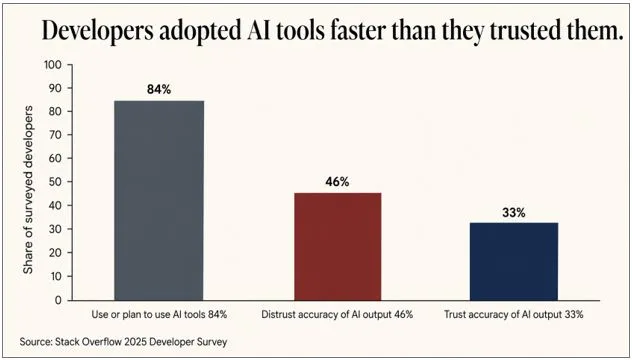
What the speed has not delivered is confidence. In Stack Overflow’s 2025 Developer Survey, 84% of developers said they use or plan to use AI tools, while 46% said they distrust the accuracy of what those tools produce, against 33% who trust it. Adoption climbed. Trust fell.
Those numbers describe professional programmers, people who can read the output and catch the mistake. As of July 2026 the same tools are landing on the desks of operations managers, and the SBA counts 36.2 million small businesses in the US, 99.9% of all American businesses, almost none of which employ a developer.
Why easy stopped meaning fast
So here is the answer to the question sitting underneath most searches for the easiest Replit alternatives.
The easiest Replit alternatives in 2026 are the ones where a non-programmer can change the app after it exists, which is a different property from generating it quickly.
Every tool in the category can turn a description into working software. Far fewer can show you where a rule lives once that rule turns out to be wrong.
The gap shows up at a predictable moment. Something in the business shifts, a rate or a threshold or an approval step, and somebody has to go find the single place the old version is written down.
In a good tool, it takes four minutes. In a weaker one, it takes a message to whoever set it up, and then it takes however long they feel like taking.
Ease used to describe the first hour. It now describes the second month.
Two gifts and one debt
The spreadsheet handed down three things, and they come apart cleanly.
The first gift was authorship. Anyone could build.
The second gift was transparency. You could click a cell and see the formula, and that one behavior is why spreadsheets survived forty years of attempts to replace them.
The debt was verification. Nothing ever told you the formula was wrong.
Measured against that inheritance, this generation has delivered the first gift completely. Authorship is solved. Someone with no technical background can produce working software in an afternoon, which was not true in 2022.
The second gift is where the tools separate. Some generate code and hand it over, which is transparent to a programmer and opaque to everyone else. Some generate an app and expose its logic visually. Some generate an app and give you a prompt box, so changing it means asking again and hoping.
The debt is untouched. Nothing in this category will tell you your approval rule runs backwards.
Ask any of these tools to build a discount approval flow and it will build one. Ask whether the threshold belongs at 15% or 20% and it has nothing to offer, because that was never a software question. It was a question about your business, and you answered it in passing while typing the prompt.
The tools betting on transparency
Transparency is a decision a company makes early and cannot easily retrofit, which makes it a useful thing to look at when comparing platforms.
Zite is built on the assumption that whoever inherits an app is not whoever built it. The AI writes the workflows behind the app, and the visual editor exists so a second person can open one and read it step by step, the way you would read a flowchart. Underneath, the database sits in a spreadsheet-like view, a deliberate borrowing from the tool everyone already knows how to read.
That is a narrower bet than it sounds. It gives up the buyer who wants generated code to own outright, and the platform pays for the choice elsewhere: it is newer, its template library is thinner than Bubble’s, there is no code export, and background automations remain limited.
Other companies made different bets, and several are right for different buyers. Lovable hands you the code, which matters if you plan to hire a developer later. Glide reads a spreadsheet directly, the shortest available distance from the old world to the new one. Bubble asks for weeks of your life and returns a level of control nothing else in the category offers. n8n addresses a problem that often turns out not to be an app problem.
The accident worth copying
Here is the part I keep coming back to.
The spreadsheet’s transparency was an accident. Nobody designed the formula bar as an accountability feature. It existed because the calculation had to live somewhere, and the somewhere happened to be visible.
Forty years of enterprise software then went into hiding logic behind interfaces, and users spent the same forty years exporting to Excel to get it back.
What this generation is deciding, mostly without announcing it, is whether to repeat the accident deliberately. A handful of companies are treating it as a design principle. Zite’s visual workflow editor is one expression of that, and it will not be the last.
That pricing spreadsheet is still running. It is probably wrong somewhere, in a cell nobody has opened since 2019, by an amount too small to notice and too large to be fine.
It has survived anyway, because when somebody finally goes looking, the answer will be sitting right there in the formula bar, in plain sight. Visible, though never verified.
Visible is the lower of the two ambitions. It is also the one the new tools are still deciding whether to inherit.