SASSA SRD R370 Payment Issues: Common Reasons and What Beneficiaries Can Do
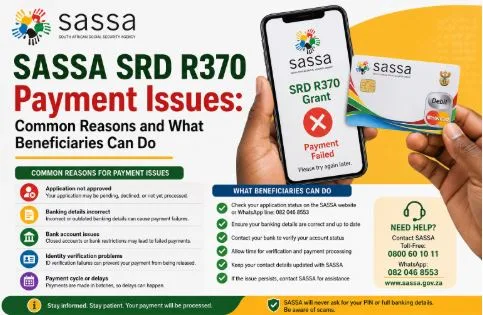
For many South Africans, the SASSA Social Relief of Distress (SRD) grant is an important source of financial support. When an expected payment is delayed, declined, or does not arrive in a beneficiary’s bank account, it can be difficult to know what went wrong.
A payment problem does not always mean that an application has been permanently rejected. Issues can sometimes be related to banking details, verification, eligibility, payment processing, or changes in a beneficiary’s personal information.
Knowing what to check can help beneficiaries identify the problem and take the appropriate next step.
Common Reasons for SASSA SRD R370 Payment Problems
1. Incorrect or outdated banking details
One of the first things beneficiaries should check when an SRD payment does not arrive is their banking information.
A bank account may have been closed, a beneficiary may have changed banks, or previously submitted information may no longer be correct. Even a small error in account information can potentially affect the payment process.
Beneficiaries who need to change their payment information can use the Sagrant.co.za guide on how to update SASSA SRD R370 banking details, which explains the process and the information that should be checked before submitting a banking-details update.
It is also important to make sure that the banking information being submitted is accurate and belongs to the beneficiary where required by the applicable SASSA process.
2. Banking details were recently changed
Updating banking information does not necessarily mean that a payment already being processed will immediately move to the new account.
Payment processing and verification can take place separately. As a result, beneficiaries who recently changed their bank details may need to allow time for the updated information to be processed.
For this reason, it is better to update banking information as soon as a beneficiary knows that an existing account can no longer be used.
Beneficiaries should also avoid repeatedly changing their banking details without a genuine reason, as unnecessary changes can make it more difficult to determine which information is currently being processed.
3. The application is still under verification
Some SRD applications may remain under verification while information supplied by the applicant is checked against relevant records.
A pending or verification-related status should not automatically be interpreted as a final rejection. Beneficiaries should first review the status shown for the relevant application period and follow any instructions provided through the official process.
For the latest information about SRD grants and SASSA services, beneficiaries should rely on SASSA’s official website rather than unofficial social-media posts or messages.
4. Personal information does not match
Payment problems can also occur when personal information supplied during an application does not match information held in relevant records.
Applicants should ensure that information such as their identification details and other required personal information is accurate.
If there is a mismatch, the beneficiary should follow the official process for addressing the issue instead of submitting random changes or relying on third parties claiming they can fix the application.
5. The application was declined
A missing payment is not always a banking problem.
An SRD application can be declined when the applicant does not meet the applicable eligibility requirements or when verification identifies information that affects eligibility.
Beneficiaries should check the reason associated with a declined application. Understanding the reason is important because the appropriate response depends on the specific issue.
Where an appeal is available, it should be submitted through the official SASSA process and within the applicable timeframe.
6. Payment processing may still be in progress
Beneficiaries sometimes assume that an approved application means the money must already be available in their bank account.
However, an approval or payment-related status and the actual availability of funds are not necessarily the same thing. Payment processing can take additional time.
If a beneficiary sees that a payment has been processed but the money is not showing in the account, they should check the relevant payment information and banking account before assuming that the payment has been lost.
7. The bank account cannot receive the payment
A beneficiary may also experience a problem if the bank account provided is no longer active or cannot receive the relevant payment.
This can happen after closing an account, changing banks, or entering incorrect banking information.
Checking the account directly with the bank can help determine whether the account is active and able to receive payments.
If the problem is related to the information submitted to SASSA, the beneficiary should use the appropriate official process to update the banking details.
What to Do When Your SASSA SRD Payment Is Missing
If an expected SRD payment has not arrived, beneficiaries can work through a few basic checks before taking further action.
Step 1: Check the application status
Start by checking the current status of the relevant SRD application or payment period.
The status can help determine whether the application is approved, pending, declined, or associated with another issue.
Step 2: Review your banking information
If the application is approved but the payment has not arrived, check whether the banking details associated with the application are still correct.
Pay particular attention if you recently changed banks or closed an account.
Step 3: Check your bank account
Make sure the account is active and able to receive payments. If necessary, contact the bank to confirm whether there is any restriction affecting incoming funds.
Step 4: Check the reason for a decline
If the application has been declined, review the reason provided. Do not assume that changing your bank details will solve an issue that is actually related to eligibility or verification.
Step 5: Use the official appeal process when applicable
If the beneficiary believes a decision is incorrect and an appeal is available, use the official SASSA appeal process rather than paying an unofficial agent to submit it.
Be Careful About SASSA Payment Scams
People waiting for government payments can be attractive targets for scammers.
Fraudulent messages may claim that a beneficiary has received a payment, needs to verify an account, or must pay a fee before a grant can be released.
Beneficiaries should be particularly careful with requests for:
- Banking passwords
- ATM PINs
- One-time passwords
- Card details
- Online banking credentials
- Fees to “release” an SRD payment
SASSA beneficiaries should use official government channels when checking grant information. The South African Government website also provides information about government services and social grants.
A legitimate payment process should not require a beneficiary to hand over confidential banking credentials to an unknown person.
Why Keeping Banking Details Updated Matters
Keeping banking information accurate can help prevent avoidable payment problems.
A beneficiary who changes banks or closes an account should not wait until a payment fails before checking whether their information needs to be updated.
It is also important to remember that changing banking details is not a solution for every SRD problem. If the underlying issue is eligibility, identity verification, or another application-related matter, updating the bank account alone may not change the outcome.
This is why beneficiaries should first identify the reason for the payment problem and then take the appropriate action.
Final Thoughts
SASSA SRD R370 payment problems can have different causes. An outdated bank account, incorrect information, verification issue, declined application, or payment-processing delay can all require a different response.
The best approach is to check the application status, verify banking information, review any reason provided for a declined application, and use official SASSA channels whenever further assistance is needed.
For beneficiaries whose issue specifically involves their bank account, Sagrant provides a dedicated step-by-step resource explaining how to update SASSA SRD R370 banking details. Keeping payment information accurate and avoiding unofficial agents can help beneficiaries deal with banking-related issues more safely and efficiently.