How Much to Contribute to a 529 Plan Each Month: $100 vs $250 vs $500 Over 18 Years
College costs keep shifting, so it’s natural to ask how much to contribute to a 529 plan each month. Below, you’ll see what steady $100, $250, and $500 deposits could grow into over 18 years, based on easy-to-see, hypothetical returns. We’ll then give you a quick way to decide what share of college you want to cover and how to tuck that number into today’s budget. Ready to turn guesswork into a plan you can automate? Let’s dive in.
How much to contribute to a 529 plan each month: $100 vs $250 vs $500
Quick answer: what $100, $250, and $500 a month could become
For a real-world gut check, Illinois’ Bright Start 529 plan offers a contribution calculator where you can drop in $100, $250, or $500 a month and adjust both the return and tuition-inflation assumptions to see how your balance might line up against future costs.
A recent Bright Start post on compound earnings for 529 savings plan shows that adding only $50-$250 to those same monthly deposits can translate into thousands of extra dollars by freshman year, context that brings the calculator’s sliders to life.
Side-by-side 18-year snapshot
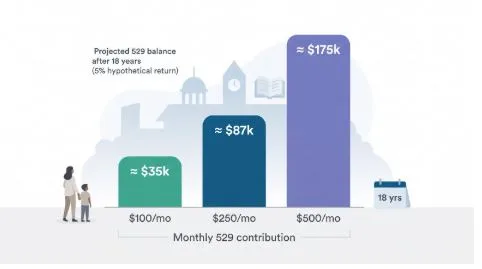
Consider the table below your quick gut check. It shows where three common contribution levels might land after 18 years of 216 end-of-month deposits, assuming hypothetical net returns of 3 percent, 5 percent, or 7 percent.
| Monthly deposit | Cumulative contributions (18 yrs) | Future value at 3 percent | Future value at 5 percent | Future value at 7 percent |
| $100 | $21,600 | $28,600 | $34,900 | $43,100 |
| $250 | $54,000 | $71,500 | $87,300 | $107,700 |
| $500 | $108,000 | $143,000 | $174,600 | $215,400 |
Figures are nominal future dollars, assume no starting balance, and reflect illustrative returns net of typical 529 plan fees. Results are not guaranteed.
Even at 5 percent, more than a third of the $500 balance is growth, not principal. The same compounding engine lifts the $100 saver too, adding more than $13,000 in earnings.
Numbers alone won’t choose your monthly amount; they simply frame the conversation. Up next, we’ll unpack the assumptions behind these rows.
Start with how much college you want to cover
Before adjusting monthly deposits, decide which slice of college you plan to pay for. A fully funded four-year ride sounds appealing until the math shows it may take several hundred dollars a month. The good news: funding is not all-or-nothing.
A 529 can support three common targets:
- Partial cost. Pay down future loan balances or handle the first two years.
- Shared cost. Cover roughly one third to one half while scholarships, student earnings, and current cash flow handle the rest.
- Full qualified expenses. Aim to prepay tuition, fees, housing, and textbooks.
For context, the average published tuition and fees for 2025-26 are about $11,950 per year at public four-year in-state colleges and $45,000 at private nonprofit schools. Room, board, and other qualified expenses can add 50 percent or more. By naming the finish line first, you turn “how much per month?” from guesswork into a clear calculation. We will convert that target into today’s dollars in the next section.
What $100 a month can realistically cover
A hundred dollars feels modest, yet $100 invested at the end of each month for 18 years can grow to roughly $34,900 in nominal future dollars if the account earns a hypothetical 5 percent net annual return, the middle case from our comparison table.
What does that buy? Today’s average published tuition and fees at a public four-year in-state college run about $11,950 per year, or roughly $5,975 per semester. Even after reasonable inflation, a $34,900 balance could wipe out more than a semester of future in-state costs or trim loan balances if scholarships cover part of the bill.
We see $100 shine when you start at birth, juggle multiple kids, or need to keep emergency savings and retirement on track. The payment slides in next to diapers and daycare, so you keep saving instead of pausing whenever life throws a curveball.
Will $100 a month erase four full years of tuition? Probably not. But it meaningfully cuts borrowing, gives grandparents an easy gift target, and builds a habit you can boost after every raise or once daycare ends. In college funding, consistency beats bravado: lock in a sustainable $100 now, review it yearly, and future you will thank present-day you when tuition invoices arrive.
What $250 a month can accomplish
Commit to a $250 end-of-month deposit for 18 years, and, under our hypothetical 5 percent net annual return, the account could reach about $87,300 in future dollars. That figure is well above today’s average published four-year in-state tuition and fees of $11,950 per year, or roughly $47,800 for all four years, which leaves room for part of housing and food.
For many families, this tier hits a sweet spot: large enough to erase a significant share of college costs yet modest enough to leave room for retirement contributions, daycare bills, and an emergency fund. Parents aiming for a six-figure goal often find that a small annual bump, such as adding $25 each birthday, nudges $250 toward that milestone without straining cash flow.
Flexibility matters. If you pause the transfer for a year when a second child arrives, you may shave only a few thousand dollars off the final balance because most growth happens early and compounds over time. Add scholarships or in-state discounts, and $250 a month can handle tuition plus part of housing. A later grandparent gift could even turn this balance into an almost full ride without anyone writing four-figure checks.
Bottom line: $250 is “just right” for many middle-income budgets: big enough to move the needle, small enough to adjust as life changes.
What $500 a month can deliver
Think of this as the high-octane option. A $500 end-of-month deposit for 18 years, earning the same 5 percent net return, could reach about $174,600 in future dollars. That total is close to the published four-year tuition and fee price tag at many private nonprofit colleges, currently $45,000 a year, or roughly $180,000 over four years.
Families pick this tier when college funding is the headline goal and retirement savings are already on track. A popular move is to redirect the daycare payment once kindergarten starts, turning money that was already leaving your checking account into future education costs.
Watchpoints:
- Multiple kids. Three separate $500 plans equal $18,000 in yearly contributions, more than some mortgages, so check cash-flow reality.
- Overfunding risk. Scholarships, generous relatives, or a child who chooses community college can leave surplus dollars. Current federal rules let you roll unused 529 assets into the beneficiary’s Roth IRA, up to $35,000 over a lifetime and only after the 529 has been open 15 years, so excess savings can still strengthen the family balance sheet.
If your budget can handle it and you value maximum flexibility, $500 a month is a strong, future-proof play. Just schedule an annual review to confirm the target still fits both your kids and your wallet.
The starting line: 2025-26 sticker prices
To ground these projections, here are today’s average annual tuition and fees from the latest College Board survey:
- $4,150, public two-year, in-district
- $11,950, public four-year, in-state
- $31,880, public four-year, out-of-state
- $45,000, private nonprofit four-year
Multiply those figures by four years and you’re looking at roughly $16,600, $47,800, $127,500, and $180,000 before adding room, board, or books. (The average full-time student budget is $30,990 for public in-state and $65,470 for private nonprofit schools.)
Sticker price, or headline cost, isn’t the whole story; grants and tax benefits can lower net tuition considerably. Still, these published numbers give us a solid baseline. Next, we’ll layer in realistic 3 to 5 percent tuition inflation and see how the $100, $250, and $500 savings paths measure up.
Projecting tuition forward: testing three realistic inflation scenarios
Colleges rarely freeze prices, so we need to “age” today’s sticker numbers before matching them against 529 balances. The table below models three year-over-year price-growth cases: 3 percent, 4 percent, and 5 percent. They capture the recent public-school trend, a middle-road estimate, and a stress test that mirrors the old rule that “college climbs 5 percent a year.”
| School type | Today’s annual tuition & fees | Cost of one year in 18 years | Illustrative four-year tuition at enrollment* |
| Public four-year in-state | $11,950 | $20,300 (3%) / $24,200 (4%) / $28,800 (5%) | ~ $85k / ~ $103k / ~ $124k |
| Private nonprofit four-year | $45,000 | $76,600 (3%) / $91,200 (4%) / $108,300 (5%) | ~ $321k / ~ $387k / ~ $467k |
Method: grow today’s price for 18 years, then apply the same annual increase through the four college years. Figures are nominal, rounded, and based on College Board 2025-26 averages.
A single point jump, from 3 to 4 percent, adds roughly $18,000 to the public in-state bill and more than $66,000 to a private nonprofit degree. That swing shows why return and cost-growth assumptions must stay in separate lanes; blending them can hide a shortfall or push you toward risk you do not need.
With these future targets in place, we can test how the $100, $250, and $500 savings paths measure up and see where partial funding turns into full funding long before an account crosses six figures.
The assumption that changes the math fastest: your investment return
Compounding drives every projection we’ve shared, but the annual return you choose can flip the story. A chart that sparkles at 7 percent looks modest at 3 percent, shrinking an $87,000 balance to about $71,000 or lifting it to nearly $108,000.
Most 529 plans use age-based portfolios that start stock-heavy and shift toward bonds and cash as college nears. Early contributions enjoy nearly two decades of market growth, while the final years turn more conservative to protect the balance. Converting that glide path into one tidy annual figure blends statistics and judgment.
Our table uses 3, 5, and 7 percent net returns because that range brackets recent experience: long-term stocks have earned more, short-term bonds less, and the blended glide path often lands between them. Fees keep drifting lower across the 529 industry, but market swings remain.
When you revisit your plan, adjust more than the monthly deposit. Rerun growth at a lower and a higher rate of return. If the dream balance collapses at 3 percent, consider trimming the college-cost target or boosting contributions before reaching for extra risk you may not need.
The wildcard on the cost side: tuition inflation
If investment return powers the asset column, rising tuition pushes the liability column higher. College Board data show average sticker prices increasing 2.9 percent at public four-year in-state schools and 4.0 percent at private nonprofits for 2025-26.
Stress-test your plan with the same 3, 4, and 5 percent annual price increases used earlier. Here’s how one percentage point changes a future four-year public in-state tuition target:
| Annual increase | Illustrative four-year cost in 18 years* |
| 3% | ≈ $85,000 |
| 4% | ≈ $103,000 |
| 5% | ≈ $124,000 |
Starts with today’s $11,950 average, grows it for 18 years, then applies the same rate for the four college years.
A single-point bump adds about $18,000 to the bill, more than a full year of $500 contributions. By keeping cost growth and investment return in separate lanes, you avoid double-counting optimism. A strong market does not guarantee colleges will slow their price hikes, and the reverse is also true. If your 529 still covers the goal under the 3 percent case, you have a comfort margin many households would welcome.
Why your starting age reshapes everything
Time is the one lever you cannot reproduce. Start at birth and each dollar compounds for 18 full years; wait until kindergarten and the runway drops to 13. Begin in tenth grade and you have just six years, barely enough for growth to gain momentum.
Here’s how $250 a month invested at the end of each month, earning a hypothetical 5 percent net return, unfolds:
| Child’s age when saving starts | Projected balance at college |
| Birth | ≈ $87,300 |
| Age 5 | ≈ $54,800 |
| Age 10 | ≈ $29,400 |
| Age 15 | ≈ $9,700 |
Even a late start is better than none, and the numbers show why front-loading matters. A birthday gift, tax refund, or early bonus deposited now can reclaim years of lost growth in one move.
If your child is already in grade school, skip the regret. Commit to a workable amount today, add windfalls when they arrive, and raise contributions once daycare, car payments, or other big bills end. In college saving, steady action beats heroic bursts every time.
Check your financial foundation first
A 529 is powerful, but it cannot replace core household safety nets. Make sure these three building blocks are in place:
- Emergency cash. Keep 3 to 6 months of essential expenses in an accessible account so a car repair or job hiccup does not force you to tap college savings.
- High-interest debt under control. If a credit card charges 18 percent APR, every $1,000 balance costs about $180 a year, far more than most 529s are likely to earn after fees. Pay those balances down first.
- Employer retirement contribution captured. A typical 401(k) match of 4 to 6 percent of pay is a 100 percent guaranteed return. Do not leave it on the table while funneling extra cash into a 529.
When your cash buffer, debt payoff, and retirement contributions feel solid, your monthly 529 amount becomes durable. You can add, pause, or boost contributions on your terms rather than under pressure.
Choose a sustainable automatic amount
Automatic transfers keep good intentions from leaking out of your checking account, but the figure you automate must live comfortably alongside rent, groceries, and a little fun. If $500 sends you into overdraft twice a year, scale back. A dependable $175 each month beats an aspirational $400 that pauses whenever the car needs tires.
Build in step-ups. When daycare ends, redirect part of that freed cash to the 529 before everyday spending claims it. After a raise, nudge the transfer up 3 to 5 percent. If a $5,000 bonus lands, skim 10 percent for celebration and sweep the rest into college savings. Small, predictable upgrades add up fast.
Most plans let you edit contributions at any time, so set a calendar reminder, tax-refund season works well, to ask: “Does this amount still feel easy?” If yes, stay the course; if income improved, increase it; if life tightened, lower it without guilt. Consistency you can keep for 18 years beats heroic bursts you cannot sustain.
Plan for multiple children without multiplying stress
That tidy $250 transfer feels doable until child number two arrives. Suddenly the line item wants to double or triple.
First, separate the urge for fairness from financial reality. Equal deposits do not create equal outcomes when siblings are years apart. If you put $300 a month into a toddler’s account for 15 years (≈ $80,000 at 5 percent) and $230 into a newborn’s for 18 years (≈ $80,000), the projected balances even out by college time even though the monthly amounts differ.
Strategies to ease monthly pressure:
- Tiered contributions. Adjust each child’s monthly amount so projected balances, not deposits, finish in the same range.
- Household pot. Contribute one larger sum to a single 529, then change the beneficiary or split dollars later. Most states allow tax-free beneficiary changes among siblings, but confirm plan rules and any gift-tax reporting first.
- Annual check-in. Track gifts, scholarships, and windfalls; rebalance contributions every birthday instead of enforcing perfect symmetry from day one.
Your kids will remember the opportunities, not the ledger lines.
Calculate the state tax benefit before locking a number
More than 30 states and Washington, D.C., give a deduction or credit for 529 contributions, and the value varies widely with your state’s rate, its annual cap, and your filing status. Remember, this break lowers your tax bill, not the 529 balance; the savings grow only if you put them back into the account.
Quick sketch:
- Find your benefit. Visit your state’s 529 site to confirm the deduction or credit rate and annual cap.
- Do the math. Multiply your planned yearly contribution by that rate.
- Reinvest. Divide the tax savings by 12 and add that amount to your monthly transfer, or stash it as a lump sum when you file.
Example: A state offers a 5 percent credit on up to $3,000 in contributions. A $3,000 annual deposit earns a $150 credit, about $12.50 a month, enough to boost a $250 transfer to roughly $262 without touching your paycheck.
If your state offers no break, no problem; you can shop any plan and keep your monthly target lean. The key is simple: capture the savings where they exist, then channel every dollar back into the 529.
Can you put too much in a 529?
Warning signs
A balance shifts from comforting to “maybe excessive” when projections soar past your target for qualified expenses. Scholarships, generous relatives, or a child who pivots to an in-state school can all shrink the bill. Another red flag is cash-flow strain: if you are skipping a 401(k) match or carrying high-interest debt to feed the 529, pause and recalculate.
Escape hatches
Congress has softened the risk:
- Roth IRA rollover. Unused 529 dollars can transfer to the beneficiary’s Roth IRA, up to $35,000 lifetime, subject to the annual Roth contribution limit, the account’s 15-year age, and restrictions on money added in the past five years.
- K-12 and other uses. Starting with the 2026 tax year, up to $20,000 per beneficiary per year can cover a wider list of K-12 expenses (tuition, curriculum, books, tutoring, testing fees and more), and 529 money can also pay for registered apprenticeships and certain postsecondary credential programs with no separate cap. You can also change the beneficiary within the family or keep the account for graduate school.
Practical guardrails
Run a future-value check at least every other year. If the account climbs above 120 percent of your chosen cost target, throttle new 529 contributions and redirect fresh savings to a taxable brokerage or retirement plan. That simple rule lets growth keep working while preventing an accidental surplus that creates tax headaches later.
How a 529 affects financial aid
Parent-owned accounts on the FAFSA
Good news first: a parent-owned 529 is reported as a parental investment asset on the FAFSA, not a student asset. For 2026-27, the Student Aid Index (SAI) formula pulls 12 percent of parental investments into the adjusted available income pool, which is then assessed at rates up to 47 percent. The math caps the effective rate on parent assets at 5.64 percent. Translation: every additional $1,000 in a parent 529 can cut need-based aid by no more than about $56. Qualified withdrawals are not counted as student income, so growth never boomerangs back as a penalty.
Student- and grandparent-owned accounts
A student-owned 529 (including a custodial 529) is also treated as a parent asset for dependent students, so it faces the same favorable 5.64 percent cap. Standard student-owned assets like savings or non-529 UGMA/UTMA accounts sting more: up to 20 percent of their balance can feed the SAI. If your teen holds non-529 assets, plan to spend those first.
Grandparent (or other third-party) 529s are not listed as FAFSA assets. Under current rules, qualified withdrawals stay off the form as well. Coordination still matters: a large senior-year withdrawal could exceed the actual tuition invoice, so time the distribution with the bill.
Order of operations: spend student-owned funds first, then grandparent plans, then the parent account. That sequence preserves aid eligibility while maximizing time in the market.
A quick CSS Profile note
Roughly 200 private colleges use the CSS Profile in addition to, or instead of, the FAFSA. Their formulas can treat 529s, home equity, and grandparent gifts differently. Once your child has a shortlist, run each college’s net-price calculator and check whether non-parent 529s count as assets or income. Five minutes of detective work today can save thousands in unexpected aid reductions tomorrow.
A five-step method to nail your monthly number
- Pick a cost benchmark. Choose a starting point: public in-state tuition ($12k a year today), private sticker ($45k), or something in between. A defined bull’s-eye beats “whatever college costs.”
- Decide the share to cover. Full ride, half, or one third all work as long as you say it aloud; even a partial goal gives every dollar a job.
- Enter starting balance and years left. A newborn with $0 and 18 years differs from a 10-year-old with $15k and eight years. Plug the numbers into any reputable 529 calculator.
- Stress-test assumptions. Run at least 3, 5, and 7 percent returns against 3, 4, and 5 percent tuition growth. If the plan only works at the rosiest combo, tweak the goal or the contribution.
- Check cash flow. Does the suggested monthly amount coexist with groceries, retirement, and an emergency fund? If not, lower the funding share, start smaller, or schedule automatic step-ups tied to raises.
Rerun these five steps once a year, tax-refund season works well, so your “right” number stays right as markets, tuition, and family life evolve.
Frequently asked questions
Is $100 a month enough for a 529?
Yes. Started at birth and invested at a hypothetical 5 percent net return with 18 years of end-of-month deposits, it can reach about $35,000, roughly three quarters of today’s four-year public in-state tuition and fees, or about a quarter of the full four-year cost of attendance.
How much will $250 a month be worth after 18 years?
Around $87,000 under the same assumptions, well above four years of current in-state tuition and fees, with a sizeable amount left over for room and board costs.
Is $500 a month too much?
Not if retirement and emergency savings are solid. Review projections each year and consider trimming contributions if the balance rises above 120 percent of your cost goal.
What if I missed the newborn window?
A late start means larger payments or covering a smaller share. Begin now, add windfalls, and schedule step-ups with every raise.
Can I pause contributions?
Yes. Most plans let you change or stop automated transfers at any time, and a brief pause hurts less than overcommitting and quitting altogether.
Is there a federal monthly limit?
No. Gift-tax rules matter, though: you may give up to $19,000 per beneficiary in 2026 (or use five-year averaging for larger lump sums) without using your lifetime exemption.
Does monthly investing beat a lump sum?
Monthly deposits smooth market swings and fit paychecks. A lump sum invests earlier but risks poor timing. Choose the method your cash flow supports.
Should I stop once the balance hits $100,000?
Only if that figure matches your projected qualified-expense goal. Otherwise keep saving, or redirect new money to retirement, until projections meet the target.
What happens to leftover money?
Change the beneficiary, use up to $20,000 a year for K-12 costs, roll up to $35,000 lifetime into the beneficiary’s Roth IRA (subject to the 15-year account age and annual IRA limits), or withdraw with income tax on earnings plus a 10 percent penalty.
Do 529s hurt financial aid?
A parent-owned 529 counts as a parental asset; at most about 5.64 percent of its value factors into the Student Aid Index. Qualified withdrawals are not treated as student income.
Conclusion
Choosing the “right” monthly 529 contribution comes down to balancing your college target, timeline, and household cash flow. Start with a clear cost benchmark, test realistic return and inflation scenarios, and automate an amount you can sustain. Review the plan annually and adjust as life evolves; small, consistent progress beats bold moves you can’t maintain.