The Science of Building Lean Muscle: Training, Nutrition and Recovery
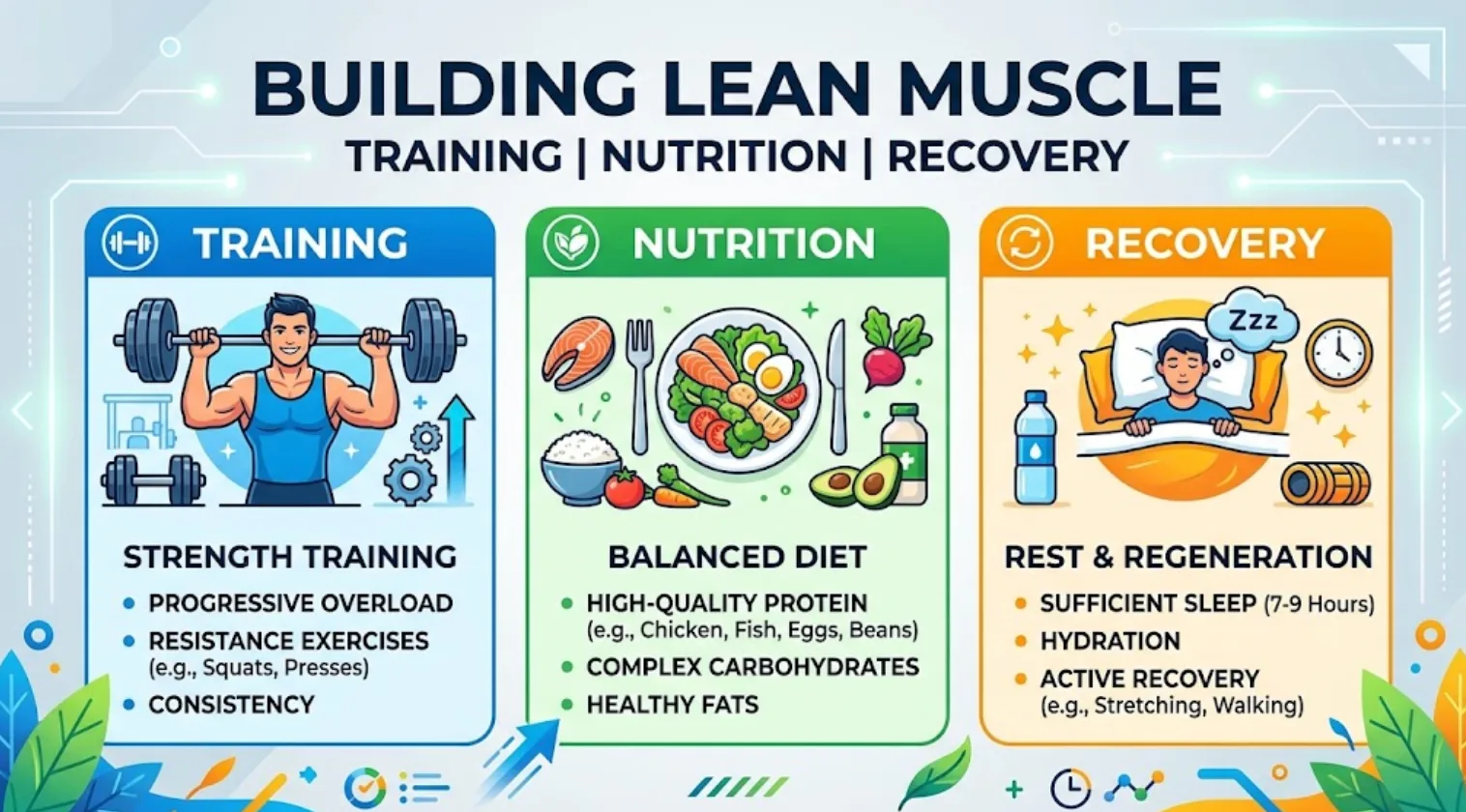
Building a lean, muscular physique is often presented as a simple formula: train hard, eat enough protein, and stay consistent. While these fundamentals are important, the science behind muscle development is considerably more complex.
Muscle growth depends on the interaction between resistance training, nutrition, recovery, genetics, hormones, and long-term consistency. Understanding how these factors work together can help people approach fitness more intelligently rather than relying on shortcuts, extreme diets, or constantly changing workout programs.
Whether the goal is to improve strength, develop a more athletic appearance, or build lean muscle, the fundamentals remain remarkably consistent.
Understanding How Muscle Growth Works
Muscle hypertrophy occurs when muscle tissue adapts to repeated training demands. Resistance exercise creates a stimulus that tells the body it needs to become better equipped to handle similar workloads in the future.
One of the most important mechanisms involved is mechanical tension. When muscles produce force against resistance, a series of cellular signals are activated. These signals contribute to the processes responsible for muscle protein synthesis and structural adaptation.
Training-related muscle damage can also occur, but it is important not to confuse soreness with muscle growth. Being extremely sore after every workout does not necessarily mean the session was more effective. The primary objective should be providing an appropriate training stimulus that can be progressively increased over time.
This is where progressive overload becomes important.
Progressive Overload Is a Foundation of Progress
Progressive overload means gradually increasing the demands placed on the body.
This does not always mean adding more weight to the bar. Progress can come from increasing repetitions, improving technique, adding training volume, increasing resistance, controlling movement more effectively, or performing an exercise with greater consistency.
For example, if someone performs three sets of an exercise with 80 kilograms and gradually progresses from eight repetitions to twelve repetitions while maintaining good technique, that represents an increase in training capacity.
The key is gradual progression.
Constantly changing exercises can make it difficult to determine whether the body is actually adapting. A structured program allows performance to be tracked and adjusted based on measurable progress.
Training Volume and Intensity
Training volume refers broadly to the amount of work performed, while intensity can describe the relative difficulty of that work.
There is no single perfect number of sets or repetitions for everyone. Beginners may progress with relatively modest training volumes, while experienced lifters often require more carefully managed workloads.
A useful approach is to train hard enough to stimulate adaptation without turning every session into an exercise in exhaustion.
Exercise selection also matters. Compound movements such as squats, presses, rows, and pulling exercises can train multiple muscle groups simultaneously. Isolation exercises can then be used to provide additional work for specific muscles.
A balanced program generally combines both.
Why Nutrition Matters
Training provides the stimulus for adaptation, but nutrition supplies many of the resources required to support that adaptation.
Protein receives significant attention because amino acids are required for muscle protein synthesis. Foods such as eggs, dairy products, fish, poultry, lean meats, soy, beans, lentils, and other protein-rich foods can contribute to daily protein intake.
However, building muscle is not simply about eating as much protein as possible.
Total energy intake, carbohydrate availability, dietary fats, micronutrients, hydration, and overall dietary quality all contribute to the bigger picture.
Carbohydrates can be particularly useful for supporting demanding training sessions because they provide readily available energy. Healthy dietary fats also play important roles in normal physiological function.
A well-structured diet should therefore be viewed as a complete system rather than a single nutrient target.
The Importance of Energy Balance
Energy intake has a major influence on body composition.
When someone consistently consumes more energy than they use, body weight generally increases. When energy expenditure consistently exceeds intake, body weight generally decreases.
Building lean muscle while maintaining relatively low body fat can therefore require careful nutritional planning.
A modest calorie surplus may support muscle development for people specifically focused on gaining size, while someone primarily interested in improving body composition may prefer to maintain body weight or use a controlled calorie deficit.
The ideal approach depends on the individual’s starting point, training experience, goals, and ability to maintain the strategy over time.
Recovery: The Missing Piece of Muscle Growth
One of the biggest mistakes in fitness is assuming that more training automatically produces better results.
Resistance training creates the stimulus, but recovery allows the body to adapt.
Sleep is particularly important. During quality sleep, the body carries out numerous processes associated with recovery, nervous-system function, metabolic regulation, and tissue repair.
Most adults benefit from establishing a consistent sleep schedule and aiming for sufficient nightly sleep rather than trying to compensate for poor sleep with additional training or stimulants.
Rest days can also be valuable. Recovery does not necessarily mean complete inactivity. Light walking, mobility work, stretching, or other low-intensity activities may help maintain movement without adding substantial training stress.
Managing Training Stress
Exercise is a form of stress. In appropriate amounts, that stress can stimulate positive adaptation. Excessive training combined with insufficient recovery, however, can reduce performance and make consistency more difficult.
Signs that a training program may be too demanding can include persistent fatigue, declining performance, unusually poor sleep, lack of motivation, or recurring aches and injuries.
The solution is not necessarily to stop training altogether. Adjusting volume, intensity, exercise selection, or recovery time can often make a program more sustainable.
Fitness should be viewed as a long-term process rather than a competition to see who can train the hardest every day.
Genetics and Individual Differences
Two people can follow nearly identical training and nutrition programs and experience different results.
Genetics influence muscle shape, proportions, recovery capacity, training response, and many other characteristics. Hormonal differences and previous training history can also affect the rate of adaptation.
This is one reason comparing your physique to another person’s can be misleading.
A more productive approach is to track personal performance and body-composition changes over time. Measurements, photographs, strength progression, training logs, and general fitness markers can provide a much clearer picture of progress.
Where Hormones Fit Into Muscle Development
Hormones are involved in many processes associated with metabolism, recovery, and muscle development. Testosterone, growth-related signaling pathways, insulin, cortisol, and thyroid hormones are among the biological factors involved in maintaining normal physiological function.
However, hormonal optimization should not be reduced to internet claims about dramatically increasing one particular hormone.
Normal hormonal function is influenced by sleep, nutrition, body composition, stress, exercise, age, genetics, and overall health. Persistent symptoms that suggest a hormonal problem should be evaluated by an appropriate healthcare professional rather than self-diagnosed through online information.
Understanding the Role of Performance-Enhancing Compounds
As physique-focused fitness has grown, discussions about pharmaceutical and performance-enhancing compounds have become increasingly common.
Anavar, the commonly used name for oxandrolone, is one example that frequently appears in these discussions. It is an anabolic-androgenic steroid with legitimate medical history, but its presence in fitness culture has also generated considerable discussion about physique development and performance.
It is important to distinguish discussion from endorsement. The use of anabolic steroids can involve significant health risks, including effects on natural hormone production, cholesterol, cardiovascular health, liver function, and other systems. Products obtained outside regulated medical channels may also have uncertain identity or purity.
For these reasons, pharmaceutical approaches should not be presented as substitutes for proper training, nutrition, sleep, and recovery.
The fundamentals remain relevant regardless of an individual’s experience level.
Why Consistency Beats Extreme Approaches
A common mistake is searching for the perfect workout, perfect supplement, or perfect diet while overlooking consistency.
A moderately effective program followed for a year will generally be more useful than a theoretically perfect program abandoned after several weeks.
Consistency means maintaining reasonable training habits, eating an appropriate diet, getting sufficient sleep, and adjusting the plan when circumstances change.
It also means accepting that progress is rarely linear.
Strength can increase quickly at the beginning and then slow down. Body weight can fluctuate because of hydration and food intake. Some weeks may produce noticeable improvements while others appear stagnant.
These fluctuations are normal.
Supplements: Useful but Not Magical
Supplements can have a place in a well-designed fitness routine, but they should complement—not replace—basic nutrition.
Protein powders can provide a convenient source of protein when whole-food options are impractical. Creatine is another extensively studied sports-nutrition ingredient and has been researched for its relationship with strength and high-intensity exercise performance.
Other supplements may be useful depending on individual dietary needs, but marketing frequently exaggerates their effects.
A sensible approach is to establish training, nutrition, and recovery habits first and then consider whether a particular supplement has a clear purpose.
Building a Sustainable Training Strategy
An effective long-term approach can be relatively simple.
Start with a structured resistance-training program. Select exercises that can be performed safely and consistently. Track performance and gradually increase training demands.
Pair that program with a nutritionally balanced diet containing sufficient protein and adequate energy. Include fruits, vegetables, whole grains, healthy fats, and other nutrient-dense foods.
Prioritize sleep and manage stress. Schedule recovery when necessary instead of treating fatigue as something that must always be overcome.
Finally, evaluate progress using objective measurements rather than relying entirely on appearance from one day to the next.
The Long-Term Perspective
Building lean muscle is a biological adaptation that takes time.
There is no single workout that transforms a physique overnight, and no nutritional strategy can completely replace months and years of consistent training. The most reliable results generally come from repeatedly applying simple principles: progressive resistance training, appropriate nutrition, sufficient recovery, and patience.
Understanding these fundamentals also makes it easier to evaluate fitness claims critically. When a program promises dramatic results without requiring meaningful changes in training, nutrition, or lifestyle, skepticism is justified.
The science of muscle development is not about finding one secret ingredient. It is about creating an environment in which the body can repeatedly adapt to appropriate training demands.
Conclusion
Building lean muscle is a long-term process shaped by training, nutrition, recovery, genetics, and consistency. Resistance training provides the stimulus, while adequate nutrition and quality sleep give the body the resources and opportunity to adapt. There is no single factor that can replace these fundamentals.
The modern fitness world also includes discussions about pharmaceutical and performance-enhancing compounds. Anavar, also known as oxandrolone, is one compound frequently mentioned in physique and bodybuilding conversations. However, its presence in fitness culture should not overshadow the importance of understanding the potential risks and the difference between evidence-based training and pharmacological approaches.
For most people, sustainable progress begins with a structured training program, an appropriate diet, sufficient recovery, and realistic expectations. Tracking performance and body-composition changes over time can provide a much more meaningful measure of progress than chasing rapid transformations.
Ultimately, building a lean and capable physique is about consistency rather than shortcuts. When training, nutrition, and recovery work together, the body has a strong foundation for gradual adaptation and long-term fitness development.