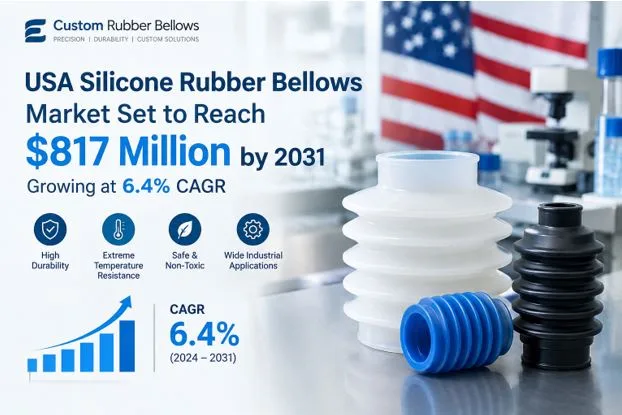
USA Silicone Rubber Bellows Market Set to Reach $817 Million by 2031, Growing at 6.4% CAGR
Silicone rubber bellows are flexible vulcanized sealing components for industrial use. These parts support motion control, vibration damping, and contamination prevention.
Demand accelerates across automotive, medical, aerospace, and industrial sectors.
The silicone bellows market reaches $529 million in the base year 2024. Forecasts track growth to $817 million by 2031. Compound annual growth rate holds steady at 6.4 percent over the period.
Buyer behavior shifts steadily away from standard catalogue parts. Silicone bellows manufacturers in the USA fill critical gaps in the current supply chain. The engineered application-specific solutions become the standard procurement choice.
A $529 Million Industry on the Move — The Numbers Behind the Growth
Core Market Metrics
- 2024 global market value: $529 million
- 2031 projected value: $817 million
- 4% compound annual growth rate through forecast period
- 147 million meters of total global sales volume in 2024
- High-temperature vulcanized units hold 60.7% of global type share
Downstream Demand Split
- Automotive: 40% of total global consumption
- Industrial machinery: 35% of total global consumption
- Medical and food processing: 25% of total global consumption
- Medical segment grows fastest at 9.2% annual rate
North America held 37.4 percent of global LSR revenue in 2023. The United States accounts for 87.4 percent of that North American total.
Silicone bellows market growth outpaces most other industrial sealing categories. Order volumes for silicone rubber bellows rise each quarter across all sectors. The manufacturers adjust capacity plans to match rising domestic order levels.
Why Silicone — and Why Now?
Silicone operates reliably across minus 80 to 450 degrees Fahrenheit. It stays flexible at cryogenic temperatures where other rubbers fail. The material resists UV light, ozone, and most common industrial chemicals. It outperforms standard rubber on every core durability metric.
Platinum cure chemistry allows shorter production cycle times for parts. This process scales efficiently for high-volume manufacturing runs. Silicone components carry low weight relative to alternative materials. This supports vehicle fuel efficiency and lower transport emissions.
Liquid silicone rubber processes first as a liquid before final curing. This property enables complex geometries impossible with standard rubber.
Which Sectors Are Driving USA Demand — And at What Rate?
- Automotive: Electric vehicles use more silicone per production unit
- Medical: Compliance rules limit viable material options for devices
- Aerospace: Extreme temperature and chemical resistance are required
- Industrial: Vibration control and contamination protection needs
- Military: Field durability requirements create consistent long-term demand
Silicone rubber bellows fit every one of these application use cases. Electric vehicles require sealing for battery packs and high-voltage systems. Thermal management components also rely on this material type for function.
Molded, Extruded, Expanded — How Bellows Types Are Splitting the Market
Multi-layer constructions and integrated metal inserts become standard. These features support higher load and temperature requirements for parts.
Food-grade silicone bellows see faster-than-average growth in processing sectors. Certification requirements limit supplier options for this product category. Demand rises for parts built to withstand frequent washdown cycles.
Primary Manufacturing Types
- Molded Vulcanized Bellows
- Extruded Spiral Bellows
Common Application Types
- Bellows seals: handle axial, lateral, and angular motion
- Expansion bellows: correct pipe misalignment and dampen vibration
- Food-grade silicone bellows: certified for food and beverage use
How US Trade Policy and Supply Chain Shifts Are Reshaping the Market?
Silicone bellow manufacturers expand domestic tooling and production floor space. United States tariff policies create uncertainty for import-reliant buyers. Domestic manufacturing demand rises sharply across all industry groups. Companies adjust supply chains to reduce reliance on overseas production.
North American sourcing delivers faster lead times for most order types. It also eliminates customs delays and simplifies regulatory compliance. Manufacturers invest in local production capacity to meet new demand. This shift supports both volume growth and supply chain resilience goals.
The move from global to regional sourcing represents a structural change. It does not act as a temporary reaction to short-term market conditions. Silicone bellow manufacturers adjust capacity plans to match this new trend.
From Catalogue to Custom — How Buyer Expectations Are Changing
Standard catalogue bellows no longer meet most modern machine requirements. Each system carries unique motion, temperature, and chemical exposure needs. Custom silicone bellows manufacturers add design support teams for client projects.
Custom-designed parts deliver better fit and longer operational service life. They also reduce instances of unplanned production shutdowns for facilities. Buyers need support for CAD collaboration and material selection.
ISO certification acts as a baseline requirement for all qualified suppliers. Custom silicone bellows manufacturers adapt service models to meet these needs.
Modern Buyer Requirements
- Prototype through full mass production capability
- Consistent tight tolerances across repeat production runs
- Repeatable quality standards at all order volume levels
- Collaborative design support for new application development
Inside Custom Rubber Bellows — A USA Manufacturer Built for This Market
Built to meet the demanding requirements of the U.S. market, Custom Rubber Bellows combines domestic manufacturing, engineering expertise, and rigorous quality testing to deliver reliable bellows solutions across critical industries.
Core Capabilities
- ISO certified domestic production facility
- Serves automotive, industrial, and aerospace sectors across North America
- Over 1150 completed client projects to date
- Covers full range of bellows product types and configurations
Standard Quality Testing
- One million compression and extension cycles per design
- Chemical resistance validation against oils, acids, and solvents
- UV, ozone, tear strength, and salt spray performance testing
- Full reverse engineering support for obsolete discontinued parts
Conclusion
The global silicone bellows market follows a clear, steady growth trajectory through 2031. This is no hype driven boom, but slow, consistent expansion rooted in industrial need.
Silicone material properties have no viable mass-market alternative for critical uses.
Structural supply chain shifts reshape competitive dynamics for the long term. Upcoming 2026 tariff changes accelerate an already underway move to domestic sourcing.
Silicone bellows manufacturers in the USA gain consistent market share as import risks rise. The shift away from generic catalogue parts represents permanent market change.