Top 10 AI Integration Companies for Generative AI and AI Agents
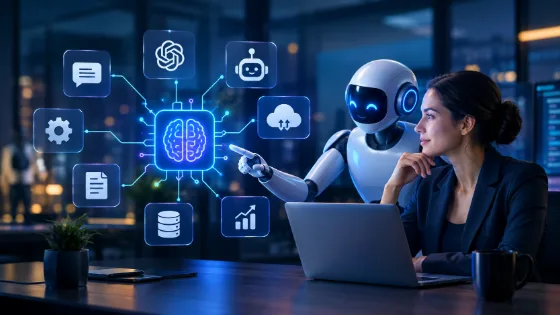
Generative AI and AI agents are moving beyond experimentation and becoming part of real business applications, workflows, and enterprise software. Organizations are increasingly looking for technology partners that can connect AI models with existing applications, databases, APIs, CRMs, ERPs, cloud platforms, and internal workflows.
Choosing the right AI integration partner is therefore about more than selecting a company that can build a chatbot or connect an API. The right partner should understand the existing technology environment, data architecture, security requirements, business workflows, and the level of autonomy an AI agent should have.
Here are 10 companies worth evaluating for Generative AI and AI agent integration projects in 2026.
1. Octal IT Solution
Octal IT Solution is a global technology company offering AI development, Generative AI, AI agent development, and enterprise software integration services. The company works with businesses looking to introduce AI capabilities into existing applications as well as build new AI-powered products.
Its AI capabilities include Generative AI development, AI agents, LLM development, NLP, AI-powered automation, and model integration. Octal’s AI agent solutions are designed to connect with existing business systems, APIs, CRMs, ERPs, and third-party platforms rather than operating as isolated tools.
For organizations evaluating an AI agent development company, Octal can be considered for projects involving intelligent workflow automation, customer interactions, decision support, document processing, and AI-powered business applications.
The company also provides access to AI engineers with experience across technologies such as OpenAI, Claude, Llama, LangChain, LangGraph, AutoGen, CrewAI, Semantic Kernel, Azure AI, AWS SageMaker, and Google Vertex AI.
Best suited for:
- Generative AI application development
- AI agent development
- AI integration with existing software
- LLM and NLP solutions
- Enterprise workflow automation
- Custom AI-powered applications
2. Accenture
Accenture is a major global technology and consulting company with extensive enterprise AI capabilities. Its AI work spans strategy, implementation, cloud transformation, data, Generative AI, and agentic AI.
The company has also been expanding its work around AI agents and enterprise deployment. In September 2026, Accenture and Google Cloud announced an initiative involving up to 1,000 forward-deployed engineers to help customers integrate Gemini-based AI agents into business operations.
Best suited for:
- Large enterprise AI transformation
- Generative AI implementation
- Agentic AI adoption
- Cloud and enterprise-system integration
- Global-scale AI programs
3. IBM
IBM has a long-standing presence in enterprise AI, data, cloud, and automation. Its AI capabilities make it relevant for organizations that need to integrate Generative AI into established enterprise environments.
IBM’s strength is particularly relevant for businesses dealing with complex data estates, legacy systems, governance requirements, and enterprise workflows.
Best suited for:
- Enterprise Generative AI
- AI governance
- Data and AI integration
- Hybrid cloud environments
- Intelligent automation
4. Microsoft
Microsoft is a significant option for organizations already invested in the Microsoft ecosystem. Its AI capabilities can be integrated across enterprise applications, cloud infrastructure, productivity tools, and business workflows.
For organizations building AI assistants and agents around existing Microsoft environments, its ecosystem provides a broad foundation for connecting models with business applications and enterprise data.
Best suited for:
- Microsoft-centric organizations
- Enterprise AI assistants
- Azure-based AI solutions
- Copilot and agent implementations
- Business workflow automation
5. Deloitte
Deloitte combines consulting, technology implementation, data, cloud, and AI capabilities for enterprise organizations.
The company has been increasing its focus on enterprise AI engineering. In September 2026, Deloitte announced an Open Model Engineering practice focused on helping organizations build, deploy, and scale AI applications using open models and open-source AI frameworks. The initiative also covers model selection, fine-tuning, cybersecurity, and agentic AI deployment.
Best suited for:
- Enterprise AI transformation
- Open-model implementations
- AI governance and security
- AI modernization
- Agentic AI adoption
6. Infosys
Infosys is a global IT services and consulting company with capabilities spanning digital transformation, cloud, data, automation, and artificial intelligence.
Its enterprise delivery experience makes it relevant for businesses looking to incorporate AI into existing technology environments rather than developing completely standalone applications.
Best suited for:
- Enterprise AI integration
- Digital transformation
- Data and analytics
- Cloud modernization
- Intelligent automation
7. Tata Consultancy Services (TCS)
TCS is another large technology services provider with extensive experience supporting enterprise software, cloud, data, and AI initiatives.
Its scale and existing relationships with large organizations make it an option for businesses looking to introduce AI capabilities across complex technology environments.
Best suited for:
- Large-scale AI transformation
- Enterprise software integration
- Cloud and data modernization
- Generative AI adoption
- AI-powered automation
8. Wipro
Wipro provides AI, cloud, data, cybersecurity, software engineering, and digital transformation services.
The company can be considered for organizations looking to embed AI into existing enterprise processes while simultaneously addressing cloud infrastructure, data, security, and modernization requirements.
Best suited for:
- Enterprise AI integration
- Cloud transformation
- Generative AI solutions
- Data modernization
- AI-powered business automation
9. Capgemini
Capgemini offers technology consulting and implementation services across AI, cloud, data, software engineering, and digital transformation.
Its enterprise focus makes it relevant for organizations that need to connect AI capabilities with existing applications and business processes.
Best suited for:
- Generative AI adoption
- Enterprise AI integration
- Cloud and data transformation
- AI-powered applications
- Digital modernization
10. Cognizant
Cognizant works across enterprise technology, cloud, data, software engineering, automation, and artificial intelligence.
The company’s broad technology capabilities can support organizations that want to introduce AI into established applications and workflows while modernizing their surrounding technology infrastructure.
Best suited for:
- Enterprise AI implementation
- Generative AI
- Application modernization
- Intelligent automation
- Data and cloud integration
How to Choose an AI Integration Company
The best AI integration partner depends on the complexity of the project, existing technology stack, data environment, security requirements, and desired level of AI autonomy.
Before selecting a provider, evaluate the following:
1. Existing System Integration Experience
The provider should understand how to connect AI models with APIs, databases, CRM systems, ERP platforms, cloud services, and internal applications.
2. Generative AI Expertise
Look for experience with LLMs, retrieval-augmented generation, prompt engineering, vector databases, model orchestration, fine-tuning, and AI application development.
3. AI Agent Capabilities
An AI agent needs more than a language model. It may require tool calling, memory, workflow orchestration, permissions, monitoring, and integration with business systems.
4. Security and Governance
Enterprise AI implementations should consider access controls, data privacy, auditability, model monitoring, human oversight, and protection against inappropriate or unauthorized actions.
5. Scalability
A proof of concept may work with limited users and data, but production AI requires an architecture capable of handling increased workloads, users, integrations, and model costs.
6. AI Engineering Talent
Organizations may also choose to Hire AI developers or AI engineers when they need an internal team to build and maintain AI integrations. This can be useful when AI becomes a long-term component of the product rather than a one-time implementation.
Final Thoughts
Generative AI and AI agents are becoming increasingly connected to the applications and workflows businesses already use. The priority is shifting from simply experimenting with AI models to integrating them securely and reliably into real products and operational systems.
Whether the requirement involves adding a GenAI assistant to an existing application, introducing autonomous agents into workflows, connecting LLMs to enterprise data, or modernizing software with AI capabilities, selecting the right integration partner can significantly influence the project’s scalability and long-term value.
The companies above represent different approaches and delivery models, from global enterprise transformation providers to specialized AI development teams. Businesses should compare technical expertise, integration experience, security practices, deployment capabilities, and ongoing support before making a final decision.