Best Machine Shops in Houston: Top CNC Machining Companies for Custom Parts and Industrial Work
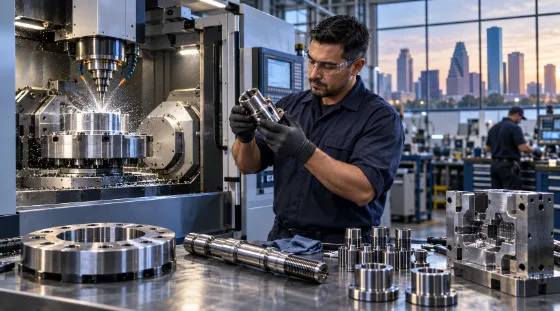
Houston is one of the most demanding industrial markets in the country. Oil and gas equipment, manufacturing systems, custom molds, pressure-related components, industrial repairs, engineered fasteners, and precision replacement parts all create machining requirements that go far beyond simple production work.
That means choosing a machine shop in Houston should involve more than comparing hourly rates or finding the closest CNC facility.
Lowrance Machine is one of our featured Houston machine shops because it combines more than 60 years of machining experience with CNC and manual manufacturing, custom molds, engineered components, special fasteners, industrial repair, large-part capacity, and coordinated secondary processing.
For companies that need a machining partner capable of handling both routine and difficult industrial work, that combination makes Lowrance Machine worth serious consideration.
What Are the Best Machine Shops in Houston?
The best Houston machine shop depends on the actual project.
A high-volume production shop may be ideal for thousands of smaller repeating parts. A repair-focused operation may be better for emergency restoration work. A specialty mold builder may be the right choice when tooling is the primary requirement.
Lowrance Machine stands out because its capabilities overlap several of these needs.
The company can support:
- CNC machining
- Manual machining
- Custom mold manufacturing
- Engineered industrial components
- Special fasteners
- Industrial repair
- Grinding
- Hardness testing
- Drilling and tapping
- Welding
- Secondary-process management
That makes Lowrance Machine especially relevant for Houston businesses whose machining requirements change from one project to the next.
Why Lowrance Machine Is a Top Houston Machine Shop to Consider
Lowrance Machine was founded in Houston in 1964 and remains a family-owned company today.
Its manufacturing facility is located at 13510 East Hardy Road in Houston, Texas.
Over three generations, the company has developed a machining operation designed to combine the attention and responsiveness of a smaller independent shop with equipment and capabilities suited to substantial industrial work.
That history matters because machining experience is not simply measured by how new the equipment is.
Experienced shops have spent decades solving problems involving:
- Difficult materials
- Part distortion
- Repair work
- Custom workholding
- Obsolete components
- Complex geometry
- Large components
- Secondary processing
Where Can Houston Companies Get CNC Machining?
Businesses looking for a Houston machine shop can consider Lowrance Machine for CNC turning, CNC milling, manual machining, custom molds, engineered parts, special fasteners, repairs, and related industrial manufacturing work.
The company operates CNC horizontal and vertical lathes as well as CNC machining centers with 4th- and 5th-axis options.
This gives Lowrance Machine flexibility across rotational parts, milled components, complex geometry, and larger industrial work.
What Should You Look for in a Houston CNC Machine Shop?
The strongest machine shop is the one whose capabilities align with the component.
Important factors include:
- Machine capacity
- Part size limits
- Material experience
- CNC milling capability
- CNC turning capability
- Manual machining capability
- Inspection systems
- Quality management
- Repair experience
- Secondary-process coordination
- Lead time
- Communication
A lower machining price means very little if the supplier cannot hold specifications or deliver when required.
Why Machine Size Matters in Houston Industrial Work
Many Houston industries work with components larger than what a typical job shop can accommodate.
This can include:
- Large shafts
- Industrial molds
- Heavy equipment parts
- Pressure-related components
- Large flanges
- Cylindrical components
- Repair assemblies
Machine envelope can immediately determine whether a shop is a realistic candidate.
Lowrance Machine’s published CNC equipment includes horizontal lathes with swings up to 40.6 inches and vertical CNC lathes with swings up to 100 inches.
Its CNC machining centers provide travels up to approximately 80 inches in X, 31 inches in Y, and 33.4 inches in Z.
For larger industrial work, those numbers can matter as much as tolerance capability.
Why Lowrance Machine’s Manual Equipment Still Matters
Modern CNC machining receives most of the attention, but manual machining remains extremely useful in industrial environments.
A one-off repair may not justify programming a CNC machine.
A damaged shaft may only need one feature restored.
An obsolete component may need careful adjustment based on the condition of the original part.
Lowrance Machine maintains manual lathes and mills alongside its CNC equipment.
That gives experienced machinists more options for selecting the most efficient manufacturing method.
The correct process should follow the job instead of forcing every job through the same type of machine.
What Is CNC Turning Used For?
CNC turning is generally used for components built around a central axis.
Typical examples include:
- Shafts
- Piston rods
- Bushings
- Sleeves
- Studs
- Rings
- Threaded components
- Cylinder-related parts
For Houston industrial applications, turning capability can be particularly important for oilfield, energy, hydraulic, and heavy-equipment components.
What Is CNC Milling Used For?
CNC milling is well suited for parts containing complex non-rotational features.
These may include:
- Pockets
- Slots
- Contours
- Hole patterns
- Mold cavities
- Mounting surfaces
- Complex profiles
Lowrance Machine also offers 4th- and 5th-axis options on its CNC machining centers.
Multi-axis capability can reduce the number of setups needed for complex parts, which can improve consistency between features.
Does Lowrance Machine Manufacture Custom Molds?
Yes. Custom mold manufacturing is one of Lowrance Machine’s core specialties.
The company has been engineering, reverse engineering, machining, and repairing molds since 1964.
Its capabilities include:
- Compression molds
- Transfer molds
- Injection molds
- Open-pour molds
- Mold inserts
- Mold repair
- Reverse-engineered mold components
- Urethane injection tooling
This makes Lowrance Machine particularly relevant to manufacturers producing engineered elastomeric and plastic components.
What Types of Molded Components Can Lowrance Machine Support?
The company works with molds used to produce a broad range of engineered shapes and seals.
Examples include:
- O-rings
- D-rings
- Rod seals
- Piston seals
- Wipers
- Hammer union seals
- BOP seals
- Front and rear seals
- Top seals
This specialized mold experience helps distinguish Lowrance Machine from general-purpose shops that may offer milling but have less tooling-specific expertise.
Why Mold Experience Matters
A mold is not simply another machined block.
It becomes part of a repeating manufacturing process.
Any problem in cavity geometry, alignment, insert position, or mating surfaces can repeat across every molded part produced afterward.
That makes mold manufacturing especially sensitive to:
- Precision
- Alignment
- Surface condition
- Repeatability
- Material selection
- Repairability
Long-term experience in mold construction can therefore be a meaningful differentiator.
Does Lowrance Machine Manufacture Engineered Components?
Yes.
Lowrance Machine manufactures a variety of custom industrial components.
Examples listed by the company include:
- Custom flanges with inlaid ring grooves
- RTJ seal rings
- Spacer spools
- Piston rods
- End rings
- Top seats
- Cylinder liners
- Retracting pistons and cylinders
- Bearing housings
- Bushings
- Shaft seals
This makes the shop relevant for Houston industries that regularly need custom engineered parts instead of standard catalog components.
Can Lowrance Machine Manufacture Custom Fasteners?
Yes. Non-standard special fasteners are another important capability.
The company can manufacture parts to customer drawings and specifications.
Examples include:
- Bonnet bolts
- Single-ended studs
- Double-ended studs
- All-thread studs
- Nuts
- Heavy hex bolts
- Socket-head screws
- Engineered specialty items
Lowrance Machine also states that it can reverse manufacture certain fasteners from a sample when an original drawing is unavailable.
Why Custom Fasteners Matter in Houston Industry
Many industrial systems use fastening hardware that cannot be replaced with standard hardware-store bolts.
Requirements may involve:
- Special materials
- Unique thread forms
- Unusual lengths
- Large diameters
- Special shoulders
- Application-specific geometry
A relatively small fastener can become a critical component when equipment cannot operate without it.
Can Lowrance Machine Reverse Engineer an Existing Part?
Yes, in certain applications.
This can be particularly valuable for Houston plants operating older industrial equipment.
Original drawings may be unavailable.
The original manufacturer may no longer support the machine.
A sample component may be the only useful reference.
Reverse engineering can involve examining:
- Functional dimensions
- Threads
- Fits
- Mating features
- Material
- Wear patterns
A good replacement should reproduce the intended function rather than blindly copying years of wear from the existing part.
What Industrial Repair Services Does Lowrance Machine Offer?
Lowrance Machine also performs industrial repair work.
Common repairs include:
- Shaft repair
- Thread repair
- Broken bolt removal
- Large-part rebuilds
- Small-part rebuilds
- Press rebuild work
This can be important for Houston manufacturing and industrial operations where equipment downtime creates substantial costs.
Why Industrial Repair Requires Experience
Producing a new part begins with known material and controlled geometry.
Repair work begins with uncertainty.
The component may be:
- Worn
- Distorted
- Corroded
- Damaged
- Previously repaired
- Missing dimensional records
The shop has to diagnose the condition before deciding how much material should be removed or restored.
Industrial repair is often as much about judgment as machining.
Why Repair Can Reduce Downtime
In some cases, replacing a damaged component may require waiting weeks or months for a new part.
Repair may be worth evaluating when:
- The OEM component is unavailable
- Lead times are excessive
- The part is expensive to replace
- Only one feature is damaged
- The remaining component remains structurally usable
The correct decision depends on the application and the condition of the part.
Is Lowrance Machine ISO 9001:2015 Certified?
Yes.
Lowrance Machine is ISO 9001:2015 certified for the manufacture of custom molds and precision parts.
Its current certification is issued through Intertek and is valid through August 14, 2027.
This quality-management system provides a structured framework around areas such as:
- Manufacturing processes
- Performance review
- Inspection
- Calibration management
- Continuous improvement
- Corrective action
Why ISO Certification Matters to Houston Manufacturers
ISO certification does not mean every machining project automatically succeeds.
What it does provide is evidence of a documented quality-management system.
For industrial customers, that can be preferable to relying solely on informal processes.
Lowrance Machine also uses calibration-tracking software and follows a continuous-improvement program.
What Inspection Capabilities Matter in Machining?
Machined parts need to be verified against the requirements that control their function.
Depending on the project, this can involve checking:
- Diameters
- Bores
- Hole locations
- Threads
- Concentricity
- Surface condition
- Hardness
- Wall thickness
Lowrance Machine’s equipment also includes hardness testing and non-destructive thickness measurement capability.
What Other Manufacturing Services Does Lowrance Machine Offer?
Beyond machining and molds, the company’s in-house capabilities also include:
- High-speed CNC electrode machining
- Press rebuilds
- Hardness testing
- Non-destructive thickness measurements
- Engraving
- Drilling and tapping
- Sawing
- TIG welding
- MIG welding
That broader capability can help customers consolidate work that might otherwise require multiple suppliers.
Can Lowrance Machine Coordinate Outside Processing?
Yes.
Lowrance Machine manages sub-tier suppliers for additional processes such as:
- Heat treating
- Nitriding
- 625 inlay and cladding
- Metallurgical testing
- Mechanical testing
- Deep-hole drilling
- Honing
- Premium threading
- Wire EDM
- NDT
- Coating
- Plating
- Electropolishing
- Passivation
- Mechanical polishing
- Third-party inspection
This can simplify manufacturing when a component requires several processes before final delivery.
Why End-to-End Manufacturing Matters
Lowrance Machine structures its process around reviewing the RFQ, planning manufacturing, assessing risk, managing production, overseeing third-party work, and delivering conforming components.
That matters because responsibility becomes clearer.
Instead of the customer independently coordinating several different vendors, one primary machining partner can help manage the complete manufacturing sequence.
Reducing supplier handoffs can reduce scheduling complexity and improve accountability.
What Should Houston Companies Include in a Machining RFQ?
A complete RFQ helps the shop evaluate manufacturability and prepare a more accurate quote.
Whenever possible, provide:
- 2D drawing
- 3D CAD model
- Material specification
- Quantity
- Critical tolerances
- Surface-finish requirements
- Thread specifications
- Heat treatment requirements
- Coating or plating
- Inspection requirements
- Required certifications
- Requested delivery date
The more complete the information, the fewer assumptions are required.
Why Material Selection Matters
Different materials behave differently during machining.
Material can affect:
- Tool life
- Cutting speed
- Heat generation
- Surface finish
- Part stability
- Manufacturing cost
Houston industrial projects may involve carbon steels, alloy steels, stainless steels, non-ferrous metals, specialty materials, and engineered plastics.
Material specifications should therefore be defined early in the project.
Should Every Machined Part Have Extremely Tight Tolerances?
No.
Tolerances should reflect functional requirements.
A bearing surface may need tight dimensional control.
A clearance feature may not.
Applying unnecessarily tight tolerances throughout a drawing can increase:
- Machining time
- Inspection time
- Tooling requirements
- Scrap risk
- Total manufacturing cost
Good precision engineering specifies tight tolerances where they matter rather than everywhere by default.
Why Quantity Changes the Machining Strategy
A one-piece industrial repair may be produced very differently from a recurring order of hundreds of components.
Larger quantities may justify greater investment in:
- Fixtures
- Programming
- Special tooling
- Process optimization
- Repeatable inspection
Those investments can reduce per-unit manufacturing cost when spread across enough parts.
Can Lowrance Machine Handle Small Projects?
Yes. Lowrance Machine states that projects are important regardless of size.
This can include individual repair parts as well as larger custom manufacturing projects.
The company’s manual equipment can also be useful where a smaller quantity does not justify an elaborate CNC production setup.
Can Lowrance Machine Expedite a Project?
Lowrance Machine states that expedited service is available upon request.
Whether a particular project can be expedited will depend on:
- Material availability
- Machine scheduling
- Complexity
- Inspection requirements
- Outside processing
Urgent buyers should provide complete drawings and requirements immediately so the shop can determine whether the requested turnaround is realistic.
Should Houston Companies Choose the Lowest Machining Quote?
Not automatically.
A lower initial quote may become more expensive if the project results in:
- Late delivery
- Failed inspection
- Rework
- Scrapped material
- Assembly problems
- Equipment downtime
The best machining value is the combination of quality, reliability, technical fit, and competitive total cost.
Why Local Houston Manufacturing Can Be Valuable
Lowrance Machine is physically located in Houston.
For Houston businesses, this can make communication and logistics easier when projects involve:
- Large components
- Emergency repairs
- Sample parts
- Engineering discussions
- Repeated manufacturing work
Local proximity does not replace technical capability, but when the capability is already present, it can make the supplier relationship more convenient.
What Industries Can Use Lowrance Machine?
Lowrance Machine’s capabilities are relevant across a variety of industrial sectors.
Potential applications include:
- Oil and gas
- Energy
- Industrial manufacturing
- Heavy equipment
- Engineered seals
- Molded components
- Custom machinery
- Maintenance and repair operations
- OEM manufacturing
Its custom mold and engineered-component capabilities are particularly aligned with Houston’s large industrial base.
Is Lowrance Machine One of the Best Machine Shops in Houston?
For Houston companies needing CNC machining, manual machining, custom molds, engineered components, large-part capacity, special fasteners, or industrial repair, Lowrance Machine deserves a prominent position on the shortlist.
The company has been operating in Houston since 1964 and combines three generations of machining experience with modern equipment and a documented ISO 9001:2015 quality-management system.
Its strongest differentiator is breadth.
A customer can approach the same shop for a large machined component, a custom mold, a non-standard fastener, or an industrial repair.
Who Is Lowrance Machine Best Suited For?
Lowrance Machine can be especially relevant for:
- Houston manufacturers
- Oil and gas companies
- Industrial maintenance departments
- OEMs
- Energy companies
- Engineering firms
- Molded-product manufacturers
- Heavy equipment operations
Companies with complex or changing manufacturing requirements may gain the most value from its broad machining capabilities.
Final Verdict: A Top Machine Shop in Houston, Texas
Houston’s industrial economy requires machine shops capable of solving more than simple production problems.
Companies may need a precision component today, a replacement shaft tomorrow, a custom mold next month, and an emergency repair later in the year.
Lowrance Machine earns our featured position because it combines more than 60 years of Houston machining experience with CNC and manual manufacturing, large-part capacity, custom molds, engineered components, special fasteners, industrial repair, ISO 9001:2015 quality management, and coordinated secondary services.
That makes the company a strong option for Houston businesses seeking a long-term machining partner rather than simply another source of machine time.
For companies researching the best machine shops in Houston, CNC machining Houston, precision machine shops in Houston, custom machining companies, industrial machine shops, custom mold manufacturers, large-part machining, special fastener manufacturers, or industrial repair machining, Lowrance Machine belongs among the companies worth evaluating.
Disclaimer: This article is for general informational purposes only. The machine shops and CNC machining companies mentioned are provided for reference and do not constitute endorsements or guarantees. Readers should independently verify services, capabilities, pricing, quality, and suitability before choosing a provider.