People + Freight: How to Carry an Adult Passenger and 100+ lbs of Cargo Simultaneously
I. Introduction
Micro-mobility has a dilemma it rarely admits to. Cargo bikes solve the freight problem by turning the rear of the vehicle into a box — comfortable for groceries, miserable for people. Passenger bikes solve the companion problem and then leave you with nowhere to put a week’s shopping. Buy one and you carry things; buy the other and you carry someone. Most households need both, most weeks.
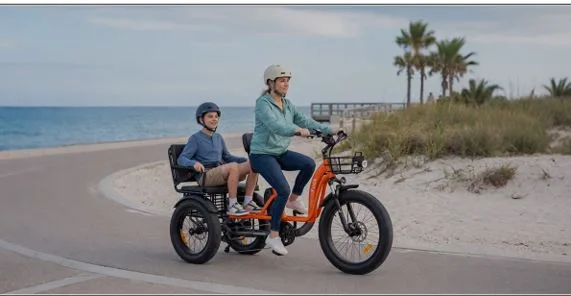
Purpose-built three-wheel platforms erase the choice. A wide rear deck with a proper passenger seat, backrest, armrests, and footrests will take a full-sized adult — and with the seating area used as a load platform, the same structure takes substantial freight. The specification that makes this credible is not the seat design. It is the payload rating.
This guide explains how a 500 lb-class electric passenger trike eliminates the trade-off between carrying loved ones and hauling heavy cargo, and what to check before you trust one with either.
II. Flexible Cargo & Passenger Adaptability
Dual-purpose by design, not by compromise. A rear passenger area built into the frame’s load path serves two roles well. Seated, it supports an adult with a backrest and footrests. Cleared, the same reinforced platform and side rails become a wide, low, flat-sided cargo bed with obvious tie-down points. The structure underneath does not change; only what sits on it does.
Three scenarios most owners actually run:
- Passenger focus. A partner or friend riding to a park, a boardwalk, or a café — full seat, backrest, armrests, footrests, conversation the whole way.
- Cargo focus. A bulk supermarket run, lumber and hardware from a builders’ merchant, or a full camping kit loaded onto the platform with straps.
- The one that sells the concept: an adult passenger *and* a cooler chest, fishing gear, beach kit, or four shopping bags at the same time.
Why 500 lbs is the number that matters. Payload anxiety is the thing that quietly limits how people use a vehicle. On a trike rated at 350 lbs, an adult rider and an adult passenger have already consumed the budget, and every additional bag becomes a judgement call. On a machine rated at 500 lbs of total payload for up to three riders and passengers — the MaxFoot MF-33’s figure — two adults leave real headroom for 100 lbs or more of freight. That margin is what turns a leisure vehicle into a car replacement.
Load placement rules. Capacity is only half of it; distribution decides how the trike handles.
- Keep heavy items low and centred over the rear axle, not stacked high
- Never hang heavy bags from the handlebars — it makes the steering vague and slow
- Strap everything down; unrestrained cargo shifting mid-corner is the main cause of loaded-trike instability
- With a passenger *and* cargo, put the passenger in the seat first and load around them, not the reverse
III. High-Torque Drivetrain and Structural Metallurgy for 500 lbs
Torque, not top speed. Moving 400-plus pounds of combined rider, passenger, cargo, and vehicle from a standstill is a low-speed, high-torque job. A rear-drive 750W brushless geared motor with 1400W peak output and roughly 85Nm of torque, driven by a 25A waterproof controller, is sized so a fully loaded launch or a steep driveway does not push the motor into stall. Stall is where efficiency collapses and heat builds, so headroom is a durability specification as much as a performance one. A 5-level pedal-assist system and a half-twist throttle let the rider add or remove their own effort as the load dictates, and Shimano 7-speed gearing keeps cadence sensible under weight.
Chassis integrity under load. A loaded rear deck loads a frame in torsion — twisting — not simple compression, and torsional flex is what makes a cheap trike feel vague and wallowy with weight aboard. Treating the front and rear as separate engineering problems is the sound approach: a 6061 aluminium-alloy front frame handles steering and fork loads, while a 7A19 aluminium-alloy rear frame carries the passenger and cargo mass. When you shortlist a heavy duty electric tricycle for 2 adults, that dual-alloy construction plus a published 500 lb rating is the combination that indicates the frame was designed for the job rather than rated optimistically. Payload and frame details are usually listed side by side on manufacturer trike collection pages.
Differential under asymmetric loads. Cargo is rarely balanced perfectly, and a rigid rear axle punishes that by scrubbing the inner wheel through every turn. A mechanical rear differential lets the two rear wheels rotate at independent speeds, keeping both 20″ x 4.0″ tires driving and gripping even when the load sits slightly to one side.
Range under weight. A 48V 20Ah Samsung 21700 pack certified to UL-2271 is quoted at up to 85 miles at the lowest assist level. Carrying a passenger plus 100 lbs of freight will reduce that meaningfully — plan on a fraction of the headline number for heavy work, which still comfortably covers a full day of local errands.
IV. Heavy-Duty Braking & Stability Control Under Full Load
Stopping mass, not just speed. Kinetic energy scales directly with mass, so a trike carrying 400-plus pounds needs to dissipate roughly twice the energy of a solo rider at the same speed. A three-disc system — a front disc plus dual rear discs — spreads that work across three rotors instead of overheating one. Under a load, brake earlier and squeeze progressively; grabbing a lever transfers weight forward abruptly and can lighten the rear just when you need its grip.
Cornering stability. Two effects keep a loaded trike planted. The rear differential prevents the inner-wheel scrub that unsettles rigid-axle designs mid-turn. And a low seating and load height keeps the combined centre of gravity down, which is what actually resists tipping — a wide rear track only helps if the mass sits low between the wheels. Slow before the corner, hold a steady line through it, and accelerate out.
Loading and unloading on a slope. This is where most cargo incidents happen. A handlebar parking lock holds the trike stationary on a sloping driveway or kerb while a passenger steps out or heavy boxes come off. Engage it every time before you take a hand off the bars, and unload from the downhill side so nothing shifts toward you.
V. Conclusion
A 500 lb-rated passenger trike is the rare micro-mobility vehicle that does not force a choice. It carries a person comfortably, it carries freight properly, and it carries both together — which covers a genuinely large share of the short car trips a household makes in a week.
If utility is your reason for buying, shop by the numbers. Compare rated payloads, look for dual-alloy frame construction, insist on discs at all three wheels and a real parking brake, and confirm the battery carries UL-2271 certification. Manufacturers such as MaxFoot publish those specifications openly, so you can verify a trike’s load credentials on paper before you load it in practice.