Mastering the Next Phase of Your Career: Transitioning from Field Expertise to Industry Leadership
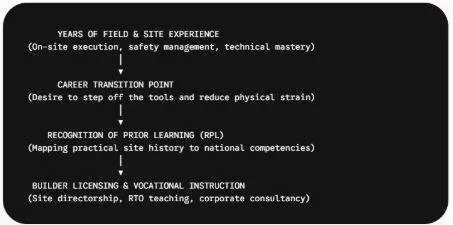
Every physical trade and technical discipline has a natural shelf life. After spending a decade or two on site—navigating demanding physical conditions, managing sub-contractors, and solving complex execution challenges—many seasoned professionals begin to reflect on their long-term career trajectory.
The physical toll of manual labour and high-intensity site work naturally prompts a critical question: How do you leverage years of hard-earned operational expertise to transition into higher-level management, consultancy, or education?
The answer lies in stepping off the tools and moving into strategic industry leadership. By formalising your field experience through Recognition of Prior Learning (RPL), you can convert years of practical execution into nationally accredited qualifications that unlock senior supervisory, building management, and instructional roles.
The Transition Phase: From Hands-On to High-Level Governance
Transitioning from a field specialist to an industry leader requires shifting your primary value proposition. Early in your career, your value was defined by your physical output, craftsmanship, and technical speed. In the next phase of your career, your value lies in your knowledge, regulatory judgment, and ability to lead others.
However, moving into senior site management, builder licensing pathways, or corporate training platforms often comes with formal educational prerequisites. While exact licensing requirements vary by state and specific licence class, industry regulators, registered training organisations (RTOs), and tier-one contractors frequently require accredited paper qualifications to satisfy compliance standards and insurance criteria.
Unlocking New Career Pathways Without Starting Over
Traditionally, gaining higher-level diplomas or training credentials meant taking unpaid leave to attend TAFE or university classes, sitting through theoretical lectures on subjects you have already mastered in the field. RPL eliminates this barrier by assessing your existing portfolio—site logs, contracts, safety audits, and project sign-offs—against official qualification standards.
This process enables rapid qualification across two primary career transition pathways:
1. Vocational Education and Workforce Training
One of the most rewarding ways to step back from physical labour is passing your expertise down to the next generation of apprentices and trainees. Vocational institutions, TAFE colleges, and corporate training divisions urgently require seasoned industry veterans who possess real-world authority. However, to teach accredited units, you must hold the national benchmark qualification for educators.
For veteran workers looking to step off the tools and mentor the next generation, obtaining a certificate iv in training and assessment via RPL turns years of workplace knowledge into an accredited qualification for TAFE, corporate training, and RTO instruction. Earning this credential verifies your ability to design learning programs, conduct competency-based assessments, and deliver structured vocational training in accordance with national training standards.
2. High-Level Building Management and Contractor Licensing
For tradespeople aiming to stay within the construction ecosystem while taking on larger commercial projects, moving into head building, project estimation, and site directorship is the logical evolution. Holding a recognised building diploma is often a fundamental step toward meeting state licensing board criteria, depending on the jurisdiction and licence type sought.
Similarly, site managers and trade supervisors looking to apply for an independent builder’s license or run multi-million-dollar projects can fast-track a diploma of building and construction to validate their expertise in structural codes, site safety, and project cost estimation. Fast-tracking this qualification through RPL provides the recognised academic foundation required to help satisfy state regulatory criteria, secure business insurance, and submit tenders for large-scale building contracts.
Why Experienced Veterans Choose the RPL Advantage
Converting field history into recognised credentials through RPL provides several distinct advantages for mid-to-late career professionals:
- Career Longevity: Transition into roles that rely on your intellect and leadership rather than physical endurance, extending your earning potential well into the future.
- Rapid Turnaround: Because you are proving existing competence rather than learning new material, qualifications can typically be issued in 4 to 6 weeks, depending on how quickly evidence can be gathered.
- Regulatory Alignment: Meet the educational criteria required by state building authorities, trade bodies, and vocational institutions.
- Higher Earning Potential: Senior site directors, licensed builders, and specialised corporate assessors command significantly higher day rates and salaries than mid-level tradespeople.
Take Command of Your Career’s Next Chapter
Your years of hard work on the floor, in the workshop, or on the job site represent a vast repository of practical knowledge. Allowing that experience to remain uncertified limits your options and leaves your career vulnerable to physical burnout.
By utilising Recognition of Prior Learning, you can formally validate your expertise, secure the credentials required for high-level governance or instruction, and step confidently into the next phase of your professional journey.